


too vanilla? —
Is the sedan having a comeback? This one arrives in the US in 2024.
Jonathan M. Gitlin
–
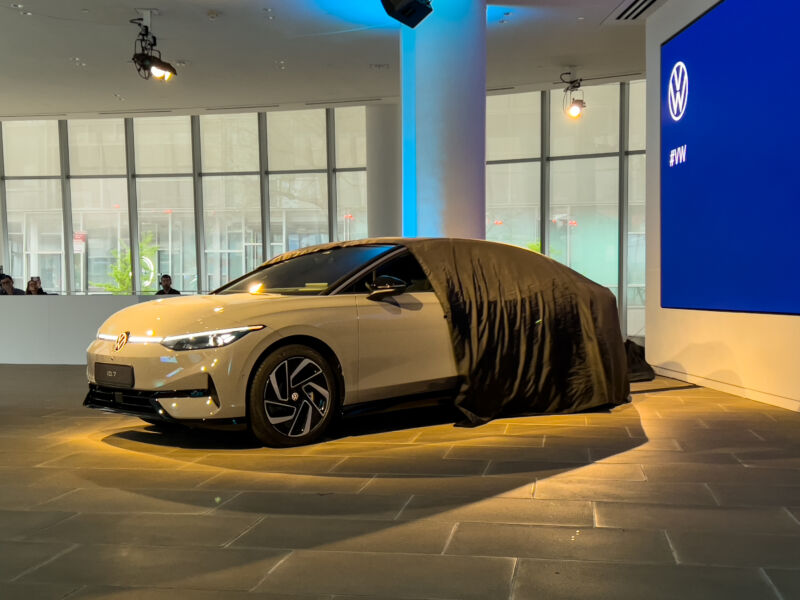
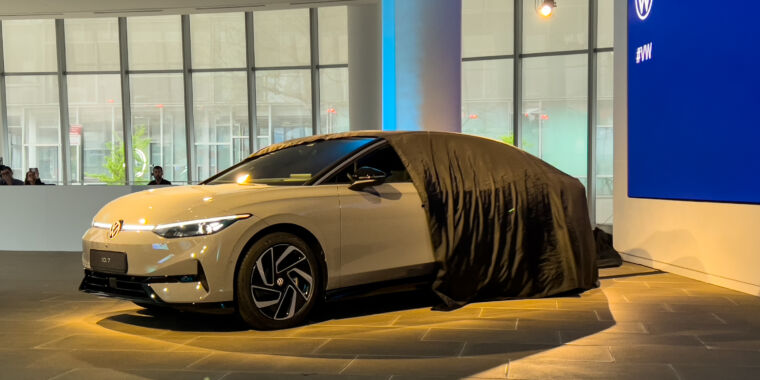
Enlarge / Volkswagen has established the “face” of its ID electric vehicles—because there’s no mistaking this for anything else.
Jonathan Gitlin
NEW YORK—On Monday morning, Volkswagen introduced its next new electric vehicle with simultaneous events in New York, Shanghai, and Berlin. It’s called the ID.7, and it will go on sale in Europe and China later this year and in North America in 2024. It’s a fairly substantial thing—more than a foot longer than the ID.4 crossover that VW now builds in Chattanooga—with a low-drag shape and some powertrain refinements that VW says will make the car highly efficient.
But it will face stiff competition in the electric sedan market, up against the established juggernaut that is the Tesla Model 3, not to mention Hyundai’s excellent new Ioniq 6.
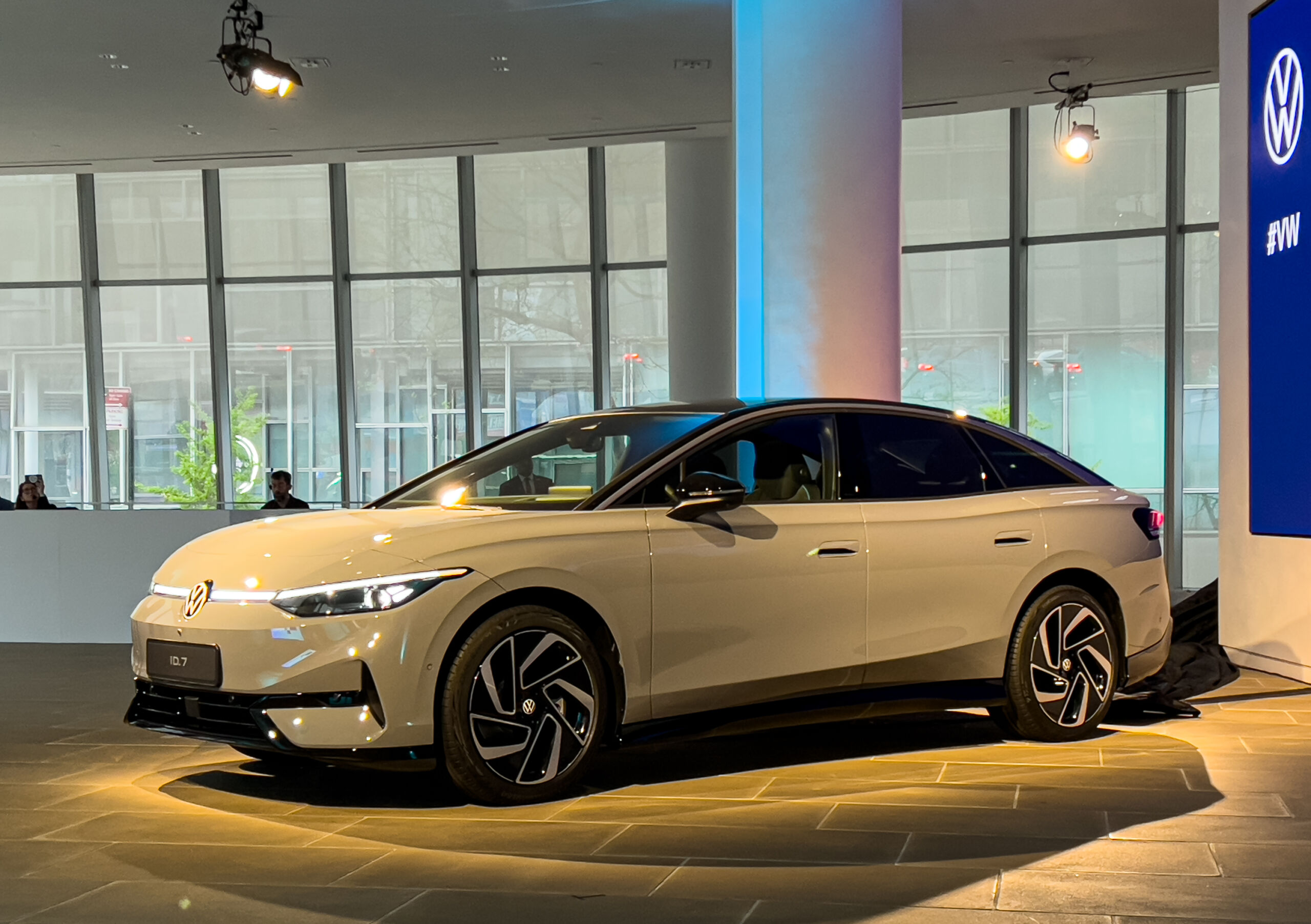
Enlarge / Its curves are more rounded than you’d see on a Model 3 or Ioniq 6, but the ID.7 is similarly low-drag.
Jonathan Gitlin
This is not our first view of the ID.7—VW showed it off underneath luminescent camouflage back in January. It’s a big car—longer even than the VW Arteon sedan at 195.3 inches (4,961 mm), with a 116.8-inch (2,967 mm) wheelbase. It’s relatively wide at 73.3 inches (1,852), but it also has a relatively low roofline at 60.6 inches (1,539 mm) that helps keep the frontal area down to 2.45 m2 in order to make the most of the ID.7’s drag coefficient of 0.23.
Although the ID.7 uses the same MEB architecture as VW’s other ID EVs, the ID.7 will see the introduction of a new drive unit, designed in-house, that it says is more efficient. It’s a permanent magnet synchronous motor with an integrated inverter and single-speed gearbox with an output of 282 hp (210 kW) that drives the rear wheels. VW says the new motor uses stronger magnets than its current motor, which lets it cope better with thermal load. It also uses more windings in the stator, and there’s improved cooling as well. (Expect an all-wheel-drive version at some point, although VW remained quiet about that today.)
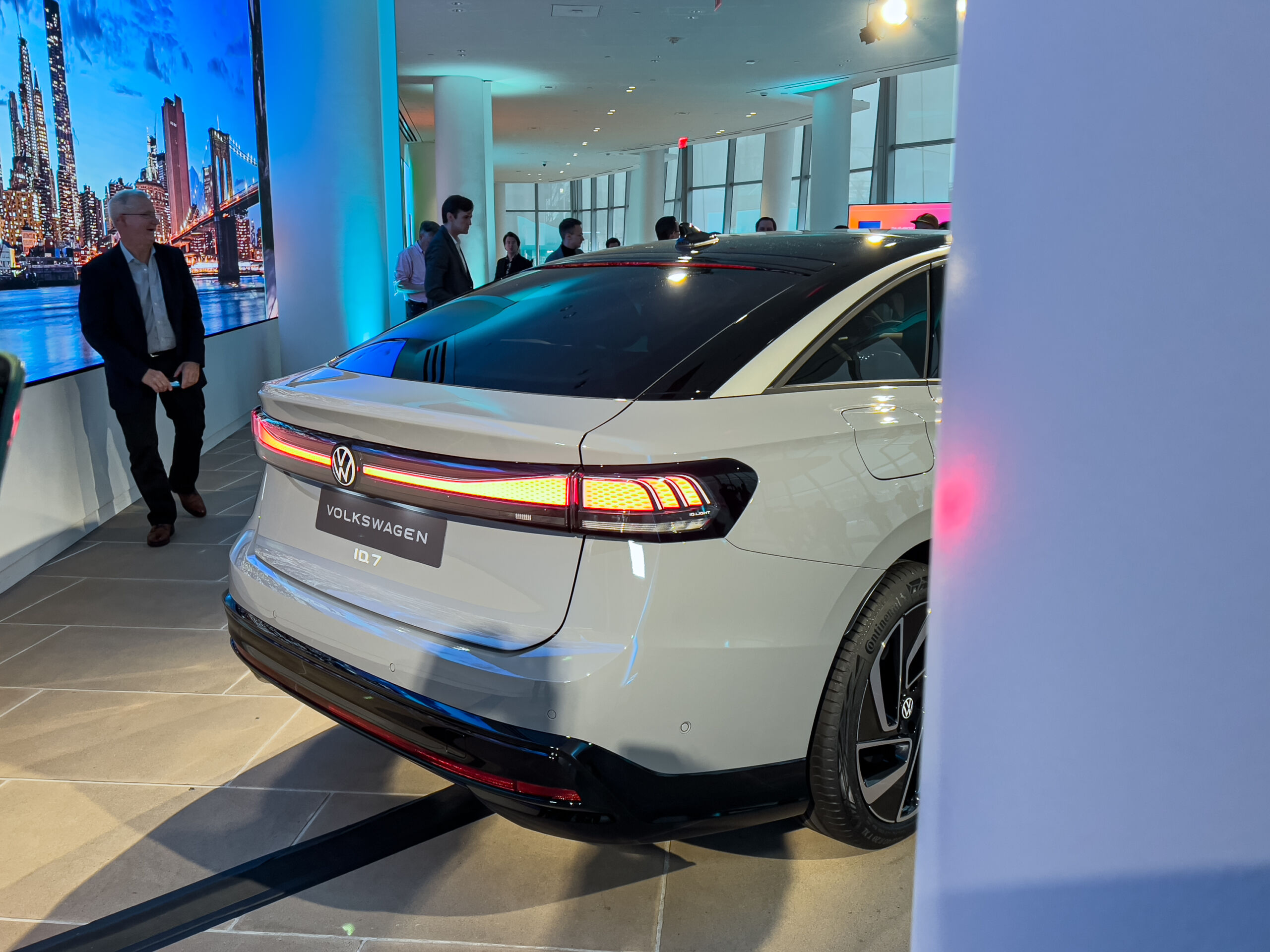
Enlarge / People complained there weren’t enough sedans. Well, here’s a new electric sedan. It won’t be the last EV sedan revealed this year, either.
Jonathan Gitlin
When paired with the larger (86 kWh net, 91 kWh gross) of the two available battery packs, the ID.7 should have a range in excess of 300 miles (483 km). It’s too soon for VW to have an official EPA range estimate, but under the very different WLTP scheme, it predicts a 700-km range between charges. The other pack has a 77 kWh usable (82 kWh gross) capacity.
As we learned in January, the interior is dominated by a 15-inch infotainment touchscreen, with a small digital display embedded in the dash directly ahead of the driver for critical information like speed. There’s also an augmented-reality heads-up display that will be standard equipment.
The ID.4 has rightly caught flak for its often-unresponsive touchscreen user interface. I was able to play with the system in the ID.7 briefly and can report that it was much less laggy than what I’ve seen on the last ID.4 I drove or the ID Buzz. I wouldn’t go as far as to call the transitions between screens snappy, but with at least a year before US cars are set to arrive, there’s still time for VW’s software division to speed things up.
-
If you’re going to make things dependent on touchscreens or capacitive panels, they really better work. And can we say that about those features of the ID.4 so far?
Jonathan Gitlin -
There’s plenty of legroom here. Rear seats will be heated as standard.
Jonathan Gitlin -
A look at the ID.7’s cargo area.
Jonathan Gitlin -
The ID.7’s wheels are very disc-like.
Jonathan Gitlin -
Is this too little, too late for VW? The ID.7 won’t charge as fast as an Ioniq 6 or a Model 3.
Jonathan Gitlin
It has a much less spartan interior than I expected, helped by the fact that the car VW brought to New York had a dark interior as opposed to the lighter press shots it supplied ahead of time. There is LED backlighting for some panels on the dash and the doors, and it feels less utilitarian than the ID.4. A full-length glass roof is standard—this one includes electrochromic dimming but appears to forgo a fabric sunshade as a result.
Just as it’s too soon to talk EPA range, it’s similarly too soon for VW to speak about US pricing. The ID.7 will be built in Emden, Germany, so it won’t be eligible for the IRS clean vehicle tax credit, which requires final assembly in North America.


