

President Biden and
his allies in Congress and state capitols have coalesced around one big
strategic idea, to reinvigorate and update the New Deal–Great Society–Obama
Democrat policy agenda—the better to demonstrate the Democratic Party’s desire
and capacity to address the needs of working- and middle-class constituencies, broaden
the party’s resonance with professional and suburban voters, and revitalize unions
and other institutional bases of political support. They’ve played this game
quite well—with one glaring, perhaps fatal exception: They’ve not come up with a
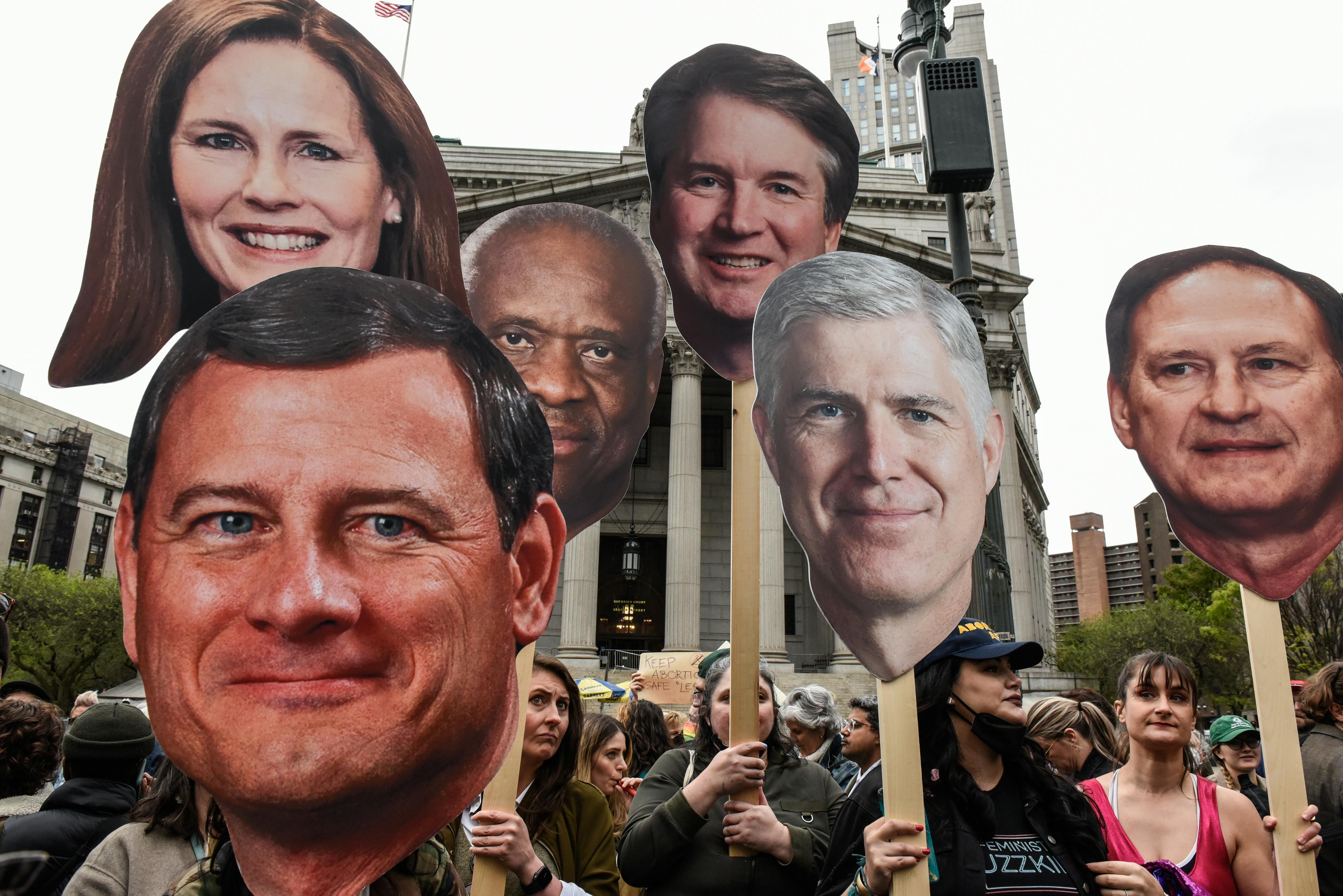
game plan to prevent the ostentatiously reactionary, often partisan Supreme
Court 6–3 supermajority from scuttling their current agenda or from
dismantling the foundational ideas from previous decades on which their new
platform has been erected.
Indeed, they have yet to even try.
This is nothing new. For decades, Democratic politicians have dodged challenging the
ultra-right’s drive to junk the post–New Deal liberal Constitution, with made-up
doctrines that, in the apt words of liberal Justice Elena Kagan, would make
“most of government unconstitutional.” It’s a good line from a justice who
understands that such rhetoric can be a powerful weapon. It stands in stark
contrast to a Democratic Party that has remained perversely tight-lipped in the
face of the existential threat the Supreme Court poses to its aspirations. If
Democrats want to change this dynamic, they will, at the very least, have to
start talking about it.
In its first two terms following Biden’s ascent to the
White House, the court’s right-wing justices have flaunted their zeal to
validate Reagan Solicitor General Charles Fried’s 2020 warning that they would “take
a constitutional wrecking ball to generations of Supreme Court doctrine.” In
addition to their incandescent elimination of a half-century-old individual right
to abortion, the reactionary justices have, with less notice, overridden
explicit constitutional and statutory text to ax long-standing labor,
consumer, health, safety, environmental, and civil rights regulatory and safety-net guarantees.
In one of the most egregious overreach cases, their June
2022 invalidation of the Biden Environmental Protection Agency’s regulatory plan (supported by both
environmental and power industry advocates) for slashing power plant carbon
emissions, the justices effectively empowered themselves to nullify any
executive program of which they, their political allies, or major political
donors disapprove. They twisted a hitherto little-used “major questions” doctrine to confer onto themselves the power and permission to block any executive
initiative not to their liking, consistency with relevant statutory text
notwithstanding—a vacuous doctrinal confection could cover any important
regulation or agency action.
Biden, and most Democratic politicians, reacted to these
body blows to liberal governance with little more than feckless press-release lamentations
that treat these “retrograde rulings”—to use historian Jeff Shesol’s words—as “discrete events rather than the defining project of the
court’s conservatives: to lay waste to the welfare state and the administrative
state, the civil rights revolution, the underpinnings of an accountable,
workable government.” The tenacious resistance
among many Democratic politicians to publicly challenge the court’s
misdeeds stands as a spectacular act of self-abnegation.
Conservatives don’t make these mistakes. They hoist the banners of “originalism” and “textualism,” as legal cover
for yoking the courts to their policy and political agendas, even while
ignoring originalist or textualist principles whenever they prove politically inconvenient.
Right-leaning politicians, pundits, and policy advocates turn arguments
developed by their academics, judges, and legal experts into slick talking
points. When liberal politicians ignore the right’s fabricated claims that modern
liberal governance flouts the Constitution, or that particular liberal measures
disregard pertinent statutory text, the results can be devastating.
For example, as I have written, two months before the March 2012 oral argument
in the blockbuster Supreme Court challenge to the Affordable Care Act’s
“individual mandate” to buy insurance, a Gallup poll reported that 54 percent
of respondents who supported the ACA thought it was unconstitutional. They
had, after all, never heard anything to the contrary. In such an environment,
conservative justices could have felt unconstrained by potential public
backlash—as evidently did the four conservative dissenters, who stridently
demanded wholesale invalidation of the law. Had the current 6–3 lineup been on the 2012 court, that dissent would have been the majority opinion, and the Affordable
Care Act would have been toast. Since the court’s new majority will likely last
for decades, it is political suicide for Democrats and liberals to continue
giving their adversaries’ threadbare legal claims free passes in political and
public opinion arenas.
Liberal politicians’ allergy to public constitutional and legal
messaging is especially puzzling, since their allies on the court itself have
no such inhibition. In shrewdly crafted
opinions and, more remarkably, in extrajudicial speeches and statements, the
liberal justices have trotted out chestnuts ready-made for talking points,
speeches, op eds, and even bumper-sticker one-liners.
There are numerous examples on hand. In June 2021, in Brnovich v. Democratic National Committee, Justice Kagan
jabbed that the right-wing majority’s decision to override unambiguous text of
the Voting Rights Act, in order to uphold an Arizona voter-suppression law, “inhabits
a law-free zone.” In December 2022, Justice
Ketanji Brown-Jackson, in an oral argument rejoinder to Alabama’s
constitutional attack on affirmative action, detailed the legislative record of
the Reconstruction amendments, to demonstrate that “the
framers themselves adopted the equal protection clause, the 14th Amendment, the 15th Amendment in a race-conscious way.”
In a
December 2021 argument over Mississippi’s unabashed effort to give Donald
Trump’s newly reconstituted court the opportunity to overturn Roe v. Wade, Justice Sonia Sotomayor snarked, “Will this institution survive the stench that this creates in
the public perception that the Constitution and its reading are just political
acts? I don’t see how it is possible.” In June
2007, after the then-new Roberts-Alito majority dropped several end-of-term
decisions upending major liberal precedents, former Justice Stephen Breyer quipped
from the bench, “It is not often in the law that so few have so quickly changed so much.”
These and other similarly punchy judicial broadsides generated extensive
media coverage and repetition. So far, liberal politicians and their P.R. teams haven’t
seen fit to either recycle these barbs or invent new ones.
There is a simple reason for liberal and Democratic leaders’ zip-lipped
nonresponse to the legal right’s provocations. They cleave to the notion that
it is simply not proper to have certain debates in certain fora; in this
construct, Democrats hold that “interpreting the law” is the exclusive province
of lawyers and judges, not politicians or voters.
Liberals internalized this idea after President Franklin Roosevelt’s
Supreme Court appointees vanquished their predecessors’ anti-regulatory
activist “Lochner-era” version of the Constitution. The court, under Chief
Justices Earl Warren and Warren Burger, reclaimed an activist role, this time to
vindicate individual and minority civil rights and liberties. Now deeply
embedded, this model is an axiomatic assumption.
However, it’s incorrect. Liberals’ phobia about mastering and publicly
messaging constitutional and legal claims is ahistorical. Not only do
their current adversaries on the right assiduously wrap themselves in the
Constitution and ignore the idea that certain discussions are somehow gauche; liberals’
own ideological predecessors did likewise. Icons such as Franklin and Theodore
Roosevelt, Abraham Lincoln, and the original Framers, including Jefferson and
Madison as well as Washington and Hamilton, crafted legally sophisticated but politically
canny characterizations of the text and Framers’ design of the Constitution and
relevant laws. They had public exchanges
that echoed across the media and an electorate that observers from de
Tocqueville onward have long recognized is idiosyncratically inclined to view
political issues through a legal and constitutional lens.
How did today’s liberals come by their historically aberrant aversion to
mixing law with politics? To some extent, they are victims of their own success.
Once FDR’s appointees proclaimed fealty to “judicial restraint,” mandating a
near-total hands-off all economic and other regulatory and safety-net laws and
actions, liberal politicians, advocates, and constituencies concerned about
pocket-book and other regulatory issues came to take for granted that all
battles concerning their priority interests would be fought and resolved on
Capitol Hill and by federal administrative agencies, or by their state and
local counterparts. None imagined that judicial interference would impede these
designs.
But history played out a different way, as civil rights and liberties
advocates took the opposite tack. They seized upon an exception to judicial
restraint that the Roosevelt court mentioned in a footnote to a 1938 decision,
for controversies about individual and minority civil rights and liberties.
Citing this footnote, advocates prodded the justices to reinvigorate national
citizenship and equality protections in the Bill of Rights and the Fourteenth and
Fifteenth Amendments. The Warren and
Burger Supreme Courts responded in the affirmative, with repeated blockbuster
decisions—most prominently, Brown v. Board of Education, that ended state-sponsored
racial segregation in 1954. When popular backlashes turned into political
culture wars, this set of liberal leaders favored courts as their champions and
the battleground on which their interests were most likely to be protected.
Unsurprisingly, these liberal culture warriors heard the right’s condemnation
of “judicial activism” as simply code for quashing the rights they had either secured
or sought: gender and racial equality, procedural due process, and, especially
abortion. As they grew more uncomfortable being labeled as “activists,” they
overcorrected by devoting fewer resources toward vilifying the increasingly
conservative court’s increasingly aggressive evisceration of statutory guarantees
important to middle- and working-class constituencies.
For
their part, advocates for such consumer, employee, and environmental causes
were hard-pressed to summon the resources or experience to effectively
oppose the ever more doctrinally audacious assaults waged by well-funded litigators
from the U.S. Chamber of Commerce and other hard-line business groups.
Many simply lacked the expertise or inclination to dissect and expose the unlawfulness
of the claims of their adversaries. By the final quarter of the twentieth
century, the exception appeared to have swallowed the rule. Endlessly repeated,
and at best half-heartedly answered, the right’s labeling of the court as a
bastion of “liberal judicial activism” gained widespread currency.
It was not always like this. Indeed, it was never like this. In
the past, when the fundamental direction and structure of government was in
play, great liberal leaders took their constitutional case directly to the
public. Consider the messaging strategies deployed by FDR and his allies: Following
the high court’s invalidation of the 1933 National Recovery Act, Roosevelt
opened his next fireside chat by voicing “a hope that you have reread the Constitution
[which] like the Bible, ought to be read again and again.” He delved into the
Constitution’s text, quoted the dissenting opinions at length, and concluded by
saying, “I want—as all Americans want—a Supreme Court that will enforce the Constitution
as written, [not] amend the Constitution by … judicial say-so.”
Eight decades before Roosevelt arrived on the scene, Abraham
Lincoln, as candidate as well as president, routinely furnished equally graphic
examples of deep-dive constitutional messaging, the most celebrated example of
which was his 1863 Gettysburg Address. In 1993, Garry Wills dissected that 272-word tour de force in his
Pulitzer Prize–winning book, Lincoln at Gettysburg: The Words That Remade
America. Wills contended that Lincoln’s aim was to read into the
Constitution, as a matter of public consciousness, the core passage of the
Declaration of Independence that laid out the “self evident truths“ that “all
men are created equal.” In fact, as detailed by Sidney Blumenthal in his 2019
panoramic study of Lincoln’s meteoric ascent in the late 1850s, All the
Powers of Earth, this project had been Lincoln’s consuming passion since
well before he entered the White House. On the stump, he hammered home that
commitment, backed by archival research and rigor rarely found outside
litigation briefs, with matchless rhetorical eloquence.
In an 1854 speech assailing the Stephen
Douglas–sponsored Kansas-Nebraska Act, which repealed the 1820 Missouri
Compromise that had banned slavery in new territories North of the Mason-Dixon
line, Lincoln stressed that Thomas Jefferson, author of the Declaration, had
also authored the Northwest Ordinance of 1787, which banned slavery in all new
territories, arguing that the Framers intended “We the People” to include all
people, not just whites. In his 1858 debates with Douglas, Lincoln acquired a
national reputation through his compelling refutations of Douglas’s embrace of
Taney’s whites-only Constitution. Unafraid of parsing the text in a political
forum, Lincoln stressed that “nowhere in the Constitution, does the word
‘slavery’ or ‘negro race’ occur.” Lincoln argued that this textual silence
meant that that the Framers’ “purpose was that [after slavery had, as the Framers expected, vanished] there should be nothing on the face of the great
charter of liberty suggesting that such a thing as slavery had ever existed
among us.”
Campaigning for the Republican presidential nomination,
in his February 1860 speech at Cooper Institute in New York City, Lincoln
documented that 21 of the 39 signatories of the Constitution
supported federal control over slavery in the territories, and that most of the
others were outspoken abolitionists, including Benjamin Franklin, Alexander
Hamilton, and Gouverneur Morris. He also cited a letter from George Washington
to the Marquis de Lafayette endorsing the prohibition of slavery in the
Northwest Territories.
Lincoln credited this Cooper Institute speech with
propelling him to the White House. A century and a half later, a National
Constitution Center panelist would label it “arguably, the most important
speech in American political and constitutional history.” For our purposes
here, the key point about the speech is that Lincoln’s erudition was evidently much
responsible for its outsize political impact. As Blumenthal relates, “Four New
York newspapers printed his speech in full.… [T]he Post filled the
front page with headlines of Lincoln’s conquest: ‘The Framers of the
Constitution in Favor of Slavery Prohibition.’”
But Lincoln merely stood on a bedrock
tradition of high-stakes constitutional debates that roiled American
politics. Our forebears lacked a fear of
mixing talk of the Constitution with political argument. The Framers, in fact,
pointedly made the Constitution terse enough to run verbatim in
newspapers and pamphlets, the better to reach all levels of a critically
attentive society.
And the Framers themselves were master
publicists. Five of the “Big Six” —Hamilton, Jefferson, Madison, Franklin, and
John Adams, all virtuoso politicians, were prolific writers of polemics ranging
from the Federalist Papers to the equivalent of modern op-eds and blog
posts. Though George Washington, the lead framer, authored few public writings,
he was always laser-focused on garnering media coverage to maintain his public
profile and advance his agendas. Chief Justice John Marshall, authoritative
interpreter and a major founding figure himself, peppered his landmark opinions
with headline-friendly sound bites and even penned
pseudonymous op-eds.
As it turns out, commingling constitutional law and
partisan politics has historically proven to be potent and revelatory.
Roosevelt had no concerns sharing the legal arguments penned by sympathetic
judges with the media and the public. Our Founders were steeped in this
tradition; the fruits of these arguments are arguably as important as our
founding documents themselves. Lincoln was happy to carry that baton, weighing
in with his own interpretations of the law in the hopes of reshaping a divided
nation. Critically, Roosevelt gave voice to the idea that the Supreme Court can
and should be accountable to the people—and the Republic did not
implode.
Today, a radically reactionary, unrepresentative movement
has precipitated a “constitutional conversation” potentially as consequential
as those in which past liberal leaders engaged brilliantly, and prevailed. So far, liberal political leaders have turned
a deaf ear. To keep this one-sided “conversation” from becoming a
constitutional catastrophe, liberal leaders must step up as their predecessors
did by troubling themselves to learn and message such lawyerly points, and
trust the media and voters to digest them. It’s a skill they need to reclaim
from the nation’s founding, to preserve its future.