

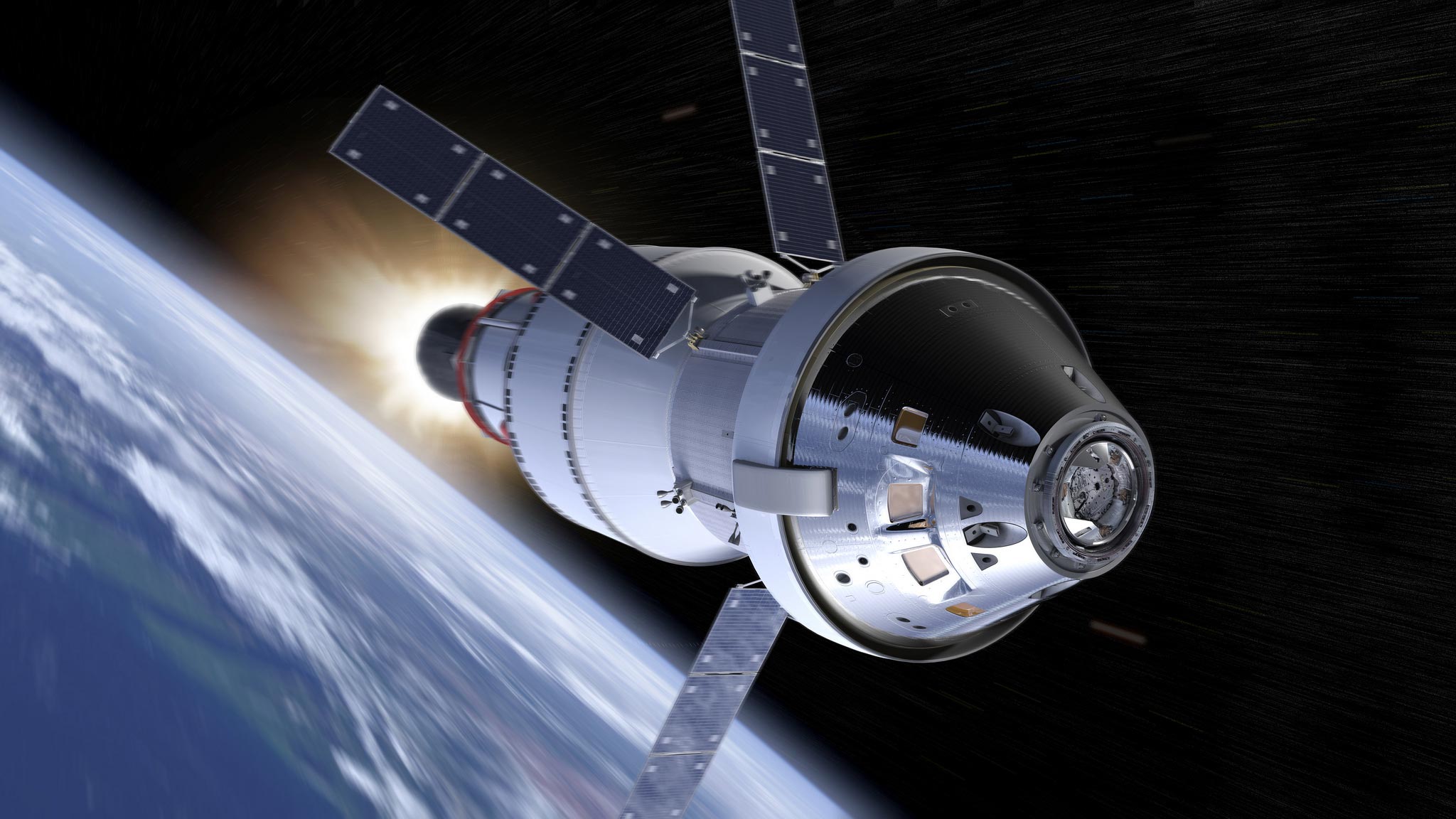
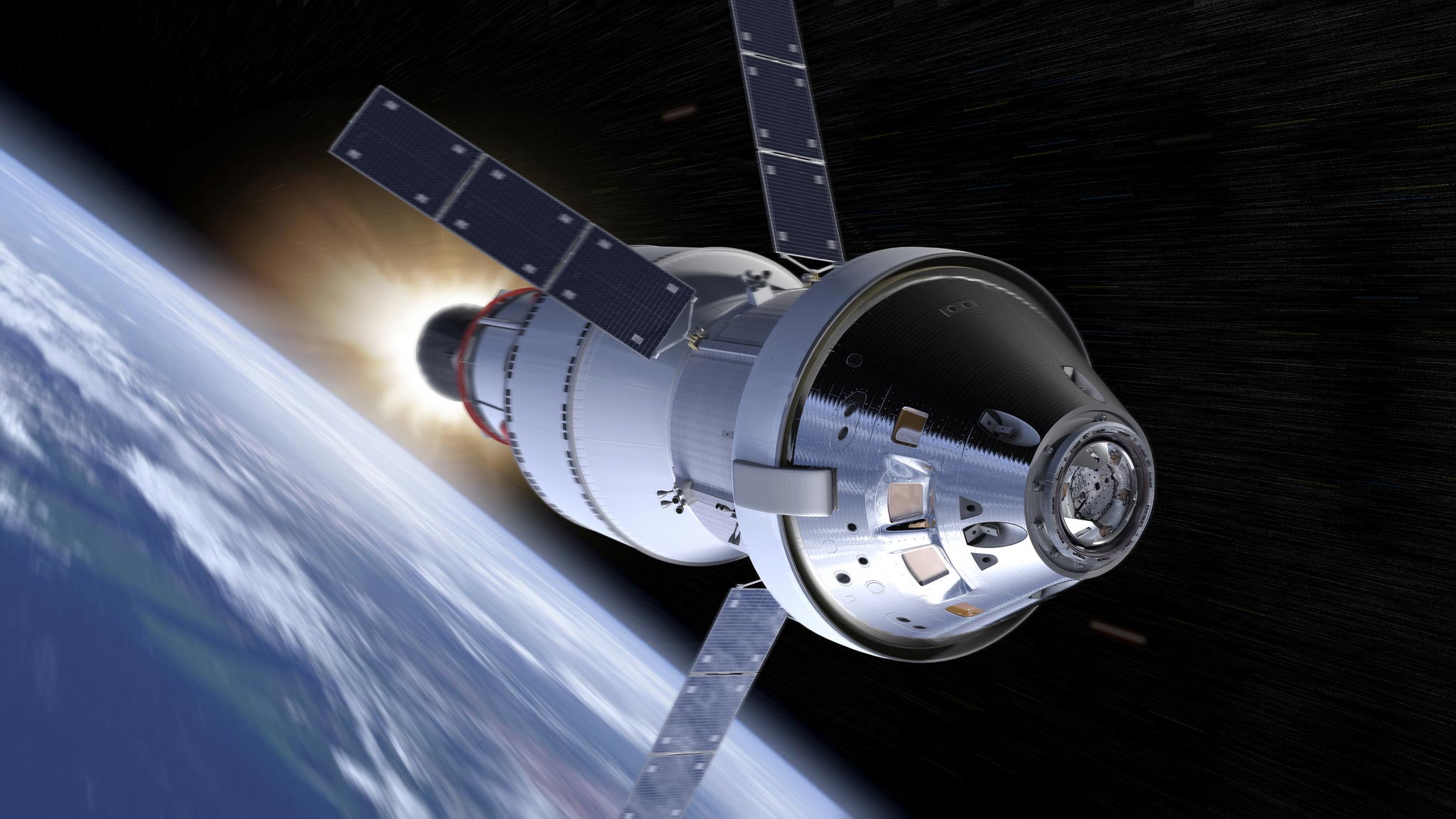
During Artemis I, Orion will venture thousands of miles beyond the moon during an approximately three week mission. Credit: NASA
Orion is
See Episode One: The Most Powerful Rocket NASA Has Ever Built.
See Episode Three: Roll to the Pad.
Video Transcript:
What an exciting day at the Kennedy Space Center. You can see the Orion spaceship coming out of the O&C building where we’ve been assembling it for several years.
As big a step as this is for us today, and rolling out and starting the journey of Artemis I to the Moon and beyond, we’re really excited for this test program to get this vehicle flown and to begin the next steps which are to send humans back to the Moon.
The twin sister of Apollo, Artemis is the name given to the program that will return humanity to the Moon. And, named after one of the largest constellations in the night Sky, Orion is the spacecraft destined to get us there.
Through Artemis missions, NASA will land the first woman and the first person of color on the lunar surface. And, these missions will allow us to explore more of the Moon than ever before, paving the way for long-term presence in lunar orbit.
We’re rolling the Orion spacecraft out, but it’s beginning its journey. We’re really kind of at the end of the building process and the beginning of getting ready to go fly.
But before Orion can travel to our nearest celestial body, it first must make a few pit stops along the way to fuel up and get ready for flight.
As we leave here today, we’re gonna go to a facility that’ll fuel the spacecraft with the rocket fuels and propellants it needs, we’ll put a launch abort system on, we’ll send it out to be stacked on the rocket and launched, and it’s really the last few yards of the game.
NASA’s Michoud Assembly Facility in New Orleans is where, in 2015, technicians with Lockheed Martin began welding the pieces of the spacecraft’s underlying aluminum structure together.
One year later, it arrived in Florida, taking up semi-permanent residence inside the Neil Armstrong Operations and Checkout Building at NASA’s Kennedy Space Center.
Engineers and technicians will spend the next five years working almost around the clock, outfitting Orion with thousands of components, and pushing the capsule through several rounds of rigorous testing, as teams prepare it for its flight around the Moon.
The first step though is the crew module’s arrival.
When the crew module shows up here at the O&C building, it’s really just a welded shell of the structure. When it gets here, we put it into a fixture down to my left called the bird cage tool, and we use that fixture to position and attach all of the mechanically attached primary and secondary structure for the crew module.
Part of that includes the heat shield, which protects the crew module as it blazes through Earth’s atmosphere at an astonishing speed as it returns home.
Technicians with Lockheed bond those thermal protection system products onto the heat shield right here in the O&C, and they do the same for the crew module’s forward bay cover.
We bond that on here, and basically this covers the forward bay of the crew module such that once we come back into the atmosphere, this gets jettisoned, and all of the landing system – i.e. parachutes – get deployed and slows the crew module down so that when it touches down in the ocean, it’s only going a few miles an hour.
With the primary and secondary structures all attached, the crew module is tested to see how everything holds up. Orion is pressurized, stressing the welds to ensure they’ll hold up under the proper loading.
Afterward, nondestructive evaluation of those welds is conducted to check for any voids or cracks.
Once the structure is deemed strong enough, the crew module is moved just a few spaces down into the O&C’s clean room for its next round of integrations.
We bring that structure into our clean room, which is what you see behind me, because we need to start integrating the propulsion system, and elements of the environmental control and life support subsystems, and those systems require a cleaner environment than the one we’re standing in out here.
When all of that is done, the crew module is on the move again, to the crew module integration station. There, all of the electrical systems, including wire harnesses and avionics boxes that control the crew module’s guidance navigation, communications, and its power subsystems, are integrated.
Next, it’s time to bring the spacecraft to life.
We power it up, and then we go into a whole series of functional tests to make sure all of the subsystems we’ve integrated up to that point are functioning properly.
But, the crew module isn’t the only thing that makes up the Orion spacecraft.
All the people, the work, the components that have gone into this vehicle, it’s just an amazing feat.
Teams also worked closely with the European Space Agency to build the service module – the element that will power Orion on its journey around the Moon. Once that arrives from Bremen, Germany, Lockheed moves forward with integrating the two.
The service module has a very similar lifecycle to the crew module. We build it up structurally, we integrate the propulsion system and the other fluid systems, and then we integrate it electrically, and power it up, and do functional tests on it.
And when we have a full service module, and a full crew module, then we stack the two together and we have what’s called the crew service module for Artemis I.
Under the Artemis program, NASA plans to not only return to the Moon, but to use that as a stepping stone to go farther than any human has ever gone before: Mars.
To get there, it’s truly a cross-country and international effort among thousands of individuals.
When you consider all the people at the Johnson Space Center, Marshall Space Flight Center, all across the agency,