


Astronauts may be exposed to high energy charged particles from galactic cosmic rays and solar particle events, as well as secondary protons and neutrons after they leave Earth’s protective atmosphere. Because biomolecules, cells, and tissues have different ionization patterns than terrestrial radiation, the associated biological consequences are poorly understood, and the degree of danger involved is subject to enormous uncertainty.
The study in mouse cells analyzed the impact of space radiation and will help scientists better estimate the safety and dangers of space travel.
An international team of scientists conducted a long-term experiment onboard the International Space Station to investigate the impact of space radiation on mouse embryonic stem cells. Their research will help scientists make a more accurate assessment of the risks and safety of space radiation for future human space flights.
The team recently published their findings in the journal Heliyon.
The researchers conducted a direct quantitative evaluation of the biological impact of space radiation in their study by transporting frozen mouse embryonic stem cells from Earth to the International Space Station, subjecting them to space radiation for four years, and quantifying the biological effect by evaluating chromosome aberrations. The results of their experiment demonstrate, for the first time, that the biological impact of space radiation is closely in line with prior predictions derived from the physical measurement of space radiation.
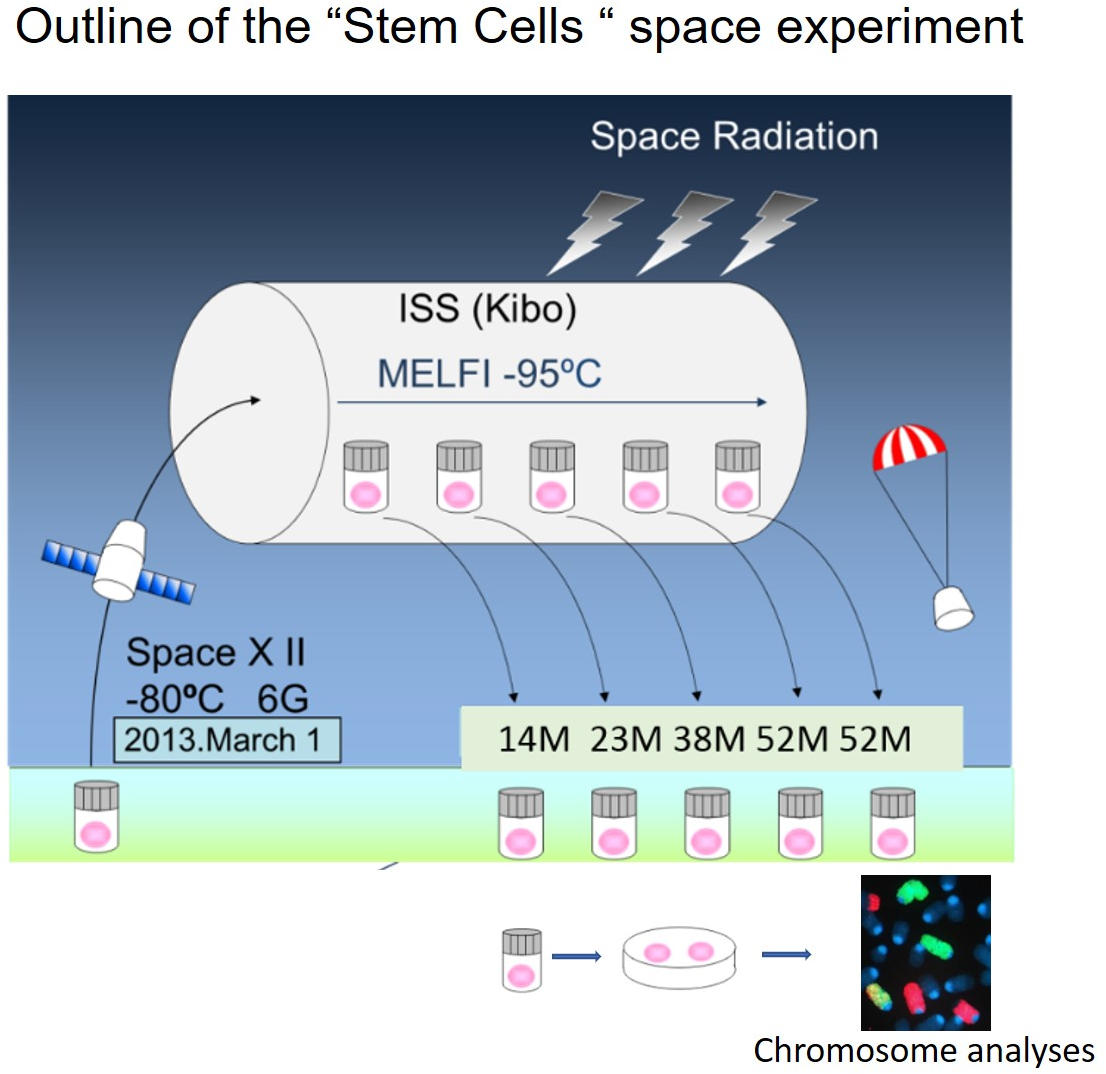
Frozen mouse embryonic stem cells were launched from the ground to the International Space Station, stored for a long period of time, recovered on the ground, and examined for chromosome aberrations. Credit: Takashi Morita, OMU
Now that regular people can travel in space, the likelihood of lengthy human missions to distant planets like the Moon and DOI: 10.1016/j.heliyon.2022.e10266
The study was funded by the Japan Aerospace Exploration Agency, the Japan Space Forum, and the Ministry of Education, Culture, Sports, Science, and Technology of Japan.


