




Researchers at the Computer Science and Artificial Intelligence Laboratory (CSAIL) have developed an artificial intelligence (AI) technique that allows machines to learn concepts shared between different modalities such as videos, audio clips, and images. The AI system can learn that a baby crying in a video is related to the spoken word “crying” in an audio clip, for example, and use this knowledge to identify and label actions in a video. The technique performs better than other machine-learning methods at cross-modal retrieval tasks, where data in one format (e.g. video) must be matched with a query in another format (e.g. spoken language). It also allows users to see the reasoning behind the machine’s decision-making. In the future, this technique could potentially be used to help robots learn about the world through perception in a way similar to humans.
A machine-learning model can identify the action in a video clip and label it, without the help of humans.
Humans observe the world through a combination of different modalities, like vision, hearing, and our understanding of language. Machines, on the other hand, interpret the world through data that algorithms can process.
So, when a machine “sees” a photo, it must encode that photo into data it can use to perform a task like image classification. This process becomes more complicated when inputs come in multiple formats, like videos, audio clips, and images.
“The main challenge here is, how can a machine align those different modalities? As humans, this is easy for us. We see a car and then hear the sound of a car driving by, and we know these are the same thing. But for machine learning, it is not that straightforward,” says Alexander Liu, a graduate student in the Computer Science and Artificial Intelligence Laboratory (CSAIL) and first author of a paper tackling this problem.
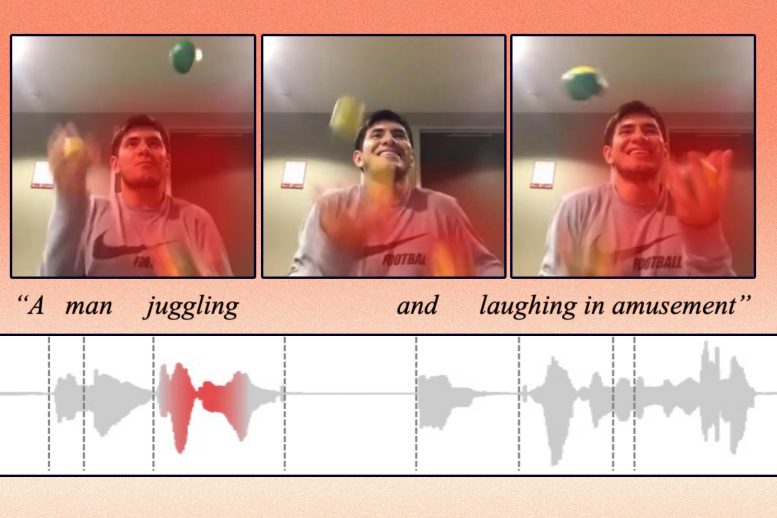
MIT researchers developed a machine learning technique that learns to represent data in a way that captures concepts which are shared between visual and audio modalities. Their model can identify where certain action is taking place in a video and label it. Credit: Courtesy of the researchers. Edited by MIT News
Liu and his collaborators developed an artificial intelligence technique that learns to represent data in a way that captures concepts which are shared between visual and audio modalities. For instance, their method can learn that the action of a baby crying in a video is related to the spoken word “crying” in an audio clip.
Using this knowledge, their machine-learning model can identify where a certain action is taking place in a video and label it.
It performs better than other machine-learning methods at cross-modal retrieval tasks, which involve finding a piece of data, like a video, that matches a user’s query given in another form, like spoken language. Their model also makes it easier for users to see why the machine thinks the video it retrieved matches their query.
This technique could someday be utilized to help robots learn about concepts in the world through perception, more like the way humans do.
Joining Liu on the paper are CSAIL postdoc SouYoung Jin; grad students Cheng-I Jeff Lai and Andrew Rouditchenko; Aude Oliva, senior research scientist in CSAIL and arXiv:2106.05438
This research was supported, in part, by the MIT-IBM Watson AI Lab and its member companies, Nexplore and Woodside, and by the MIT Lincoln Laboratory.