


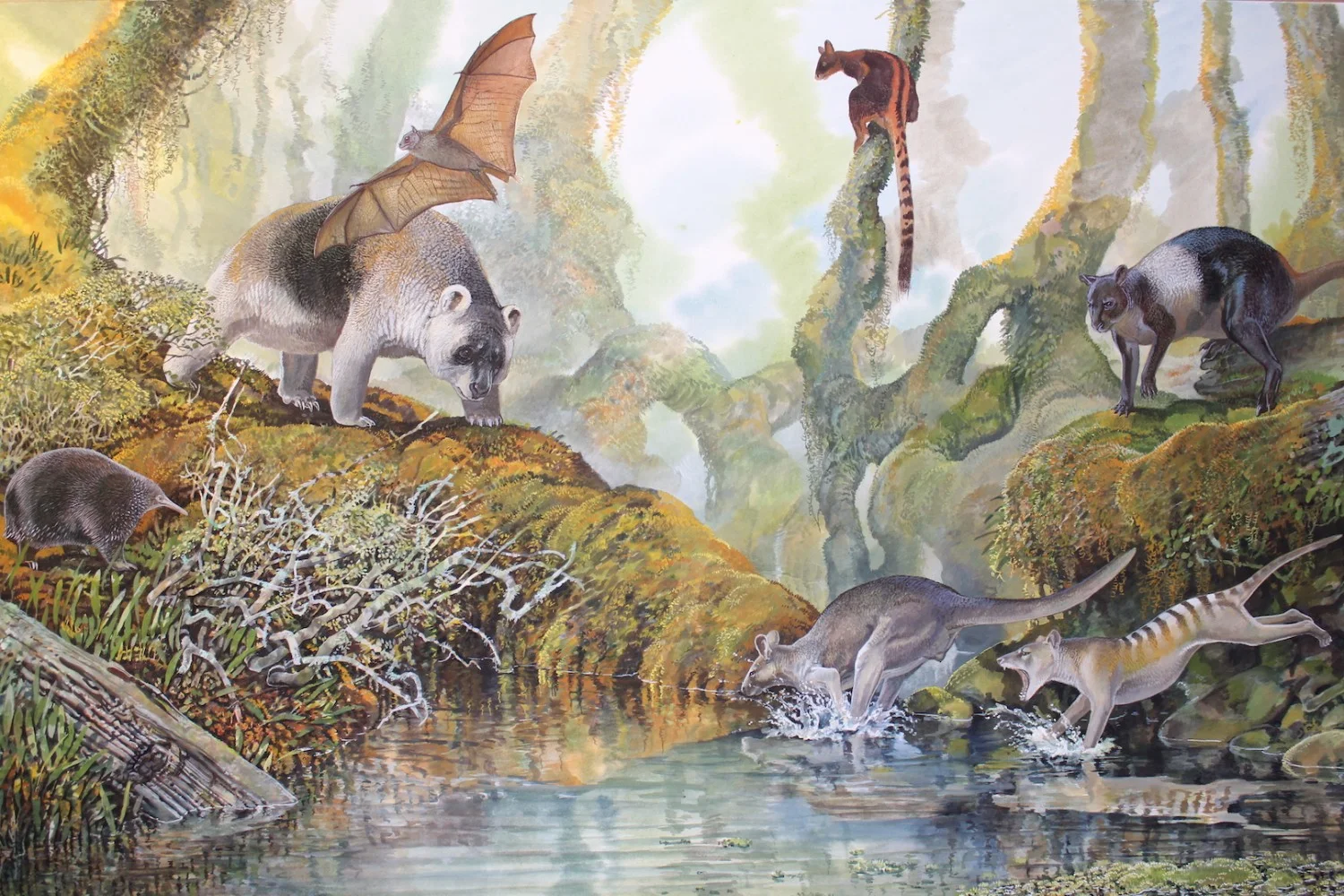
Illustration of PNG megafauna Hulitherium, Thylacine, Protemnodon, Tree Kangaroo, Bulmer’s Flying Fox and Bruijn’s Long-beaked Echidna (left to right) species: Hulitherium thomasetti, Thlacinus sp. cf. T. cynocephalus, Protemnodon nombe, Protemnodon tumbuna, Dendrolagus noibano, Aproteles bumerae (extant), Zaglossus bruijni (extant) in New Guinea, Upper Montane forest. Credit: Peter Schouten (End of the Megafauna)
The reign of Papua New Guinea’s megafauna continued long after humans arrived.
A new study suggests that a giant kangaroo that formerly traversed the Papua New Guinea Highlands on four legs may have lived as recently as 20,000 years ago, long after large-bodied megafauna on mainland Australia became extinct.
In an effort to learn more about the fascinating natural history of PNG, paleontologists from Flinders University and archaeologists and geoscientists from Australian National University (ANU) have reexamined megafauna bones from the rich Nombe Rock Shelter fossil site in Chimbu Province.
New dating methods from the research reveal that when humans first arrived in the PNG Highlands, roughly 60,000 years ago, numerous giant mammal species, including the extinct thylacine and a marsupial that resembled a panda (named Hulitherium tomasettii), were still present.

Excavations at the Nombe rock shelter taken in 1979 during early fieldwork led by the Australian National University. Credit: Barry Shaw (ANU) / Archaeology in Oceania journal.
Surprisingly, two large extinct kangaroo species, one of which bounded on four legs rather than two, may have survived in the region for an additional 40,000 years.
“If these megafaunal species did indeed survive in the PNG Highlands for much longer than their Australian equivalents, then it may have been because people only visited the Nombe area infrequently and in low numbers until after 20,000 years ago,” says ANU Professor of Archaeological Science Tim Denham, co-lead author in the new study published in the journal Archaeology in Oceania.
“Nombe rock shelter is the only site in New Guinea known to have been occupied by people for tens of thousands of years and preserves remains of extinct megafaunal species, most of them unique to New Guinea.
“New Guinea is a forested, mountainous, northern part of the formerly more extensive Australian continent called ‘Sahul’ but our knowledge of its faunal and human history is poor compared with that of mainland Australia,” says Professor Denham who initially undertook fieldwork in the PNG Highlands in 1990.
Research co-author Professor Gavin Prideaux, from the DOI: 10.1002/arco.5274
The study was funded by the Australian Research Council.


