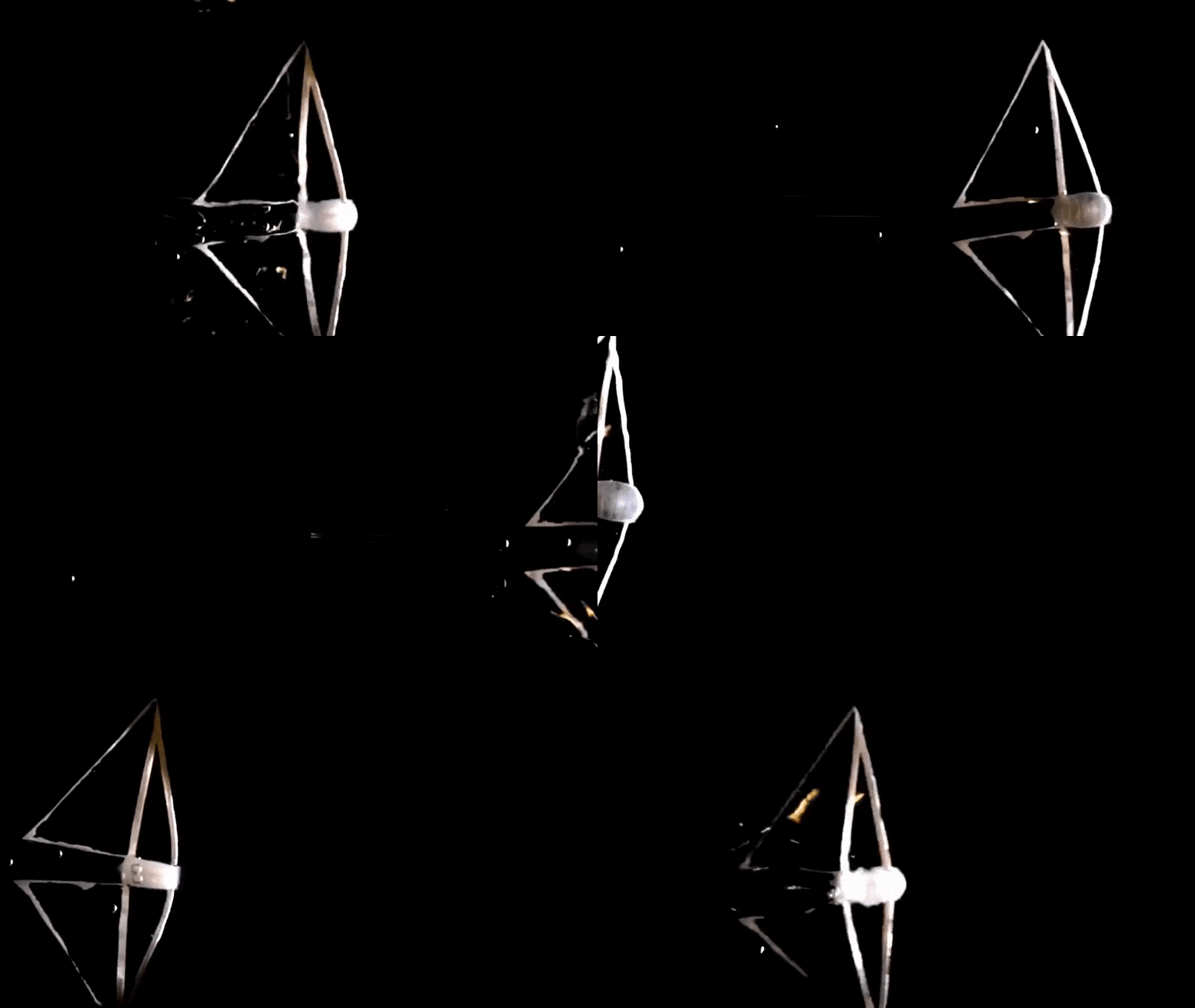
Inspired by the biomechanics of the manta ray, researchers developed an energy-efficient soft robot that can swim more than four times faster than previous swimming soft robots. Credit: NC State University
Researchers have developed an energy-efficient soft robot that can swim more than four times faster than previous swimming soft robots by taking inspiration from the biomechanics of the manta ray. Developed at
Inspired by the biomechanics of the manta ray, researchers at North Carolina State University have developed an energy-efficient soft robot that can swim more than four times faster than previous swimming soft robots. The robots are called “butterfly bots,” because their swimming motion resembles the way a person’s arms move when they are swimming the butterfly stroke. Credit: Jie Yin, NC State University
Two types of butterfly bots were developed by the researchers. One was specifically built for speed and was able to reach average speeds of 3.74 body lengths per second. A second was designed to be highly maneuverable, capable of making sharp turns to the right or left. This maneuverable prototype was able to reach speeds of 1.7 body lengths per second.
“Researchers who study aerodynamics and biomechanics use something called a Strouhal number to assess the energy efficiency of flying and swimming animals,” says Yinding Chi, first author of the paper and a recent Ph.D. graduate of NC State. “Peak propulsive efficiency occurs when an animal swims or flies with a Strouhal number of between 0.2 and 0.4. Both of our butterfly bots had Strouhal numbers in this range.”
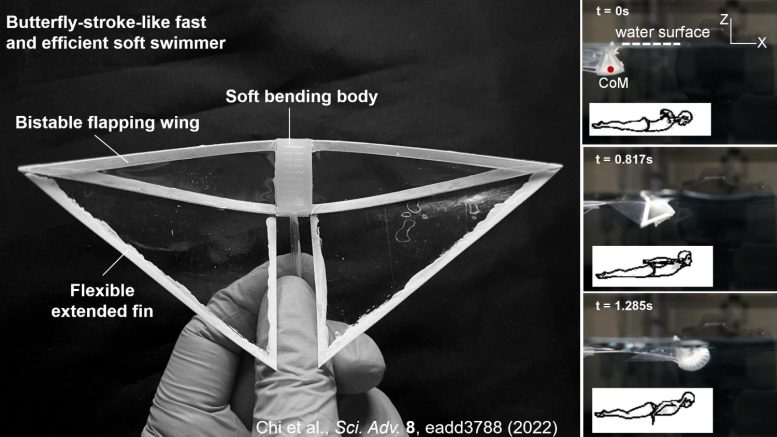
The butterfly bots derive their swimming power from their wings, which are “bistable,” meaning the wings have two stable states. The wing is similar to a snap hair clip. A hair clip is stable until you apply a certain amount of energy (by bending it). When the amount of energy reaches critical point, the hair clip snaps into a different shape – which is also stable.
The researchers from North Carolina State University have recently developed a fast and efficient soft robotic swimmer that swims resembling human’s butterfly-stroke style. It can achieve a high average swimming speed of 3.74 body length per second, close to five times faster than the fastest similar soft swimmers, and also a high-power efficiency with low cost of energy. The small-sized swimmer is light weight and only has 2.8 grams. It has a soft body and a pair of bistable flapping wing. The design of the wing is inspired by the bistable hair clips. The soft body can bend up and down driven by pressurized pneumatic air, which consequently drives the fast flapping of the wings via snapping, a phenomenon often observed in Read More