



By Harvard University, Department of Organismic and Evolutionary BiologySeptember 22, 2022
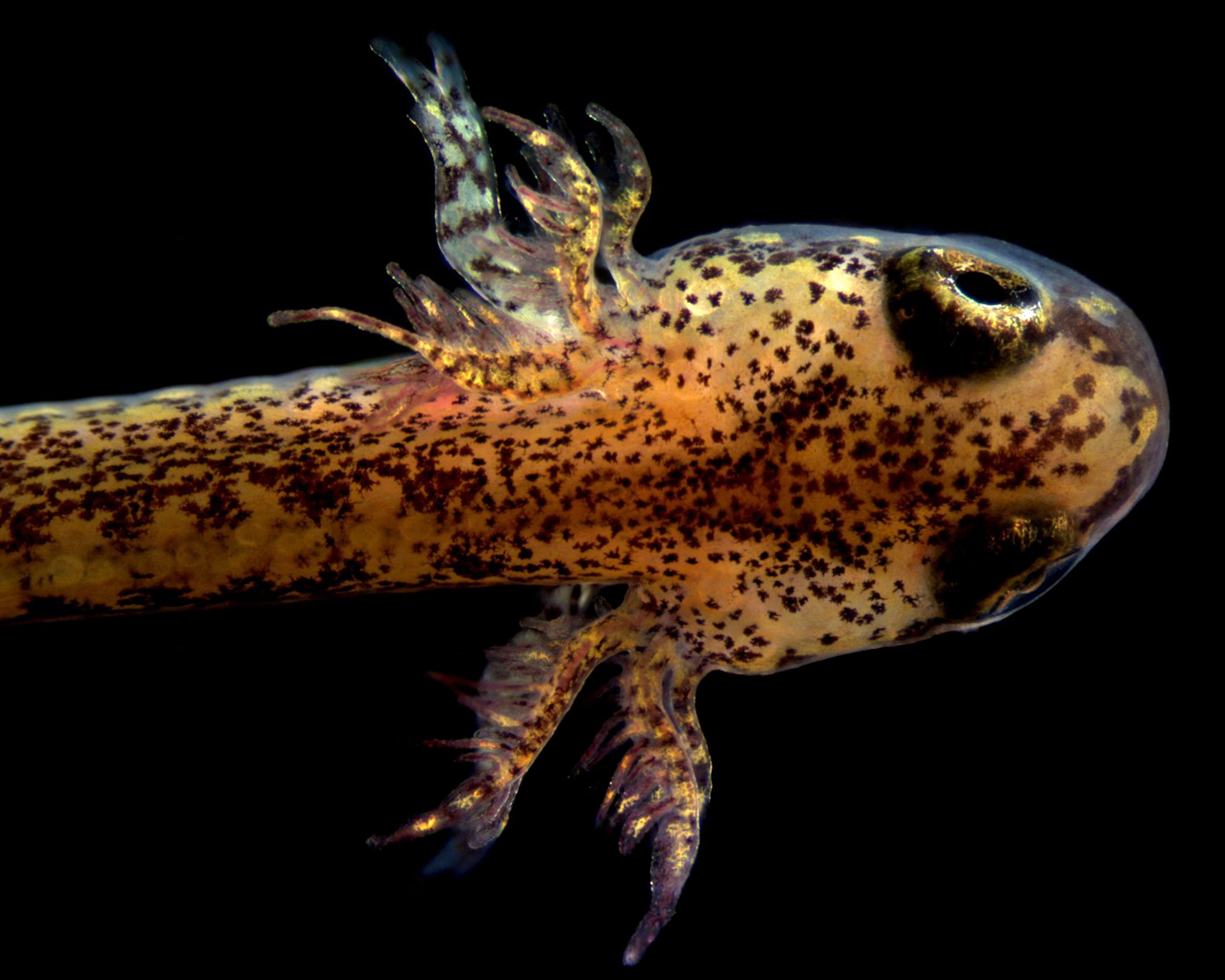
Hemidactylium scutatum larvae, lungless salamander native to eastern North America. Credit: Zachary R. Lewismorpho
Despite lung loss in adults for millions of years, lungless salamanders develop lungs as embryos.
For many vertebrates, including humans, their lungs are essential. Four living amphibian clades, however, no longer breathe via their lungs and instead breathe predominantly through their wet skin. Little is known about the developmental basis of lung loss in these clades.Researchers at Harvard University’s Museum of Comparative Zoology and Department of Organismic and Evolutionary Biology examined the Plethodontidae, a dominant family of salamanders that are all lungless as adults, and discovered that they do develop lungs as embryos, providing insight into the evolution of lung loss over millions of years. Their findings were recently published in the journal Science Advances.Plethodontidae is the most species-rich salamander family, accounting for more than two-thirds of all current salamander diversity. All adult plethodontids lack lungs and breathe solely through nonpulmonary tissues, primarily the skin and mucus membranes of the mouth and throat. Lung loss has happened at least four times in distantly related amphibians independently, and there are more cases of lung reduction or loss in both amphibians as well as some vertebrates. However, the developmental explanation for this loss is unknown.“Clearly lungless salamanders do fine without lungs given that they make up about two-thirds of all salamander species,” said lead author Zachary R. Lewis, former doctoral candidate (Ph.D.’16), “perhaps losing lungs enabled, rather than hindered, this remarkable evolutionary success.”This research builds on Lewis’ doctoral work in the lab of senior author Professor James Hanken. Lewis, Hanken, and co-author Associate Professor Ryan Kerney of Gettysburg College examined the morphology of lung development in both lung and lungless salamanders using histology and micro-CT. They discovered that lungless salamanders develop lungs as embryos in the same manner as lungs develop in other species. The researchers subsequently employed in situ hybridization and DOI: 10.1126/sciadv.abo6108The study was funded by the National Science Foundation, the Museum of Comparative Zoology, the Wetmore-Colles Fund, and the Robert G. Goelet Summer Research Award.