



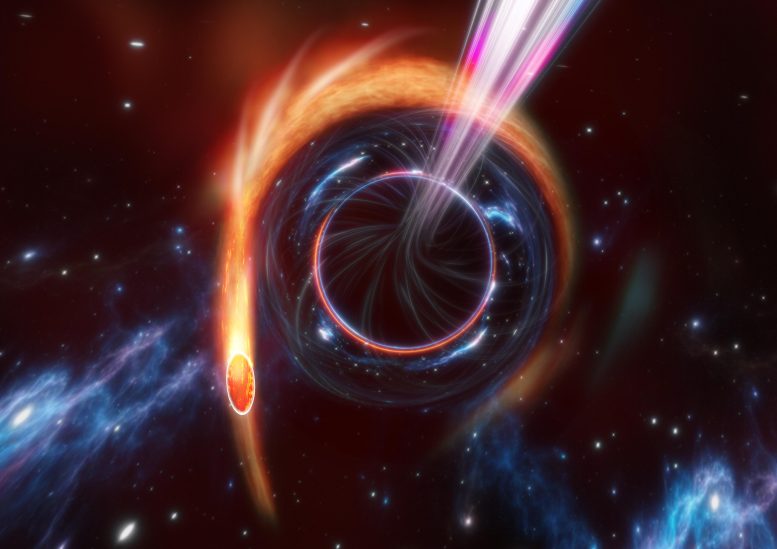
A star is being consumed by a nearby supermassive black hole. Astronomers call this a tidal disruption event (TDE). What makes this TDE a very rare TDE is that as the black hole rips apart the star, two jets of material moving with almost the speed of light are launched in opposite directions producing light in all wavelengths. Such jetted-TDEs are extremely rare and AT2022cmc, depicted here is the first one discovered with an optical telescope. Credit: Carl Knox – OzGrav, ARC Centre of Excellence for Gravitational Wave Discovery, Swinburne University of Technology
Zwicky Transient Facility Makes First Discovery of a Rare Cosmic “Lunch”
Astronomers caught a University of Maryland (UMD) and NASA Goddard Space Flight Center.
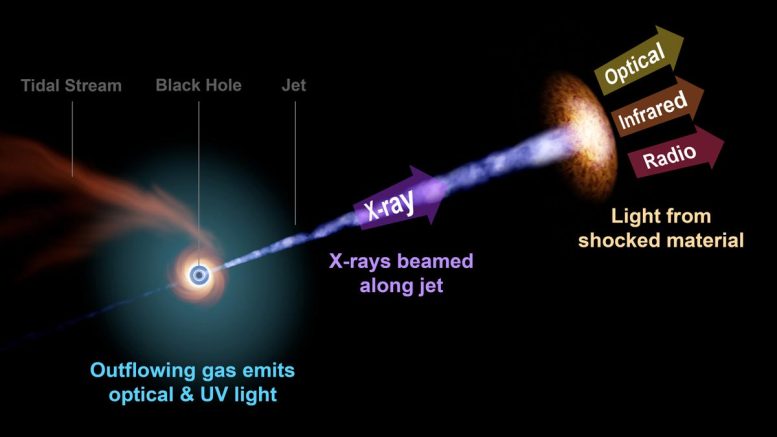
The jetted tidal disription event AT2022cmc was first observed in the ZTF optical data and was followed by 21 other astronomical facilities that saw it shine in X-ray,UV, infrared and radio. Credit: Zwicky Transient Facility/R.Hurt (Caltech/IPAC)
AT2022cmc is a peculiar case of what is known as a tidal-disruption event or TDE. TDEs happen with a star approaching a black hole is violently ripped apart by the black hole’s gravitational tidal forces—similar to how the Moon pulls tides on Earth but with greater strength. Then, pieces of the star are captured into a swiftly spinning disk orbiting the black hole. Finally, the black hole consumes what remains of the doomed star in the disk.
In some extremely rare cases such as AT2022cmc, the supermassive black hole launches “relativistic jets” — beams of matter traveling close to the speed of light — after destroying a star. Discovered in February 2022, astronomers led by Andreoni followed up AT2022cmc and observed it with multiple facilities at multiple wavelengths. The analysis is now published in the journal Nature.
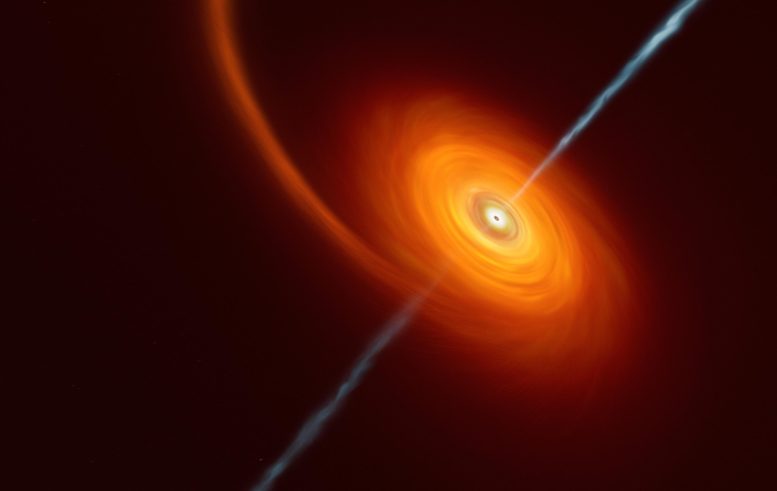
Artist’s impression of the jetted tidal disruption event AT2022cmc. Credit: ESO/M.Kornmesser
“The last time scientists discovered one of these jets was well over a decade ago,” said Michael Coughlin, an assistant professor of astronomy at the University of Minnesota Twin Cities and co-lead on the paper. “From the data we have, we can estimate that relativistic jets are launched in only 1% of these destructive events, making AT2022cmc an extremely rare occurrence. In fact, the luminous flash from the event is among the brightest ever observed.”
The novel data-crunching method — equivalent to searching through a million pages of information every night — allowed Andreoni and colleagues to conduct a rapid analysis of the ZTF data and identify the AT2022cmc TDE with relativistic jets. They quickly started follow-up observations that revealed an exceptionally bright event across the electromagnetic spectrum, from the X-rays to the millimeter and radio.
Supermassive Black Hole Violently Rips Star Apart, Launches Relativistic Jet.
Reference: “A very luminous jet from the disruption of a star by a massive black hole” by Igor Andreoni, Michael W. Coughlin, Daniel A. Perley, Yuhan Yao, Wenbin Lu, S. Bradley Cenko, Harsh Kumar, Shreya Anand, Anna Y. Q. Ho, Mansi M. Kasliwal, Antonio de Ugarte Postigo, Ana Sagués-Carracedo, Steve Schulze, D. Alexander Kann, S. R. Kulkarni, Jesper Sollerman, Nial Tanvir, Armin Rest, Luca Izzo, Jean J. Somalwar, David L. Kaplan, Tomás Ahumada, G. C. Anupama, Katie Auchettl, Sudhanshu Barway, Eric C. Bellm, Varun Bhalerao, Joshua S. Bloom, Michael Bremer, Mattia Bulla, Eric Burns, Sergio Campana, Poonam Chandra, Panos Charalampopoulos, Jeff Cooke, Valerio D’Elia, Kaustav Kashyap Das, Dougal Dobie, José Feliciano Agüí Fernández, James Freeburn, Cristoffer Fremling, Suvi Gezari, Simon Goode, Matthew J. Graham, Erica Hammerstein, Viraj R. Karambelkar, Charles D. Kilpatrick, Erik C. Kool, Melanie Krips, Russ R. Laher, Giorgos Leloudas, Andrew Levan, Michael J. Lundquist, Ashish A. Mahabal, Michael S. Medford, M. Coleman Miller, Anais Möller, Kunal P. Mooley, A. J. Nayana, Guy Nir, Peter T. H. Pang, Emmy Paraskeva, Richard A. Perley, Glen Petitpas, Miika Pursiainen, Vikram Ravi, Ryan Ridden-Harper, Reed Riddle, Mickael Rigault, Antonio C. Rodriguez, Ben Rusholme, Yashvi Sharma, I. A. Smith, Robert D. Stein, Christina Thöne, Aaron Tohuvavohu, Frank Valdes, Jan van Roestel, Susanna D. Vergani, Qinan Wang and Jielai Zhang, 30 November 2022, Nature.
DOI: 10.1038/s41586-022-05465-8
AT2022cmc was observed by 21 astronomical facilities around the world. These include Palomar 48-inch Samuel Oschin Telescope (Zwicky Transient Facility), Liverpool Telescope, Blanco telescope, GROWTH-India Telescope, Very Large Telescope, Nordic Optical Telescope, Very Large Array, Submillimeter Array, Northern Extended Millimeter Array, James Clerk Maxwell Telescope, upgraded Giant Metrewave Radio Telescope, Palomar 60-inch Telescope, Palomar 200-inch Hale Telescope, Asteroid Terrestrial-impact Last Alert System, Gran Telescopio Canarias, Calar Alto Observatory, W.M. Keck Observatory, Gemini Observatory, Neil Gehrels Swift Observatory, Neutron Star Interior Composition Explorer and Hubble Space Telescope.