


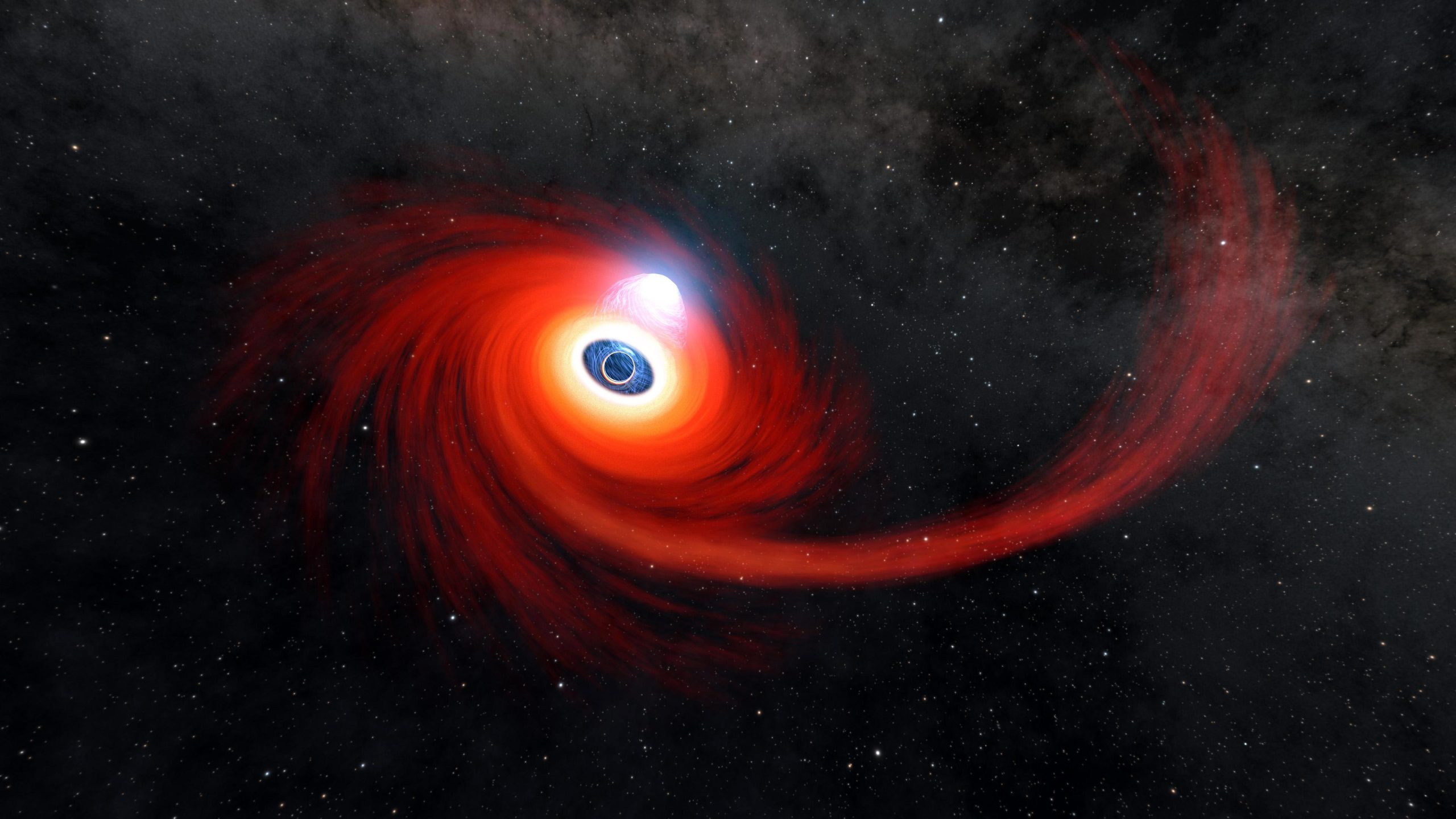
A disk of hot gas swirls around a black hole in this illustration. The stream of gas stretching to the right is what remains of a star that was pulled apart by the black hole. A cloud of hot plasma (gas atoms with their electrons stripped away) above the black hole is known as a corona. Credit: NASA/JPL-Caltech
NASA Gets Unusually Close Glimpse of Black Hole Destroying a Star
Recent observations of a black hole called a corona. NASA’s NuSTAR (Nuclear Spectroscopic Telescopic Array) satellite is the most sensitive space telescope capable of observing these wavelengths of light, and the event’s proximity provided an unprecedented view of the corona’s formation and evolution, according to a new study published in the Astrophysical Journal.
The work demonstrates how the destruction of a star by a black hole – a process formally known as a tidal disruption event – could be used to better understand what happens to material that’s captured by one of these behemoths before it’s fully devoured.
When a star wanders too close to a black hole, the intense gravity will stretch the star out until it becomes a long river of hot gas, as shown in this animation. The gas is then whipped around the black hole and is gradually pulled into orbit, forming a bright disk. Credit: Science Communication Lab/Zwicky Transient Facility (ZTF), located at the Palomar Observatory in Southern California. It was subsequently studied by NASA’s Neil Gehrels Swift Observatory and Neutron star Interior Composition Explorer (NICER) telescope (which observes longer X-ray wavelengths than Swift).
Then, around 300 days after the event was first spotted, NASA’s NuSTAR began observing the system. Scientists were surprised when NuSTAR detected a corona – a cloud of hot DOI: 10.3847/1538-4357/ac898a
More About the Mission
A Small Explorer mission led by the California Institute of Technology (Caltech) and managed by NASA’s Jet Propulsion Laboratory (NASA’s Goddard Space Flight Center. ASI provides the mission’s ground station and a mirror data archive. Caltech manages JPL for NASA.