


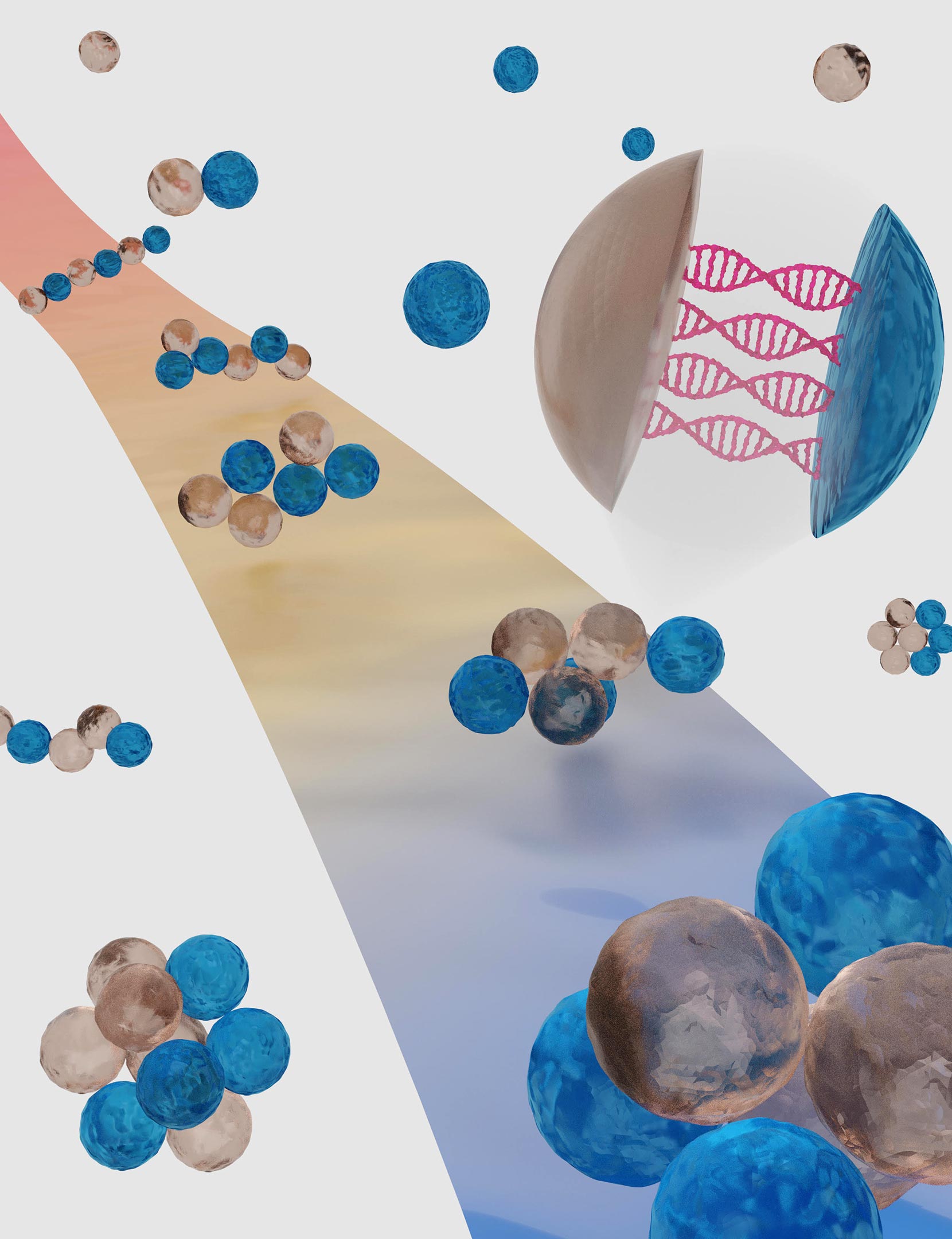
The illustration shows how droplets with different DNA strands first combine into chains, which are then programmed to fold into specific geometries, analogous to protein folding. The carpet highlights one folding pathway of a hexamer chain folding into a polytetrahedron. The zoom shows how the formation of DNA double helices drives droplet-droplet binding. Credot: Image courtesy of Kaitlynn Snyder
Breakthrough opens up new possibilities for the creation of next-generation materials.
A new way to self-assemble particles has been created by a team of physicists. This advance offers new promise for building complex and innovative materials at the microscopic level.
Self-assembly, introduced in the early 2000s, gives scientists a means to “pre-program” particles, which allows for the construction of materials without further human intervention. This is basically the microscopic equivalent of Ikea furniture that can assemble itself.
The breakthrough, reported today, September 28, in the journal Nature, centers on emulsions—droplets of oil immersed in water—and their use in the self-assembly of foldamers. These are unique shapes that can be theoretically predicted from the sequence of droplet interactions.

Microscopy images show a chain of alternating blue and yellow droplets folding into a crown geometry through blue-blue, blue-yellow, and finally, yellow-yellow interactions, mediated by sticky DNA strands. Microscopic droplets are programmed to interact via sticky DNA strands to uniquely fold into well-defined shapes, as shown here. Credit: Image courtesy of the Brujic Lab
Borrowing from the field of biology, the self-assembly process mimics the folding of proteins and DOI: 10.1038/s41586-022-05198-8
The work was supported by grants from the National Science Foundation (DMR-1420073, PHY17-48958, DMR-1710163) as well as by the Paris Region under the Blaise Pascal International Chairs of Excellence.