


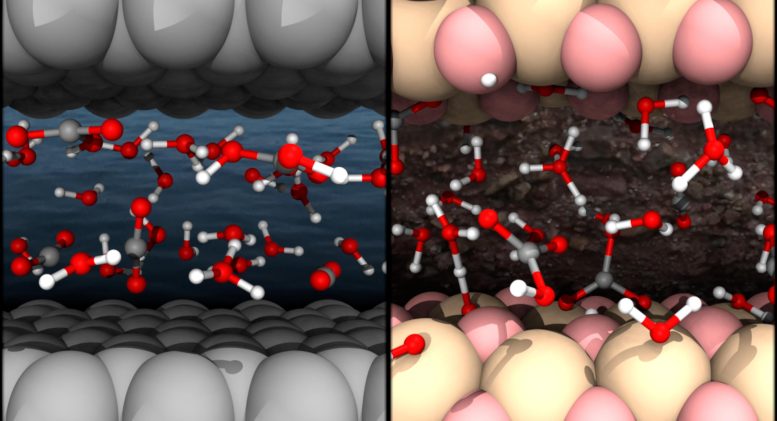
Left: the solution is confined by graphene. Right: the solution is confined by stishovite (SiO2). The white, grey, red, and pink balls are the hydrogen, carbon, oxygen, and silicon atoms, respectively. Credit: HKUST
According to a new study by the Hong Kong University of Science and Technology (HKUST), CO2 in the deep Earth may be more active than previously believed and could have played a bigger role in climate change than previously thought.
The research, led by Professor Pan Ding, analyzed the dissolution of CO2 in water and its potential effects on reducing the return of carbon from underground to the atmosphere.
The vast majority of the Earth’s carbon is buried in its interior. That deep carbon influences the form and concentration of carbon near the surface, which can in turn impact global climate over geologic time. It is therefore important to assess how much carbon lies in deep reservoirs hundreds of kilometers underground.
“Existing research has focused on carbon species above or close to the Earth’s surface. However, more than 90 percent of the Earth’s carbon is stored in the crust, mantle, and even core, which is poorly known,” Professor Pan explained.
Using first-principles simulations in physics, his team found that CO2 may be more active than previously thought in Earth’s deep carbon cycle, which largely influences the carbon transport between Earth’s deep and near-surface reservoirs.
Confining CO2 and water in suitable nanoporous minerals may enhance the efficiency of underground carbon storage, the study found. It suggests that in carbon capture and storage efforts, turning CO2 together with water into rocks under nanoconfinement offers a secure method to permanently store carbon underground with a low risk of return to the atmosphere.
The findings have been published recently in the international academic journal DOI: 10.1038/s41467-022-33696-w