A diamond quantum sensor-based detection technique can more accurately estimate battery charge, leading to an extended range for electric vehicles.
High-
Credit: Tokyo Tech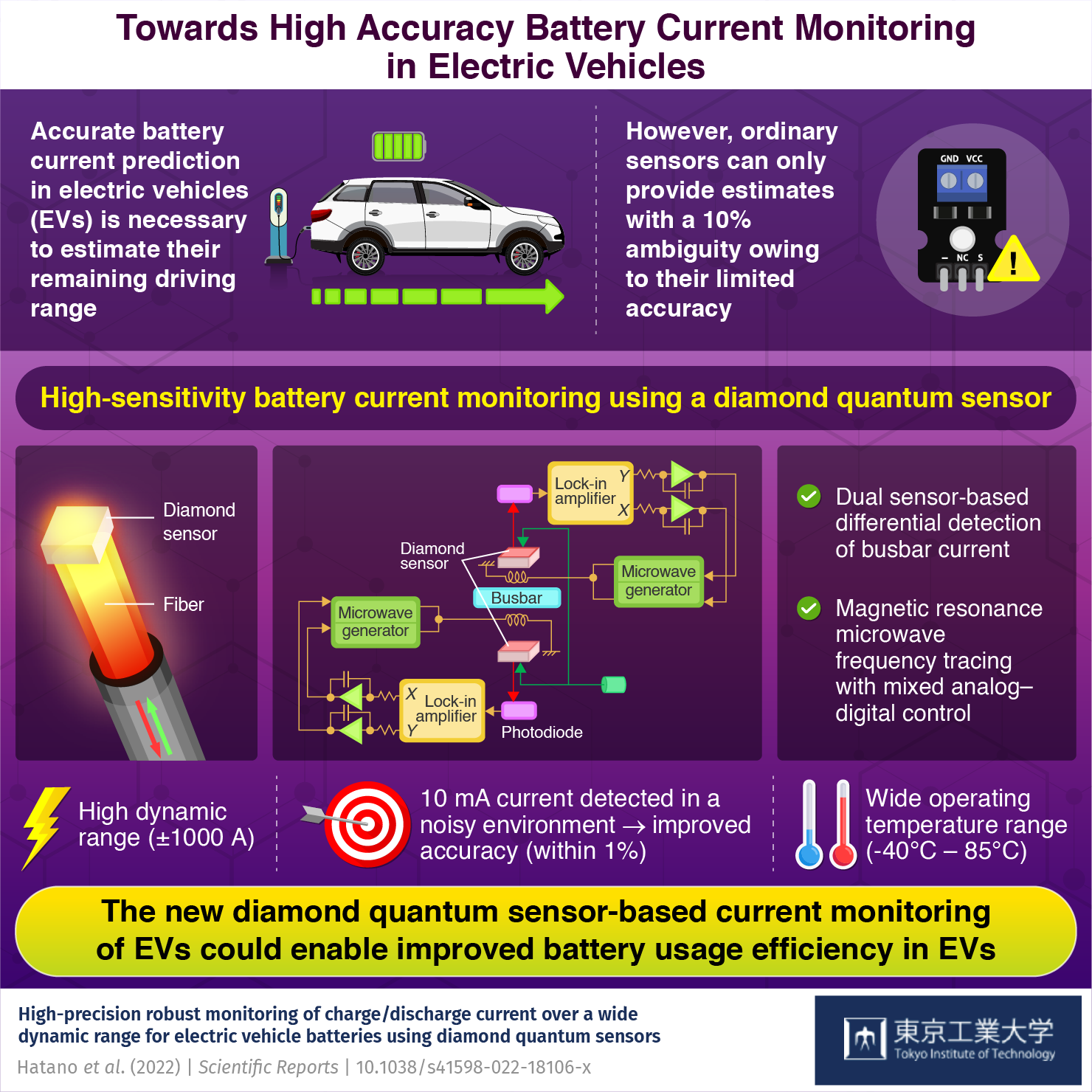

A diamond quantum sensor-based detection technique can more accurately estimate battery charge, leading to an extended range for electric vehicles.
High-
Credit: Tokyo Tech
“We developed diamond sensors that are sensitive to milliampere currents and compact enough to be implemented in automobiles. Furthermore, we measured currents in a wide range as well as detected milliampere-level currents in a noisy environment,” explains Prof. Hatano.
In their work, the researchers developed a prototype sensor using two diamond quantum sensors that were placed on either side of the busbar (electrical junction for incoming and outgoing currents) in the car. They then used a technique called “differential detection” to eliminate the common noise detected by both the sensors and retain only the actual signal. This, in turn, enabled them to detect a small current of 10 mA amid background environmental noise.
Next, the team of scientists used a mixed analog-digital control of the frequencies generated by two microwave generators to trace the magnetic resonance frequencies of the quantum sensor over a bandwidth of 1 gigahertz. This allowed for a large dynamic range (ratio of largest to smallest current detected) of ±1000 A. Moreover, a wide operating temperature range of − 40 to + 85 °C was confirmed to cover general vehicular applications.
Finally, the team tested this prototype for Worldwide Harmonized Light Vehicles Test Cycle (WLTC) driving, a standard test for energy consumption in EVs. The sensor accurately traced the charge/discharge current from -50 A to 130 A and demonstrated the battery charge estimation accuracy within 1%.
What are the implications of these findings? Prof. Hatano remarks, “Increasing battery usage efficiency by 10% would reduce battery weight by 10%, which will reduce 3.5% running energy and 5% production energy of 20 million new EVs in 2030 WW. This, in turn, corresponds to a 0.2% reduction in CO2 emissions in 2030 WW transportation field.”
We certainly hope this breakthrough takes us one step closer to a carbon-neutral society!
Reference: 6 September 2022, Scientific Reports.
DOI: 10.1038/s41598-022-18106-x
Funding: The Ministry of Education, Culture, Sports, Science and Technology