

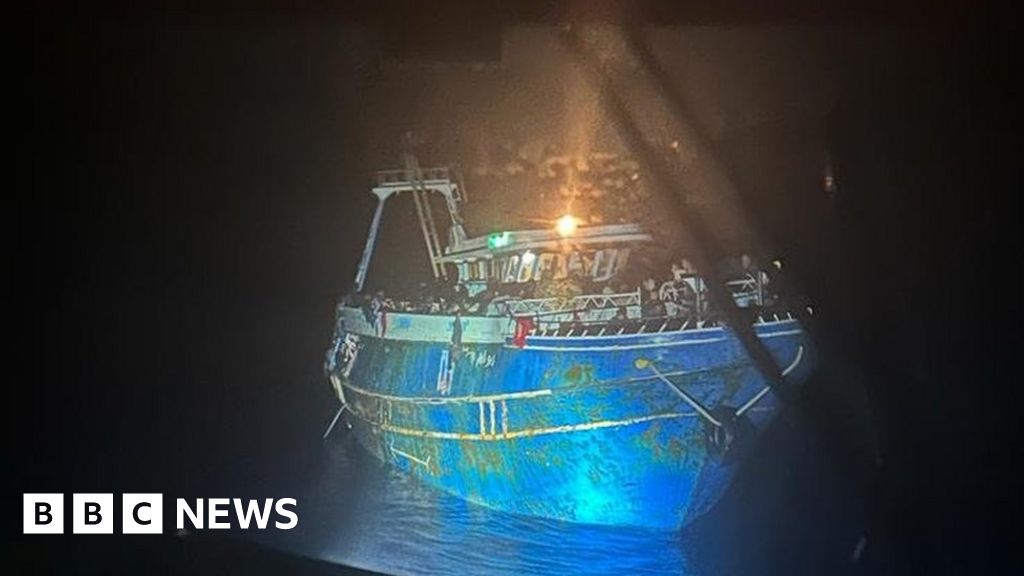
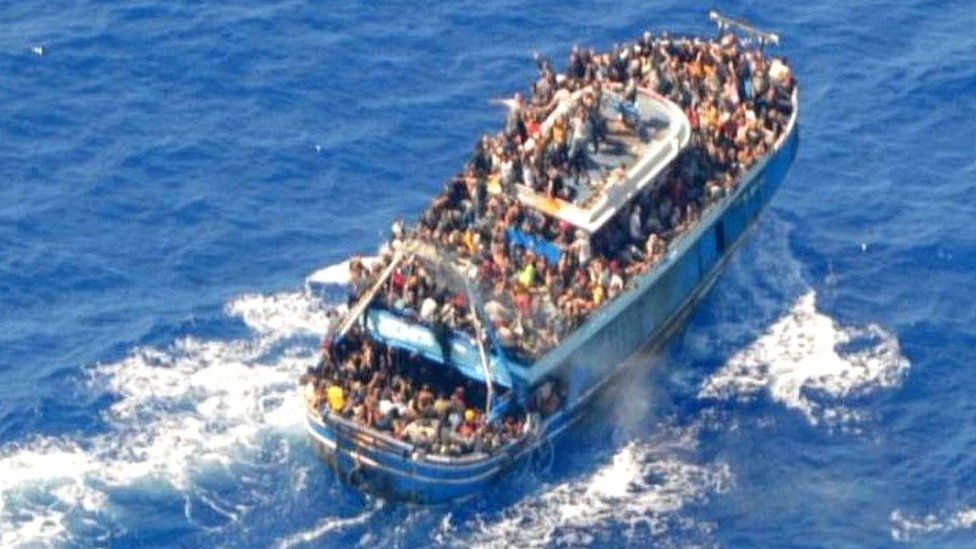
The Greek coastguard released images of the crowded boat before it went down
By Nick Beake in Kalamata & George Wright in London
BBC News
Survivors from a fishing boat that sank off southern Greece in one of Europe’s worst migrant disasters say up to 100 children may have been on board.
At least 78 people have already been confirmed dead in the disaster.
But scores more could still be missing at sea, with reports suggesting that up to 750 people were aboard the vessel.
Greece’s public broadcaster ERT is reporting that 11 to 12 arrests have been made at the Kalamata Port Authority.
The country’s coastguard has been criticised for not intervening earlier but authorities say their offers of aid were refused.
Rescuers are still scouring the seas off Greece in a massive search operation, as hopes of finding more survivors dwindle.
Shocking accounts of a large number of women and children travelling in the hold of the ship have come via medics who treated the mostly male survivors.
The boat had reportedly been travelling from Libya to Italy before it capsized.
The senior doctor at Kalamata General Hospital who treated survivors of Wednesday’s shipwreck has told the BBC as many as 100 children were on the vessel.
Dr Manolis Makaris, head of cardiology, said: “They (the survivors) told us that there were children in the bottom of the ship. Children and women.”
He said two patients had given him estimated figures.
“One told me about 100 children, the other about 50, so I don’t know the truth – but it is many,” he added.
Dr Makaris said he believed as many as 600 people could have died in the disaster.
“The exact number of all the people who were on the boat was 750. This is the exact number that everyone told me about this,” he said.
Dr Makaris said families of some Egyptian children who were missing had sent him photographs of their young relatives, in the hope he would recognise them after treating them.
“It was a tragedy,” he said. “Everyone in Europe must not accept this situation. We have to do something. Everyone has to do something so it doesn’t happen again.”
A reporter from Greece’s ANT1 channel asked a survivor if there were 100 children on board, to which the survivor replied: “Yes.”
The charity Save the Children, citing testimonies from survivors, also gave the same number. The BBC has not been able to independently verify this figure.
But Greek government spokesman Ilias Siakantaris said there were unconfirmed reports that up to 750 people in total were on the boat.
“We do not know what was in the hold… but we know that several smugglers lock people up to maintain control,” he told public broadcaster ERT.
Image source, Hellenic Coast Guard
A later picture of the fishing boat in the hours before it sank was released by the coast guard on Thursday
Families of some of the missing have arrived in Kalamata in search of their loved ones.
“My relatives were on the boat,” said Aftab, who had travelled from the UK and said at least four of his relatives from Pakistan were unaccounted for.
“We’ve had confirmation. We found one of the relatives in [the rescue centre]. But the others we haven’t got hold of yet,” he told the BBC.
A Syrian man from the Netherlands broke down as he revealed his wife and brother-in-law were missing.
Timeline of events (all times in GMT)
- 08:00 Greek coast guard says they are informed about a migrant boat by Italian authorities
- 11:00 Coast guard says it makes contact with boat – it does not request help
- 12:17-15:34 Multiple distress calls from boat according to Alarm Phone charity
- 15:00 First commercial vessel supplies food and water
- 19:40-22:40 Greek coastguard vessel sailed near the migrant boat, observing at a distance not finding any problem in its navigation
- 22:40 Report of engine failure
- 23:04 Migrant boat overturns and sinks
- 04:00 Vessels help in rescue efforts
The boat went down about 80km (50 miles) south-west of Pylos, according to the Greek coastguard.
A timeline provided by the coastguard said that initial contact was made with the fishing boat at 14:00 local time (11:00 GMT) the previous day, and no request for help had been made.
It said the Greek shipping ministry had made repeated contact with the boat and was told it simply wanted to sail on to Italy.
A coastguard spokesman told ERT that the boat’s engine broke down in the early hours of Wednesday, then people on board started to move around causing it to capsize. He said everyone rescued was male.
Alarm Phone, an emergency helpline for migrants in trouble at sea, received the first call from the boat in distress just over an hour after the coastguard first made contact on Tuesday.
Activist Nawal Soufi was the first to raise the alarm after being contacted by people on the boat on Tuesday morning.
In a Facebook post, Ms Soufi said the situation became “complicated” when a rescue boat approached the vessel and tied a rope to it while throwing bottles of water.
She said some of the people on board then felt in “extreme danger” due to fears the rope could cause the boat to flip, and that fights on board over water could result in it capsizing. The boat then moved away.
Watch: Survivors winched to safety after Greece boat disaster
Alarm Phone complained that the coastguard was “aware of the ship being in distress for hours before any help was sent”, adding that authorities “had been informed by different sources” that the boat was in trouble.
However, coastguard spokesperson Nikos Alexiou said they tried to convince the vessel to get help and “stayed by if they needed us to save people”.
Former Greek Prime Minister Alexis Tsipras visited Kalamata on Thursday and spoke to survivors who explained how they thought the boat had capsized.
“The Greek coastguard asked the vessel to follow them, but they couldn’t. The coastguard then threw a rope but because they didn’t know how to pull the rope, the vessel started dangling right and left,” News247 quoted the survivor as saying.
“The coastguard boat was going too fast but the vessel was already dangling to the left, and that’s how it sank.”
Greece is observing three days of mourning. Campaigning has been suspended ahead of the parliamentary election on 25 June and a TV debate due to happen on Thursday has been cancelled.
The country is one of the main routes into the European Union for refugees and migrants from the Middle East, Asia and Africa.
Last month the Greek government came under international criticism over video reportedly showed the forceful expulsion of migrants who were set adrift at sea.
Are you in Greece? Have you noticed anything which we should be reporting? You can share your experiences by emailing haveyoursay@bbc.co.uk.
Please include a contact number if you are willing to speak to a BBC journalist. You can also get in touch in the following ways:
If you are reading this page and can’t see the form you will need to visit the mobile version of the BBC website to submit your question or comment or you can email us at HaveYourSay@bbc.co.uk. Please include your name, age and location with any submission.