

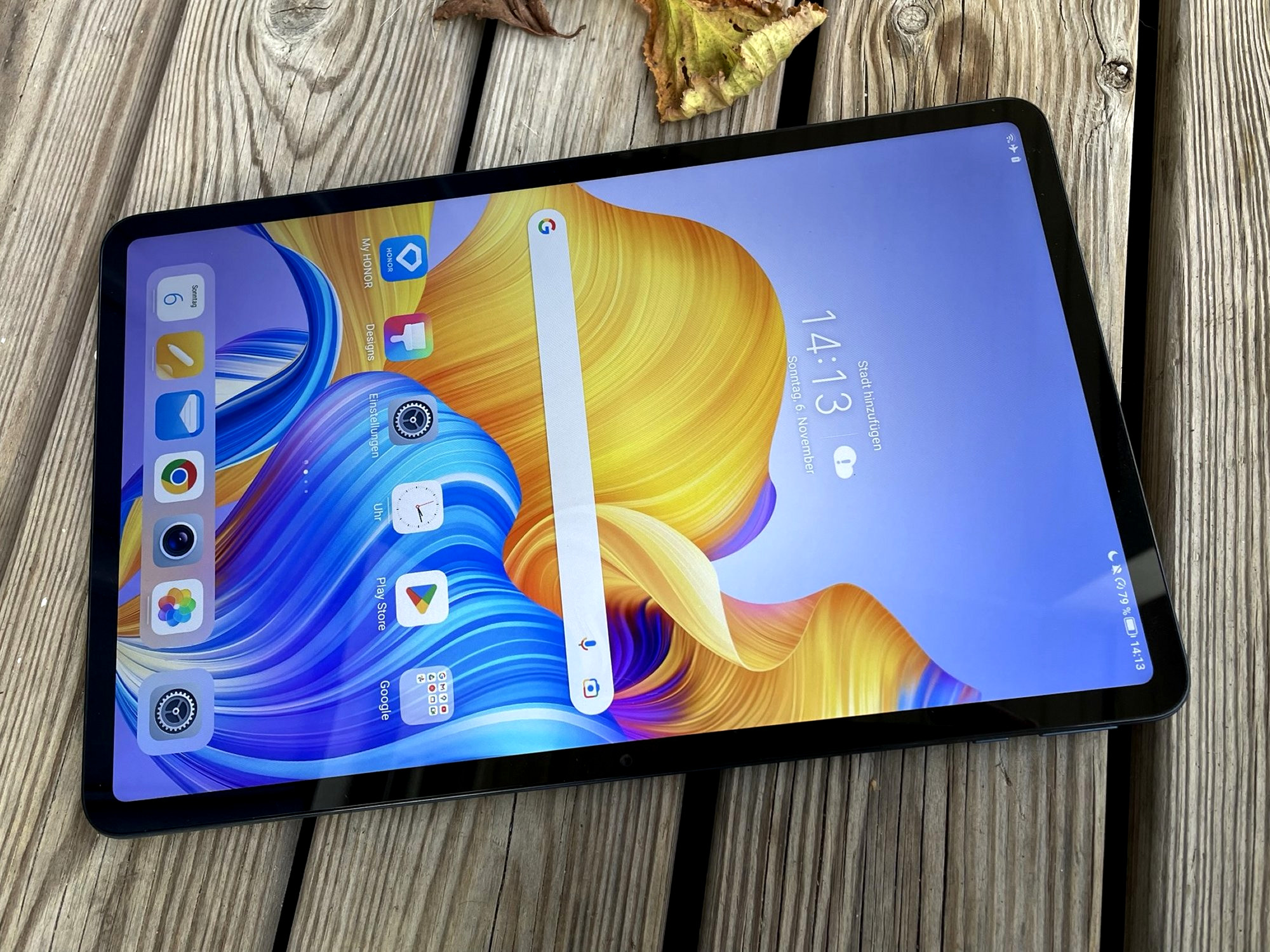
Going big. Honor is introducing its first tablet in the form of the Pad 8 and thus attempting to make its mark in the tablet category. The Pad 8 is currently one of the cheapest 12-inch tablets on the market at US$299.90. It also has a solid mid-range performance and features. Our review reveals how well the XXL tablet performs in practice and where it falls short.
Manuel Masiero, ? Florian Schmitt (translated by Jacob Fisher), Published ??

A display size of 12 inches, a slick aluminum case, and a surround sound system with 8 loudspeakers: Those who expect to be confronted with a high price for the Honor Tab 8 may be in for a surprise. The tablet, equipped with 6 GB of RAM, 128 GB storage space and a Snapdragon 680, only costs around US$299.90, which currently makes it the most reasonably priced Android tablet for its size.
Despite the low price, the rest of the tablet’s equipment does not fall too short. This includes a 7250 mAh large battery, which supports fast charging at 22.5 watts, as well as special OS features for working across screens.
Display
12.00 inch 5:3, 2000 x 1200 pixel 194 PPI, capacitive, native pen support, IPS, glossy: yes, 60 Hz
Storage
128 GB UFS 2.2 Flash, 128 GB
, 109 GB free
Connections
1 USB 2.0, Audio Connections: USB-C, Brightness Sensor, Sensors: Accelerometer, DRM WideVine L1, Camera2 API Level 3, USB OTG, DTS:X Ultra
Networking
802.11 a/b/g/n/ac (a/b/g/n = Wi-Fi 4/ac = Wi-Fi 5), Bluetooth 5.1
Size
height x width x depth (in mm): 6.9 x 278.54 x 174.06 ( = 0.27 x 10.97 x 6.85 in)
Battery
7250 mAh Lithium-Polymer, 22,5 W charging speed (max. 10V 2.25A)
Operating System
Android 12
Additional features
Speakers: 8 speakers, Keyboard: virtual, 22,5W charger, USB cable, Quick start guide, Warranty information, MagicUI 6.1, 24 Months Warranty, fanless
Weight
520 g ( = 18.34 oz / 1.15 pounds), Power Supply: 52 g ( = 1.83 oz / 0.11 pounds)
Note: The manufacturer may use components from different suppliers including display panels, drives or memory sticks with similar specifications.
|
Rating |
Date |
Model |
Weight |
Height |
Size |
Resolution |
Best Price |
|---|---|---|---|---|---|---|---|
| 81.7 % |
11/2022 |
Honor Pad 8 SD 680, Adreno 610 |
520 g | 6.9 mm | 12.00″ | 2000×1200 | |
| 88.5 % |
10/2021 |
Apple iPad 2021 A13 Bionic, A13 Bionic GPU |
487 g | 7.5 mm | 10.20″ | 2160×1620 | |
| 84.1 % |
11/2021 |
Lenovo Tab P11 Plus Helio G90T, Mali-G76 MP4 |
490 g | 7.5 mm | 11.00″ | 2000×1200 | |
| 85.8 % |
08/2021 |
Samsung Galaxy Tab S7 FE 5G SD 750G 5G, Adreno 619 |
608 g | 6.3 mm | 12.40″ | 2560×1600 | |
| 87.6 % |
12/2021 |
Xiaomi Pad 5 SD 860, Adreno 640 |
511 g | 6.85 mm | 11.00″ | 2560×1600 |
Honor packs the Pad 8 in a 7.9 millimeter thin and well-made unibody case out of aluminum, which, together with its matte surface finish in the only available color Blue Hour, makes for a high quality impression. The 12-inch tablet feels pleasantly light to hold thanks to its weight of 520 grams. The volume rocker and the power button sit firmly in the metal chassis, do not wobble, and have a firm pressure point.
Thanks to a display-surface ratio of 87 percent, the Pad 8 offers a good combination of slim design and user friendliness. The screen bezel is just over 7 millimeters wide on all sides, which allows the tablet to be held comfortably in one hand without making incorrect inputs on the display. The selfie camera is also located in the bezel to save space, thus conveniently disappearing from the user’s field of view.
For those really wishing to do so, the Pad 8 can be dented in the middle and its metal chassis twisted a little under torsional stress when gripped by its two short sides. But considering the large display diagonal, the stability of the Honor Pad 8 is rather good and more than sufficient for everyday use. However, the tablet lacks IP certification.
The 5 MP camera on the backside protrudes a few millimeters from the cases, meaning that the tablet does not lie completely flat on the table. Nonetheless, it barely wobbles back and forth due to its size, even when tapping the corner next to the camera.
The Honor Pad 8 is only available in one storage variant. With 6 GB of LPDDR4 RAM and 128 GB of UFS 2.2 storage, it officially costs US$299.90. The Honor tablet produces powerful surround sound from a total of 8 speakers with DTS:X Ultra support.
Other features include an OTG-capable USB-C port with USB 2.0 speed, which has to be used for connecting audio devices via cable due to the lack of a 3.5 mm jack. The tablet supports DRM Widevine L1 and can therefore also play streams in HD quality.
The Pad 8 runs Android 12 in conjunction with Honor’s Magic UI 6.1 user interface. At the time of testing (mid-November, build number 6.1.0.141), the Android security patches were from August 1, 2022 and thus already quite outdated. To date, Honor has not specified how long the Pad 8 will be supplied with security patches and system upgrades.
Two software features of Magic UI 6.1 take advantage of the 12-inch tablet’s screen size: multi-windows mode and cross-screen working.
Multi-windows mode allows for up to 4 apps to be displayed on the tablet at the same time, to be positioned next to or above each other, and to be changed in size. In addition, images, text and documents can be transferred between open apps and, for example, photos can be dragged from the photo app to the email app to be sent as attachments.
Multi-windows mode is not supported by every app, but it functioned flawlessly with a number of apps in our tests, including YouTube, Chrome, Google Photos and Honor’s own note-taking app, Memo.
Users can pair the Pad 8 with an Honor smartphone for cross-screen work. The smartphone’s screen is mirrored on the tablet’s screen, making it possible to drag and drop photos and videos from the smartphone onto the tablet. However, only Honor smartphones with Magic UI 3.0 and higher are compatible.
The Honor Pad 8 is restrained in terms of communication. Although the mobile network menu item appears in the Android settings, Honor does not offer a mobile option for its tablet. NFC and a GPS module are also missing. This leaves only Bluetooth 5.1 and Wi-Fi 5 as communication modules.
Connected to our Asus ROG Rapture GT-AXE11000 reference router, the Honor Pad 8 achieves good and stable Wi-Fi transmission rates in both send and receive directions. At rates of around 350 MB/s, this falls within the range of what Wi-Fi 5 is capable of.
| Xiaomi Pad 5 Adreno 640, SD 860, 128 GB UFS 3.1 Flash |
|
| Samsung Galaxy Tab S7 FE 5G Adreno 619, SD 750G 5G, 64 GB UFS 2.1 Flash |
|
| Apple iPad 2021 A13 Bionic GPU, A13 Bionic, 64 GB SSD |
|
| Lenovo Tab P11 Plus Mali-G76 MP4, Helio G90T, 128 GB UFS 2.1 Flash |
|
| Samsung Galaxy Tab S7 FE 5G Adreno 619, SD 750G 5G, 64 GB UFS 2.1 Flash |
|
| Xiaomi Pad 5 Adreno 640, SD 860, 128 GB UFS 3.1 Flash |
|
| Apple iPad 2021 A13 Bionic GPU, A13 Bionic, 64 GB SSD |
|
| Lenovo Tab P11 Plus Mali-G76 MP4, Helio G90T, 128 GB UFS 2.1 Flash |
|
| Honor Pad 8 Adreno 610, SD 680, 128 GB UFS 2.2 Flash |
|
| Honor Pad 8 Adreno 610, SD 680, 128 GB UFS 2.2 Flash |
|
; iperf3 receive AXE11000; iperf 3.1.3: Ø344 (326-357)
; iperf3 transmit AXE11000; iperf 3.1.3: Ø357 (323-366)

In general, you shouldn’t expect too much from integrated cameras in tablets. If you look at the product website of the Honor Pad 8, this seems to be the case here as well. There, the cameras do not even appear in the description of the tablet and are instead hidden in the technical data.
Reading through the specifications, we learn that the main and selfie camera each have a resolution of merely 5 MP. In the camera menu, we find out that both cameras can record videos at up to 1080p at 30 frames per second. The single microphone does its job quite well.
Photos and videos taken by the main and selfie camera are of modest quality. As a result, photos are not particularly sharp and are always somewhat washed out. On other hand, both cameras together reproduce colors quite vividly and realistically. However, the main camera cannot cope with low-light shots and hardly brings out details.
A special feature of the camera software is the document mode, which, however, does not live up to its promise. The document mode automatically crops photographed pages, but did not manage to display text pages sharply under testing and neither has text recognition nor the option to create PDF files.
Image Comparison
Choose a scene and navigate within the first image. One click changes the position on touchscreens. One click on the zoomed-in image opens the original in a new window. The first image shows the scaled photograph of the test device.
Daylight photo 1Daylight photo 2Low light shot

click to load images
Here we take a closer look at the Honor Pad 8’s main camera under controlled lighting conditions.
Under optimal lighting, it reproduces the colors of the ColorChecker test chart quite accurately and only shows larger deviations from the reference colors in the darker green and brown tones. The test chart is also relatively sharp, but the transitions between the chart elements are already frayed in the center of the image.
The main camera is completely overwhelmed in 1 lux residual light; the test chart appears very grainy and dark. But its elements can still be recognized to some extent.

16.3 ∆E
13 ∆E
15 ∆E
19.6 ∆E
13.7 ∆E
8.3 ∆E
12.8 ∆E
13.4 ∆E
13.3 ∆E
10 ∆E
11.9 ∆E
9.8 ∆E
9 ∆E
14.3 ∆E
12.7 ∆E
8.9 ∆E
10.3 ∆E
13.4 ∆E
3.9 ∆E
8.8 ∆E
11.9 ∆E
11.2 ∆E
8.3 ∆E
5.7 ∆E

29.1 ∆E
54.1 ∆E
39.6 ∆E
38.7 ∆E
44.5 ∆E
65.9 ∆E
53.9 ∆E
35.2 ∆E
43.1 ∆E
26.9 ∆E
67.8 ∆E
65.6 ∆E
30.8 ∆E
51.1 ∆E
36.8 ∆E
78.2 ∆E
43.1 ∆E
46.9 ∆E
92.1 ∆E
71.1 ∆E
52.6 ∆E
37.3 ∆E
24.3 ∆E
14.4 ∆E
Honor includes a USB cable (type A to C), a 22.5-watt power adapter, a quick-start guide, and a service guarantee card with the Pad 8. The manufacturer does not offer any accessories specifically tailored to the tablet in its web store.
The Honor Pad 8 comes with a 24-month warranty in the EU. This may differ from region to region, so be sure to check with your manufacturer before purchasing. On its website, the manufacturer limits the warranty for the included power adapter to 6 months and the warranty for the included USB cable to 3 months.
The IPS screen of the Honor Pad 8 responds quickly and precisely to inputs. Active pen input is a must for a tablet of its size. However, only capacitive pen input is possible on the Pad 8, which works much less accurately. Moreover, Honor does neither a suitable pen for its tablet, nor a keyboard cover.
Users who are used to a higher refresh rate than 60 Hz in mobile devices will immediately notice the difference in the Honor Pad 8. Compared to rivals such as the Xiaomi Pad 5 with its 120 Hz screen, our review sample feels much less smooth and this is noticeable in the lag effect that occurs, for example, when scrolling through menus and websites.
A fingerprint sensor is absent from the tablet, so only the 2D face recognition of the selfie camera is available for biometric authentication. This works reliably in good lighting conditions, but it is not a particularly secure login method.

The IPS screen of the Honor Pad 8 has a resolution of 2,000 x 1,200, which corresponds to an aspect ratio of 5:3 and a not too high pixel density of 194 PPI. The screen does not support HDR10, HLG or Dolby Vision. In view of its low luminance values, however, this would not have made much sense anyway because the HDR effect would have been quite unspectacular.
The IPS panel achieves an average brightness of 381.6 cd/m² on a full white background, which puts it at the very end of the ranks of the partly much brighter comparison devices. If the brightness measurement is limited to a single image section (APL18 measurement), a maximum of 386 cd/m² is possible.
While many IPS panels use pulse width modulation (PWM) to control screen brightness, we did not detect any PWM flickering in the Honor Pad 8. Sensitive users can thus use the tablet without hesitation.
| 432 cd/m² |
366 cd/m² |
362 cd/m² |
||
| 379 cd/m² |
379 cd/m² |
383 cd/m² |
||
| 368 cd/m² |
394 cd/m² |
371 cd/m² |
||
Distribution of brightness
X-Rite i1Pro 2
Maximum: 432 cd/m² (Nits) Average: 381.6 cd/m² Minimum: 2.1 cd/m²
Brightness Distribution: 84 %
Center on Battery: 379 cd/m²
Contrast: 1263:1 (Black: 0.3 cd/m²)
ΔE Color 4.76 | 0.59-29.43 Ø5.3
ΔE Greyscale 6.7 | 0.57-98 Ø5.5
95.8% sRGB (Calman 2D)
Gamma: 2.234
| Honor Pad 8 IPS, 2000×1200, 12.00 |
Apple iPad 2021 IPS, 2160×1620, 10.20 |
Lenovo Tab P11 Plus IPS, 2000×1200, 11.00 |
Samsung Galaxy Tab S7 FE 5G LCD IPS, 2560×1600, 12.40 |
Xiaomi Pad 5 IPS, 2560×1600, 11.00 |
|
|---|---|---|---|---|---|
| Brightness middle |
379 |
507 34% |
410 8% |
619 63% |
491 30% |
| Brightness |
382 |
491 29% |
400 5% |
593 55% |
473 24% |
| Brightness Distribution |
84 |
90 7% |
83 -1% |
91 8% |
91 8% |
| Black Level * |
0.3 |
0.5 -67% |
0.29 3% |
0.22 27% |
0.87 -190% |
| Contrast |
1263 |
1014 -20% |
1414 12% |
2814 123% |
564 -55% |
| Colorchecker dE 2000 * |
4.76 |
1.7 64% |
4.47 6% |
2.6 45% |
1.9 60% |
| Colorchecker dE 2000 max. * |
9.25 |
3.9 58% |
8.84 4% |
6.6 29% |
4.1 56% |
| Greyscale dE 2000 * |
6.7 |
2.4 64% |
5.1 24% |
4 40% |
3 55% |
| Gamma |
2.234 98% |
2.25 98% |
2.248 98% |
2.17 101% |
2.21 100% |
| CCT |
8468 77% |
6923 94% |
7966 82% |
6973 93% |
7182 91% |
* … smaller is better
Screen Flickering / PWM (Pulse-Width Modulation)
ℹ
To dim the screen, some notebooks will simply cycle the backlight on and off in rapid succession – a method called Pulse Width Modulation (PWM) . This cycling frequency should ideally be undetectable to the human eye. If said frequency is too low, users with sensitive eyes may experience strain or headaches or even notice the flickering altogether.
| Screen flickering / PWM not detected |
 |
||
|
In comparison: 53 % of all tested devices do not use PWM to dim the display. If PWM was detected, an average of 19625 (minimum: 5 – maximum: 3846000) Hz was measured. |
|||
Series of measurements at a fixed zoom level and different brightness settings
In the display settings, you can only adjust the screen color via the color temperature selection, since no other display modes are available. Under the preset “Standard” setting, the display delivers the most balanced color representation, but still only scores moderately in terms of picture quality. The IPS panel deviates significantly from the ideal colors, grayscale in particular, and is too cool at a color temperature of 8468 K.
Display Response Times
ℹ
Display response times show how fast the screen is able to change from one color to the next. Slow response times can lead to afterimages and can cause moving objects to appear blurry (ghosting). Gamers of fast-paced 3D titles should pay special attention to fast response times.
The viewing-angle stable IPS display does not offer particularly high brightness levels for outdoor use. Readability becomes difficult in direct sunlight due to strong reflections on the screen. On the other hand, the Honor Pad 8 can be used well in a shady spot.

The Honor Pad 8 houses a Snapdragon 680, which has 6 GB of LPDDR4X RAM. The Adreno 610 integrated in the SoC takes care of the graphics processing.
The eight-core processor helps the Honor Pad 8 achieve a solid system speed, but does not turn the tablet into a racehorse. Operation is mostly smooth in everyday use, but small stutters occur from time to time. Several open apps can push the Honor to limits, depending on the application. If games run smoothly, this is usually due to compromises in graphics details.
Similarly equipped tablets force the Honor Pad 8 to assume a lower position in the synthetic benchmarks. The Samsung Galaxy Tab S7 FE 5G and the Lenovo Tab P11 Plus are closest to the review sample in terms of performance, but they are a little faster overall. The Apple iPad 2021 and the Xiaomi Pad 5 are in a much higher performance league. Due to the somewhat outdated Adreno 610 GPU, the gap to the competition in the graphics benchmarks is even greater.
The Honor Pad feels fast during web surfing, as pages load quickly and are displayed swiftly. The browser benchmarks also attest to the tablet’s solid performance, placing it between Samsung’s Galaxy Tab S7 FE 5G and Lenovo’s Tab P11 Plus. Apps are loaded quite quickly thanks to the high sequential read performance of the UFS 2.2 storage.
| Xiaomi Pad 5 |
|
| Samsung Galaxy Tab S7 FE 5G |
|
| Average of class Tablet (806 – 6908, n=26, last 2 years) |
|
| Lenovo Tab P11 Plus |
|
| Honor Pad 8 |
|
| Average Qualcomm Snapdragon 680 4G (2564 – 2738, n=5) |
|
| Apple iPad 2021 |
|
| Xiaomi Pad 5 |
|
| Samsung Galaxy Tab S7 FE 5G |
|
| Average of class Tablet (1492 – 10926, n=26, last 2 years) |
|
| Honor Pad 8 |
|
| Average Qualcomm Snapdragon 680 4G (5667 – 5852, n=5) |
|
| Lenovo Tab P11 Plus |
|
| Xiaomi Pad 5 |
|
| Samsung Galaxy Tab S7 FE 5G |
|
| Average of class Tablet (675 – 8167, n=26, last 2 years) |
|
| Lenovo Tab P11 Plus |
|
| Average Qualcomm Snapdragon 680 4G (3361 – 3824, n=5) |
|
| Honor Pad 8 |
|
| Xiaomi Pad 5 |
|
| Average of class Tablet (542 – 22308, n=26, last 2 years) |
|
| Samsung Galaxy Tab S7 FE 5G |
|
| Lenovo Tab P11 Plus |
|
| Average Qualcomm Snapdragon 680 4G (2098 – 2183, n=5) |
|
| Honor Pad 8 |
|
| Xiaomi Pad 5 |
|
| Samsung Galaxy Tab S7 FE 5G |
|
| Lenovo Tab P11 Plus |
|
| Average of class Tablet (772 – 1598, n=26, last 2 years) |
|
| Honor Pad 8 |
|
| Average Qualcomm Snapdragon 680 4G (917 – 1199, n=5) |
|
Legend
Honor Pad 8 Qualcomm Snapdragon 680 4G, Qualcomm Adreno 610, 128 GB UFS 2.2 Flash
Xiaomi Pad 5 Qualcomm Snapdragon 860, Qualcomm Adreno 640, 128 GB UFS 3.1 Flash
| Apple iPad 2021 A13 Bionic GPU, A13 Bionic, 64 GB SSD |
|
| Xiaomi Pad 5 Adreno 640, SD 860, 128 GB UFS 3.1 Flash |
|
| Lenovo Tab P11 Plus Mali-G76 MP4, Helio G90T, 128 GB UFS 2.1 Flash |
|
| Samsung Galaxy Tab S7 FE 5G Adreno 619, SD 750G 5G, 64 GB UFS 2.1 Flash |
|
| Honor Pad 8 Adreno 610, SD 680, 128 GB UFS 2.2 Flash |
|
| Xiaomi Pad 5 Adreno 640, SD 860, 128 GB UFS 3.1 Flash |
|
| Samsung Galaxy Tab S7 FE 5G Adreno 619, SD 750G 5G, 64 GB UFS 2.1 Flash |
|
| Lenovo Tab P11 Plus Mali-G76 MP4, Helio G90T, 128 GB UFS 2.1 Flash |
|
| Honor Pad 8 Adreno 610, SD 680, 128 GB UFS 2.2 Flash |
|
| Apple iPad 2021 A13 Bionic GPU, A13 Bionic, 64 GB SSD |
|
| Xiaomi Pad 5 Adreno 640, SD 860, 128 GB UFS 3.1 Flash |
|
| Apple iPad 2021 A13 Bionic GPU, A13 Bionic, 64 GB SSD |
|
| Samsung Galaxy Tab S7 FE 5G Adreno 619, SD 750G 5G, 64 GB UFS 2.1 Flash |
|
| Lenovo Tab P11 Plus Mali-G76 MP4, Helio G90T, 128 GB UFS 2.1 Flash |
|
| Honor Pad 8 Adreno 610, SD 680, 128 GB UFS 2.2 Flash |
|
| Apple iPad 2021 A13 Bionic GPU, A13 Bionic, 64 GB SSD |
|
| Xiaomi Pad 5 Adreno 640, SD 860, 128 GB UFS 3.1 Flash |
|
| Samsung Galaxy Tab S7 FE 5G Adreno 619, SD 750G 5G, 64 GB UFS 2.1 Flash |
|
| Lenovo Tab P11 Plus Mali-G76 MP4, Helio G90T, 128 GB UFS 2.1 Flash |
|
| Honor Pad 8 Adreno 610, SD 680, 128 GB UFS 2.2 Flash |
|
| Xiaomi Pad 5 Adreno 640, SD 860, 128 GB UFS 3.1 Flash |
|
| Samsung Galaxy Tab S7 FE 5G Adreno 619, SD 750G 5G, 64 GB UFS 2.1 Flash |
|
| Lenovo Tab P11 Plus Mali-G76 MP4, Helio G90T, 128 GB UFS 2.1 Flash |
|
| Honor Pad 8 Adreno 610, SD 680, 128 GB UFS 2.2 Flash |
|
| Apple iPad 2021 A13 Bionic GPU, A13 Bionic, 64 GB SSD |
|
| Xiaomi Pad 5 Adreno 640, SD 860, 128 GB UFS 3.1 Flash |
|
| Apple iPad 2021 A13 Bionic GPU, A13 Bionic, 64 GB SSD |
|
| Lenovo Tab P11 Plus Mali-G76 MP4, Helio G90T, 128 GB UFS 2.1 Flash |
|
| Samsung Galaxy Tab S7 FE 5G Adreno 619, SD 750G 5G, 64 GB UFS 2.1 Flash |
|
| Honor Pad 8 Adreno 610, SD 680, 128 GB UFS 2.2 Flash |
|
| Apple iPad 2021 A13 Bionic GPU, A13 Bionic, 64 GB SSD |
|
| Xiaomi Pad 5 Adreno 640, SD 860, 128 GB UFS 3.1 Flash |
|
| Lenovo Tab P11 Plus Mali-G76 MP4, Helio G90T, 128 GB UFS 2.1 Flash |
|
| Samsung Galaxy Tab S7 FE 5G Adreno 619, SD 750G 5G, 64 GB UFS 2.1 Flash |
|
| Honor Pad 8 Adreno 610, SD 680, 128 GB UFS 2.2 Flash |
|
| Xiaomi Pad 5 Adreno 640, SD 860, 128 GB UFS 3.1 Flash |
|
| Apple iPad 2021 A13 Bionic GPU, A13 Bionic, 64 GB SSD |
|
| Lenovo Tab P11 Plus Mali-G76 MP4, Helio G90T, 128 GB UFS 2.1 Flash |
|
| Samsung Galaxy Tab S7 FE 5G Adreno 619, SD 750G 5G, 64 GB UFS 2.1 Flash |
|
| Honor Pad 8 Adreno 610, SD 680, 128 GB UFS 2.2 Flash |
|
| Apple iPad 2021 A13 Bionic GPU, A13 Bionic, 64 GB SSD |
|
| Xiaomi Pad 5 Adreno 640, SD 860, 128 GB UFS 3.1 Flash |
|
| Samsung Galaxy Tab S7 FE 5G Adreno 619, SD 750G 5G, 64 GB UFS 2.1 Flash |
|
| Lenovo Tab P11 Plus Mali-G76 MP4, Helio G90T, 128 GB UFS 2.1 Flash |
|
| Honor Pad 8 Adreno 610, SD 680, 128 GB UFS 2.2 Flash |
|
| Apple iPad 2021 A13 Bionic GPU, A13 Bionic, 64 GB SSD |
|
| Xiaomi Pad 5 Adreno 640, SD 860, 128 GB UFS 3.1 Flash |
|
| Lenovo Tab P11 Plus Mali-G76 MP4, Helio G90T, 128 GB UFS 2.1 Flash |
|
| Samsung Galaxy Tab S7 FE 5G Adreno 619, SD 750G 5G, 64 GB UFS 2.1 Flash |
|
| Honor Pad 8 Adreno 610, SD 680, 128 GB UFS 2.2 Flash |
|
| Apple iPad 2021 A13 Bionic GPU, A13 Bionic, 64 GB SSD |
|
| Xiaomi Pad 5 Adreno 640, SD 860, 128 GB UFS 3.1 Flash |
|
| Samsung Galaxy Tab S7 FE 5G Adreno 619, SD 750G 5G, 64 GB UFS 2.1 Flash |
|
| Lenovo Tab P11 Plus Mali-G76 MP4, Helio G90T, 128 GB UFS 2.1 Flash |
|
| Honor Pad 8 Adreno 610, SD 680, 128 GB UFS 2.2 Flash |
|
| Apple iPad 2021 A13 Bionic GPU, A13 Bionic, 64 GB SSD |
|
| Xiaomi Pad 5 Adreno 640, SD 860, 128 GB UFS 3.1 Flash |
|
| Lenovo Tab P11 Plus Mali-G76 MP4, Helio G90T, 128 GB UFS 2.1 Flash |
|
| Samsung Galaxy Tab S7 FE 5G Adreno 619, SD 750G 5G, 64 GB UFS 2.1 Flash |
|
| Honor Pad 8 Adreno 610, SD 680, 128 GB UFS 2.2 Flash |
|
| Apple iPad 2021 A13 Bionic GPU, A13 Bionic, 64 GB SSD |
|
| Xiaomi Pad 5 Adreno 640, SD 860, 128 GB UFS 3.1 Flash |
|
| Samsung Galaxy Tab S7 FE 5G Adreno 619, SD 750G 5G, 64 GB UFS 2.1 Flash |
|
| Lenovo Tab P11 Plus Mali-G76 MP4, Helio G90T, 128 GB UFS 2.1 Flash |
|
| Honor Pad 8 Adreno 610, SD 680, 128 GB UFS 2.2 Flash |
|
| Apple iPad 2021 A13 Bionic GPU, A13 Bionic, 64 GB SSD |
|
| Xiaomi Pad 5 Adreno 640, SD 860, 128 GB UFS 3.1 Flash |
|
| Lenovo Tab P11 Plus Mali-G76 MP4, Helio G90T, 128 GB UFS 2.1 Flash |
|
| Samsung Galaxy Tab S7 FE 5G Adreno 619, SD 750G 5G, 64 GB UFS 2.1 Flash |
|
| Honor Pad 8 Adreno 610, SD 680, 128 GB UFS 2.2 Flash |
|
| Apple iPad 2021 A13 Bionic GPU, A13 Bionic, 64 GB SSD |
|
| Xiaomi Pad 5 Adreno 640, SD 860, 128 GB UFS 3.1 Flash |
|
| Samsung Galaxy Tab S7 FE 5G Adreno 619, SD 750G 5G, 64 GB UFS 2.1 Flash |
|
| Lenovo Tab P11 Plus Mali-G76 MP4, Helio G90T, 128 GB UFS 2.1 Flash |
|
| Honor Pad 8 Adreno 610, SD 680, 128 GB UFS 2.2 Flash |
|
| Honor Pad 8 | Lenovo Tab P11 Plus | Samsung Galaxy Tab S7 FE 5G | Xiaomi Pad 5 | Average 128 GB UFS 2.2 Flash | Average of class Tablet | ||||||||||||||||||||||||||||||||||||||||||||||||||||||||||||||||||
|---|---|---|---|---|---|---|---|---|---|---|---|---|---|---|---|---|---|---|---|---|---|---|---|---|---|---|---|---|---|---|---|---|---|---|---|---|---|---|---|---|---|---|---|---|---|---|---|---|---|---|---|---|---|---|---|---|---|---|---|---|---|---|---|---|---|---|---|---|---|---|---|
| Sequential Read 256KB |
833.56 |
503 -40% |
861 3% |
1459 75% |
684
The Honor Pad 8 lends its strong surround sound to games from a total of 8 speakers. In contrast, its graphics performance is not exactly thrilling. Because the Adreno 610 is not very powerful, you have to dial down the details in a large number of games. PUBG Mobile does exactly that on its own without any prompting, since the maximum graphic setting that can be selected for the tactical shooter is “Balanced/Medium”. Even then, PUBG Mobile doesn’t run too smoothly at an average of 25 frames per second. Things look better in the graphically simpler Armajet, where the tablet can fully utilize its maximum frame rate of 60 frames per second. Frame rates were determined with our Gamebench test tool. ; Armajet; 1.61.6: Ø59.6 (54-60) ; PUBG Mobile; 2.2.0: Ø24.8 (20-26) The Honor Pad 8 remained cool at all times in our tests. Even after a one-hour stress test, surfaces only warmed up to a maximum of 33.3 °C, which is not even lukewarm. Internally, the SoC temperatures remain within the green range. As the 3DMark Wild Life stress tests show, the tablet can still draw upon almost 100 percent of its performance, even after many runs. Honor Pad 8 Adreno 610, SD 680, 128 GB UFS 2.2 Flash; Wild Life Stress Test Stability; 0.0.0.0: Ø2.68 (2.67-2.68) Apple iPad 2021 A13 Bionic GPU, A13 Bionic, 64 GB SSD; Wild Life Stress Test Stability: Ø39.5 (38.7-44.5) Lenovo Tab P11 Plus Mali-G76 MP4, Helio G90T, 128 GB UFS 2.1 Flash; Wild Life Stress Test Stability; 0.0.0.0: Ø8.09 (8.08-8.11) Xiaomi Pad 5 Adreno 640, SD 860, 128 GB UFS 3.1 Flash; Wild Life Stress Test Stability; 0.0.0.0: Ø20.5 (20.3-20.6) Honor Pad 8 Adreno 610, SD 680, 128 GB UFS 2.2 Flash; Wild Life Extreme Stress Test; 1.1.0.2: Ø0.737 (0.728-0.748) Apple iPad 2021 A13 Bionic GPU, A13 Bionic, 64 GB SSD; Wild Life Extreme Stress Test: Ø10.7 (10.6-12.2) Lenovo Tab P11 Plus Mali-G76 MP4, Helio G90T, 128 GB UFS 2.1 Flash; Wild Life Extreme Stress Test; 1.0.5.1: Ø2.31 (2.28-2.31) Xiaomi Pad 5 Adreno 640, SD 860, 128 GB UFS 3.1 Flash; Wild Life Extreme Stress Test; 1.0.5.1: Ø5.86 (5.85-5.89)
Power Supply (max.) 39.8 °C = 104 F | Room Temperature 21.9 °C = 71 F | Fluke t3000FC (calibrated), Voltcraft IR-260 (+) The average temperature for the upper side under maximal load is 29.2 °C / 85 F, compared to the average of 30.4 °C / 87 F for the devices in the class Tablet. The DTS:X Ultra-compatible speaker system is one of the highlights of the Honor Pad 8. A total of 8 sound membranes are equally distributed over the two short sides of the tablet. A tweeter- and a woofer pair are behind each of the 4 speaker openings. The sound produced by the speaker system is balanced and powerful. In contrast to many other smartphone and tablet speakers, even bass tones are present in the sound mix. The factory-enabled DTS:X Ultra in the sound settings amplifies the surround sound and can automatically adapt to the sound being played via profiles such as music, movie or game. A USB-C adapter may be required to connect wired audio devices to the Honor Pad 8. Bluetooth 5.1 is wireless. Common Bluetooth codecs such as aptX and aptX HD are supported. Frequency diagram (checkboxes can be checked and unchecked to compare devices) Honor Pad 8 audio analysis(+) | speakers can play relatively loud (84 dB) Xiaomi Pad 5 audio analysis(+) | speakers can play relatively loud (84.4 dB) Honor equips the Honor Pad 8 with a 7250 mAh battery that can be charged with up to 22.5 watts. The included power adapter provides exactly the same power. Under testing, the tablet recharged from 0 to 100 percent in 1:59 hours when turned off. Wireless charging is not supported. Power consumption in the Honor Pad 8 is consistently low. It requires significantly less power than the comparison devices, especially when idling and under moderate load. Honor Pad 8 Qualcomm Snapdragon 680 4G; 1920×1080 Aztec Ruins Normal Offscreen: Ø4.44 (3.56-4.75) Apple iPad 2021 Apple A13 Bionic; 1920×1080 Aztec Ruins Normal Offscreen: Ø10.9 (6.88-12.6) Lenovo Tab P11 Plus Mediatek Helio G90T; 1920×1080 Aztec Ruins Normal Offscreen: Ø4.95 (4.61-5.32) Samsung Galaxy Tab S7 FE 5G Qualcomm Snapdragon 750G 5G; 1920×1080 Aztec Ruins Normal Offscreen: Ø4.12 (1.975-5.8) Xiaomi Pad 5 Qualcomm Snapdragon 860; 1920×1080 Aztec Ruins Normal Offscreen: Ø7.83 (4-8.78) Honor Pad 8 Qualcomm Snapdragon 680 4G; Idle 150cd/m2: Ø1.232 (1.132-1.477) Apple iPad 2021 Apple A13 Bionic; Idle 150cd/m2: Ø2.87 (2.83-2.97) Xiaomi Pad 5 Qualcomm Snapdragon 860; Idle 150cd/m2: Ø1.88 (1.838-2.2) Although the Honor Pad 8 has a smaller battery than many of its rivals with its 7250 mAh battery, it keeps up very well in terms of battery life. Simulated web browsing lasts just over 12 hours, and video playback around 14 hours. This puts the Honor in the same runtime league as Apple’s iPad 2021 and Lenovo’s Tab P11 Plus. Battery Runtime
Pros+ 12 inch IPS display + lightweight aluminum body + Android 12 & productivity features + powerful sound from 8 speakers + good battery life Cons– 60Hz only – hardly any performance reserves – no active pen input – moderate system performance – no GPS, no option for mobile telephony – no memory expansion possible – no IP certification  Honor has achieved a solid tablet debut with the Pad 8. If you are looking for a mid-range Android device that is large as possible and cheap as possible at the same time, Honor’s 12-inch tablet is the right candidate because there are currently no cheaper alternatives in this form factor. The Pad 8 also scores with its lightweight and high-quality case and features such as good battery life, surround sound from 8 speakers, and DRM Widevine L1 for streaming HD content from Netflix & Co.
The productivity features integrated in Magic UI 6.1, such as the simultaneous display of multiple apps, can be used well on the large IPS screen. However, the full range of features are only available to users with a compatible Honor smartphone. Honor also does not fully utilitze the productivity aspect in other areas. Active input pens are not supported, for example, and the manufacturer does not offer a docking keyboard. In view of the low price, it is clear that Honor had to cut corners in some areas, such as the Wi-Fi module, which is limited to Wi-Fi 5, and the missing microSD slot. Moreover, the hardware falls a little short in some areas, which is particularly evident in the not too bright IPS display and the SoC. The Snapdragon 680 used in the Honor Pad 8 hardly offers any performance reserves and quickly reaches its limits in demanding apps. The lack of a refresh rate higher than 60 Hz may also deter some buyers, especially since similarly priced tablets such as the 11-inch and much faster Xiaomi Pad 5 already offer a 120 Hz display. Alternatives to the Honor Pad 8 include the aforementioned Xiaomi Pad 5, the Apple iPad 2021 and the Lenovo Tab P11 Plus. To date, Honor appears to be offering its Pad 8 on its website in the following countries: China, Malaysia, Germany, France, the UK, Italy, Belarus and Mexico. Simply click here to go directly to the product page, then click on Buy, whereupon you will be asked to select from one of the aforementioned countries. The UK, for example, is offering the Honor Pad 8 for £229.99 as part of its Black Friday sales. In France, this price is 299.99€, and MX$ 8,499.00 in Mexico. Prices are as of 18.11.2022 and are subject to change.
Honor Pad 8 Connectivity 36 / 70 → 51% Games Performance 14 / 78 → 18% Application Performance 66 / 92 → 72% Tablet – Weighted Average  My fascination for computers started with the C64. Since then, I’ve put everything that comes my way in terms of hardware through its paces. From the C64 to the Amiga 500 and the first PC with an 8088 CPU, my list of projects has grown increasingly longer. For more than 20 years now I have also turned my hobby into my profession and have been active in the mobile section of Notebookcheck since 2021. Before that, I worked as a hardware editor for IDG Media (tecChannel.de) and VNU Business Publications (PC professional), among others.  Translator: Jacob Fisher – Translator – 120 articles published on Notebookcheck since 2022 Growing up in regional Australia, I first became acquainted with computers in my early teens after a broken leg from a football (soccer) match temporarily condemned me to a predominately indoor lifestyle. Soon afterwards I was building my own systems. Now I live in Germany, having moved here in 2014, where I study philosophy and anthropology. I am particularly fascinated by how computer technology has fundamentally and dramatically reshaped human culture, and how it continues to do so. Manuel Masiero, 2022-11-18 (Update: 2022-11-18) | ||||||||||||||||||||||||||||||||||||||||||||||||||||||||||||||||||