


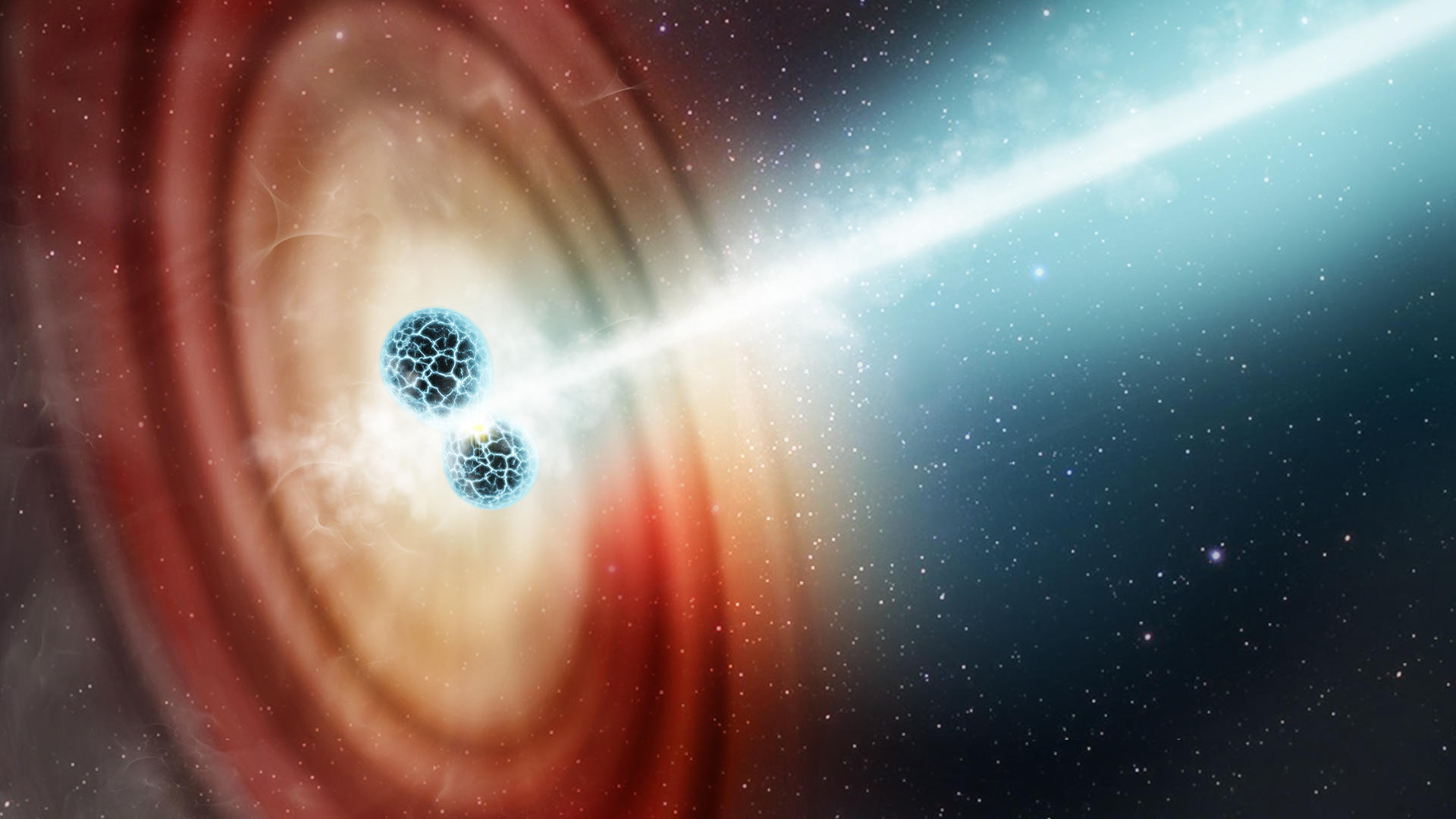
This is an artist’s impression of two neutron stars colliding. The smashup between two dense stellar remnants unleashes the energy of 1,000 standard stellar nova explosions. In the aftermath of the collision, a blowtorch jet of radiation is ejected at nearly the speed of light. The jet is directed along a narrow beam confined by powerful magnetic fields. The roaring jet plowed into and swept up material in the surrounding interstellar medium. Credit: Elizabeth Wheatley (STScI)
Over 299,000,000 meters a second — an ultra-fast jet blasting from a star crash.
Neutron stars are the surviving “trash-compacted” cores of massive stars that exploded. Despite weighing more than our Sun, they would fit inside New York City. At this unimaginable density, a single teaspoon of surface material would weigh at least 4 billion tons on Earth.
If that doesn’t make your mind spin, just imagine what happens when two of these condensed cannon balls collide head-on. They ripple the very fabric of time and space in a phenomenon called
Two neutron stars, the surviving cores of massive stars that exploded, collided sending a ripple through the fabric of time and space in a phenomenon called gravitational waves. In the aftermath, a blowtorch jet of radiation was ejected at nearly the speed of light, slamming into the material surrounding the obliterated pair. Astronomers used Hubble to measure the motion of a blob of material the jet slammed into. Credit: Hubble Space Telescope have made a unique measurement indicating that a jet was blasted across space at speeds faster than 99.97% the speed of light by a titanic collision between two neutron stars.
The explosive event, dubbed GW170817, occurred in August 2017. The blast generated energy comparable to a supernova explosion. It was the first time gravitational waves and gamma rays were detected together from a binary neutron star merger.
This was a significant turning point in the research of these extraordinary collisions. In addition to the discovery of gravitational waves, 70 observatories across the world and in space saw the aftermath of this merger across a large swath of the electromagnetic spectrum. This signaled an important development in the area of Time Domain and Multi-Messenger Astrophysics, which makes use of a number of “messengers” including gravitational waves and light to analyze the progression of the universe through time.
Just two days later, scientists quickly aimed Hubble toward the explosion’s location. The neutron stars collapsed into a Space Telescope Science Institute in Baltimore, Maryland.
By combining the different observations, they were able to pinpoint the explosion site. The Hubble measurement showed the jet was moving at an apparent velocity of seven times the speed of light. The radio observations show the jet later decelerated to an apparent speed of four times faster than the speed of light.
In reality, nothing can exceed the speed of light, so this “superluminal” motion is an illusion. Because the jet is approaching Earth at nearly the speed of light, the light it emits at a later time has a shorter distance to go. In essence, the jet is chasing its own light. In actuality, more time has passed between the jet’s emission of the light than the observer thinks. This causes the object’s velocity to be overestimated – in this case seemingly exceeding the speed of light.
“Our result indicates that the jet was moving at least at 99.97% the speed of light when it was launched,” said Wenbin Lu of the University of California, Berkeley.
The Hubble measurements, combined with the VLBI measurements, announced in 2018, greatly strengthen the long-presumed connection between neutron star mergers and short-duration gamma-ray bursts. That connection requires a fast-moving jet to emerge, which has now been measured in GW170817.
This work paves the way for more precision studies of neutron star mergers, detected by the DOI: 10.1038/s41586-022-05145-7
The


