



CIUDAD JUÁREZ, Mexico — Across the border from El Paso, Texas, a bus goes house to house, picking up children and transporting them to a place that has become an oasis in a city with a reputation for drug cartel violence.
The students are part of a youth orchestra in Juárez, called Orquesta Sinfónica Esperanza Azteca, or Aztec Hope Symphony Orchestra. With donations from local businesses and secondhand instruments, violinist Jové García runs the after-school program that teaches 250 children, ages 7 to 18, how to play an instrument or sing in a choir. His main goals are to keep the children safe and give them an opportunity to better their lives.
“The gangs, they start doing drugs, drinking and even getting killed, so I think the most important thing of this program is that we’re saving lives,” he said. “Music saves lives.”
García started the children’s music program in 2008, when feuding drug gangs earned Juárez the title of the deadliest city in the world. That year, 1,587 people were killed and the murder rate kept increasing. In 2010, Juarez police reported 3,111 homicides.
Members of organized crime displayed the bodies of their victims on the streets, as frustration grew among the city’s residents. “People lived in fear,” he said.
The inspiration to teach music to children who were living in the midst of violence came from the documentary “Tocar y Luchar” (“To Play and Strive”), García said. The film features Venezuelan music educator and activist José Antonio Abreu, who created a system of choirs and orchestras to help children in his home country.
“I wanted to be an opportunity generator,” García said.
He started out in a classroom he rented with donations, teaching 60 students how to play stringed instruments: violin, cello, viola and double bass. The Mexican education department eventually took note of the program’s success and made it part of a national chain of federally funded orchestras for children in need.
Garcia now had the funds to rent more space and he increased the number of Juarez students to 500.
Then the pandemic struck. Right before Christmas 2020, Mexico’s education secretary laid off all 700 teachers of the Esperanza Azteca orchestras and defunded the program. “For those of us with kids, it was terrible not to be able to afford presents,” said García, a father of four.
That’s when he turned to his father’s boss, air conditioning factory owner and engineer Daniel Domínguez. The engineer made space for an impromptu music classroom on the floor of his factory, Flutec, so the children could continue music lessons. He teamed up with other local entrepreneurs to continue funding the Juárez orchestra as best they could.
The students now practice 15 to 20 hours a week at a private school that gives García rental space at a discount so that he can house the instruments and teach classes.
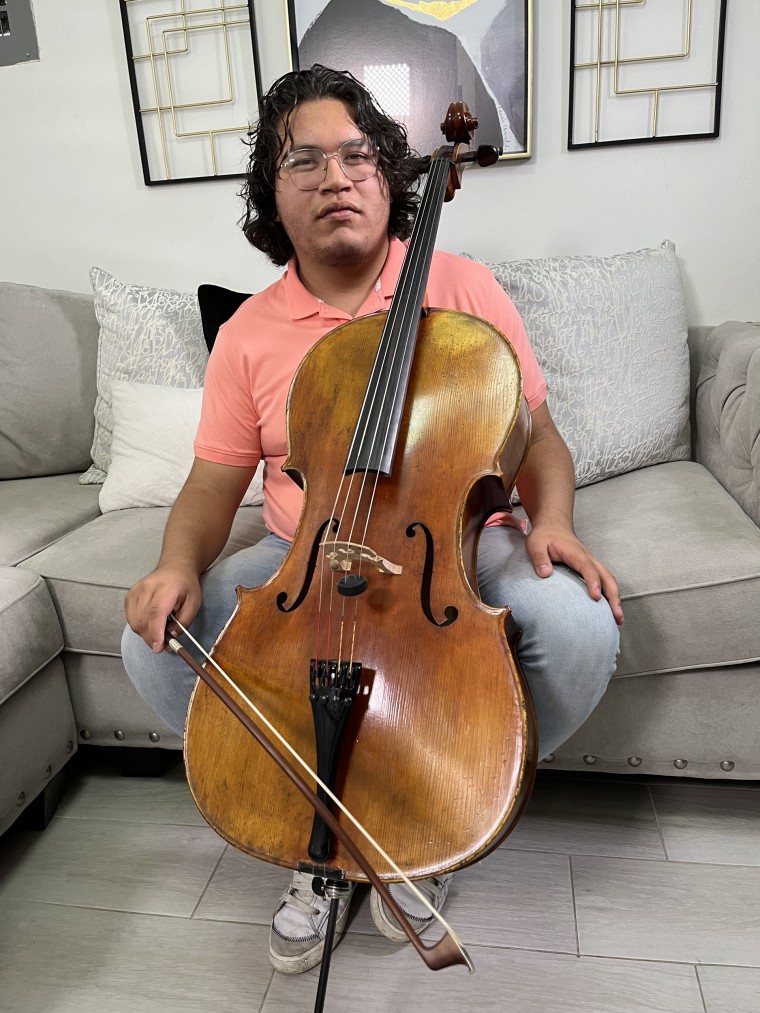
Among the project’s beneficiaries is Hasiel Mateos, 18, who’s been learning to play the cello for the last seven years. Being part of the orchestra helped the teenager cope with his father’s death from Covid.
“My father loved for me to play, and I play like he’s listening to me every time I play, so that makes me better,” he said.
His mother, Aida Vianey Espinoza, 44, said the program has helped her son learn discipline and teamwork. Mateos has been accepted to medical school and will be a freshman in August.
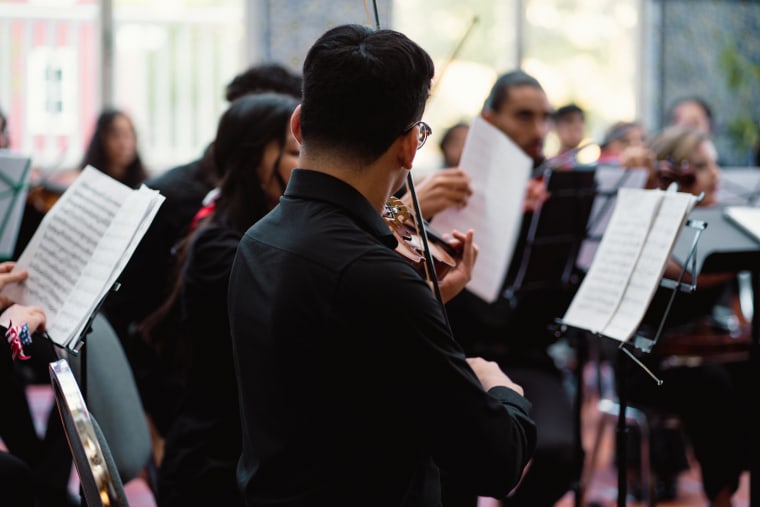
Instead of a border wall, a musical bridge
For Vielka Esparza, 15, the music program is her “safe space.” “While I am playing, I kind of forget everything and I’m just in my own world,” the violin player said.
The Esperanza Azteca program also has a choir. Renata Arvizo, 17, is a soloist. She wakes up every weekday at 4 a.m. to cross the border and attend school in El Paso, but returns in the afternoon to her hometown for voice lessons.
She considers the program a bridge between Mexicans and Americans.
“Here in the theaters, we see people that come from El Paso, from Chihuahua, from here locally, and it’s truly amazing being able to share culture, musically,” Arvizo said.
The music students occasionally get a chance to showcase their musical talents in the U.S. They have performed the last two years in Washington, D.C., for the Cinco de Mayo celebrations sponsored by the Mexican Cultural Institute.
They’ve also crossed the border into El Paso and combined their musical talents with the youth orchestra there. Garcia calls the merged orchestra “the bridge.”
“We need more bridges than walls,” he said. “Music is the universal language,” he added “It reaches across borders.”

Andrea Mitchell is chief Washington correspondent and chief foreign affairs correspondent for NBC News.

Heather’s Corner
Erika Angulo is a producer for NBC News based in Miami. Her award-winning work includes coverage of the Oklahoma tornadoes, the U.S.-Mexico drug war, the Chilean miners’ rescue and the 2010 Haiti earthquake.


