

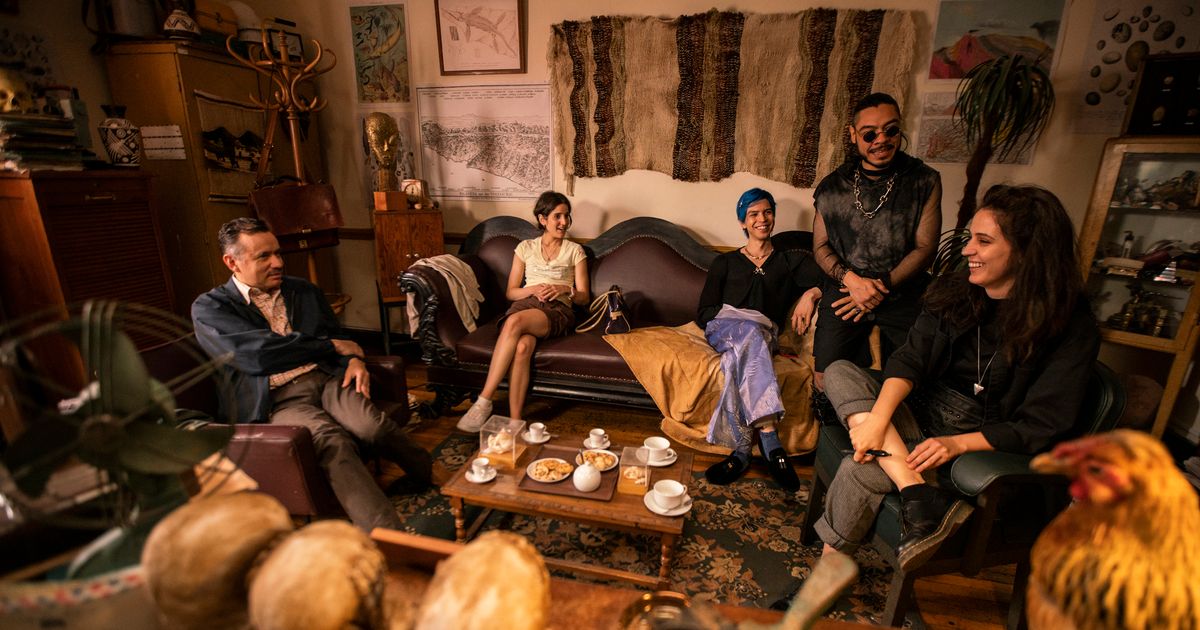

When I first heard that Los Espookys, the surreal, near-universally beloved HBO comedy about a quartet of friends peddling customized, low-fi horror experiences in an “unnamed Latin American country,” had been canceled, I didn’t think about my favorite character (Andrés) or my favorite joke (Tati’s stint with Herbialite, of course). I thought about my friends.
Espookys’s core four reflected the people I surround myself with: Renaldo (Bernardo Velasco), the gothic sweetheart; Andrés (Julio Torres), the aloof, cyan-obsessed twink; Úrsula (Cassandra Ciangherotti), the grounded glue of the operation; and of course, Tati (Ana Fabrega), whose eccentricities defy enumeration. These are people I know: queer, counterculture Latinx folks doing silly things with their silly friends. Los Espookys was the first time I saw the people I love reflected in pop culture in such an intimate way. The first time I saw people like myself simply existing on camera.
When you set aside the water spirits and American diplomats getting trapped in mirror dimensions, Espookys was incredibly human for a half-hour HBO comedy. Nothing within its uncanny landscape — not Andrés’s relationship with The Moon, Renaldo’s half-baked impression of Max Headroom, or Tati’s gig manually moving the second hand of the town clock — needed an explanation. These oddities were presented at face value, as if they were ordinary ways of life. The dialogue, simple yet hilarious in its straightforwardness, demonstrated the lived-in ease of friendships united by a shared passion. Most of it was Spanish with English subtitles, and vice versa when necessary; an intentional decision to welcome both American and Latin audiences. Espookys felt distinctly personal, a series that actively courted the audience it wanted without compromise. What other scripted show rested so comfortably in queer culture, casting guest stars like Kim Petras and Isabella Rosselini, while accurately depicting hyper-specific aspects of Latin culture, such as sensationalist Spanish-language TV shows, or the fact that every family has a brash, scheming Scorpio prima like Sonia?
It’s rare that a TV show can extend into an identity. And yet Espookys bled into my daily life, backgrounding important moments in my most formative relationships. When the first season came out, I was in college, the first time I was surrounded by queer Latinx people like myself; my friends and I called ourselves the “Espookys.” Before I came out to my family, I watched the show with my Puerto Rican father every week. Espookys helped me understand the relationship between being Latin and queer, so that I felt more comfortable bridging the two around him. Existing in the same world as Los Espookys was a blessing. It made me realize I wasn’t alone.
Many critics, including our own Matt Zoller Seitz, have compared Espookys to Scooby-Doo. That’s not too far off, both in content and vibe; the characters are so distinct, the mysteries so fascinating. And in the Latinx tradition of magical realism, Espookys’s explorations of illicit phantasmagoria never once turned scary. Even in moments that should feel frightening, like Renaldo’s haunting by an impaled pageant queen in season two, the series evokes a feeling of wonder in place of terror, encouraging the audience to embrace the possibilities within the inexplicable and unknown. And at Espookys’s most elementary level, it worked to heal the inner child of its viewers, inviting them to engage in their own harmless obsessions while celebrating their quirks.
In creating Los Espookys, Torres, Fabrega, and Fred Armisen built a world where anything could happen, and often, the most inexplicable events did. Its cancellation continues a dangerous precedent: that shows for marginalized audiences exist simply to “break ground” for a fleeting moment, and once they serve their perceived purpose, they get the chop.
We may never see another show as warm and weird as Los Espookys. Maybe it will have an everlasting fanbase, à la other two-and-done comfort comedies like Detroiters or Flight of the Conchords. Or maybe, like Party Down, another gone-to-soon sitcom, the show will have a revival push in a few years, possibly re-emerging at another network, motivated by cries of “remember Los Espookys?” and “unjustly canceled.” And maybe, if the setting is right, it will feel like old friends getting together as if no time has passed.
Los Espookys Was a Blessing