


In Taxi Driver, Travis Bickle, a war
veteran turned cabbie, drives aimlessly through New York at night, increasingly
detached from society and increasingly violent, until he finds a mission
for redemption in saving Iris, a trafficked teenager. Alone in his small
apartment, he writes in his journal, “I am God’s lonely man.”
Paul Schrader, who wrote Taxi Driver,
has been creating versions of this lonely, often violent man for half a century.
Variations of him appear in Rolling Thunder, Hardcore, Mishima,
Affliction, and in Schrader’s recent trilogy, beginning with First
Reformed and The Card Counter and now concluding with Master
Gardener. In First Reformed, Ethan Hawke plays a Dutch Reformed
Calvinist minister and former military chaplain racked with guilt over leading
his son into the false cause of the Iraq War, where he died. In The Card
Counter, Oscar Isaac plays a professional gambler, one who previously served
time for war crimes he committed as a torturer-interrogator at Abu Ghraib. In
prison, he learned card counting, which helps him win but also allows him to
focus completely on the moment instead of a past for which he can never forgive
himself.
The three films in the trilogy share no
characters or story lines. Instead, as befits the author of Transcendental Style in Film,
they form a spiritual arc of latter-day reckoning, of reflections on America’s
past determining its present. If the first two dealt with more recent American tragedies,
in Master Gardener Schrader expands his scope. Though the film takes
place sometime in the present, it’s not current events that concern Schrader
here. His plantation-garden setting connects it to America’s entire history,
the deep roots of American racism, and the possibility of redemption from this country’s
original sin, white supremacy.
Master Gardener’s
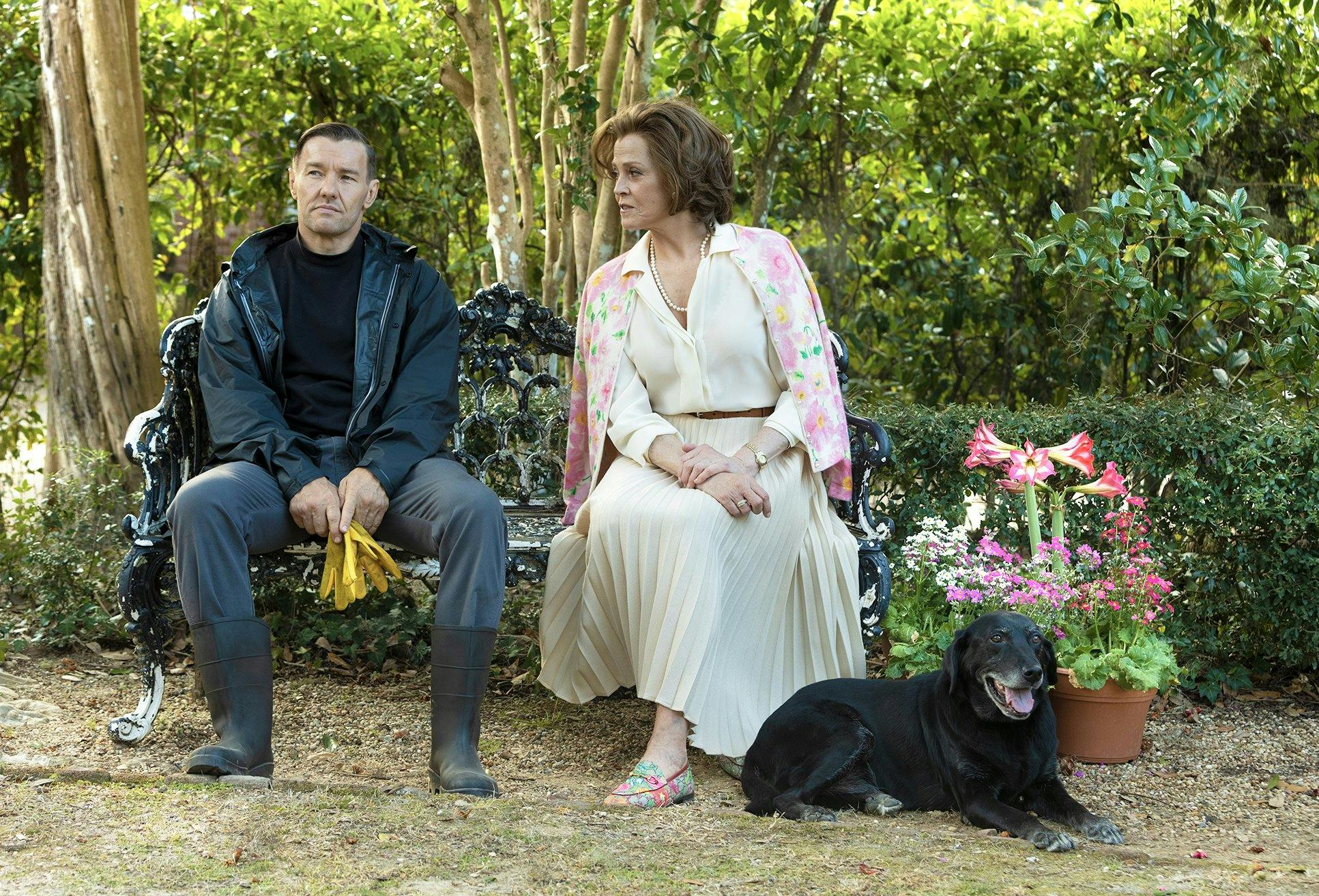
Narvel Roth (Joel Edgerton) certainly fits the God’s Lonely Man bill. He tends
the extensive gardens of a large historic Louisiana estate owned by a Southern
dowager, Norma Haverhill (Sigourney Weaver) and lives a simple life on the
grounds, writing about and studying gardening. At first glance, Narvel appears
a nurturing mentor to his diverse young apprentices. In his head-to-toe black overalls,
black rubber boots, and long sleeves, he looks like he hosts a PBS Sunday show
on competition orchids. Narvel shares his expertise on soil nutrition, even insisting
his team each breathe in deeply the scent of the loam, and the cultural histories
of gardens. He exudes a master’s serenity, a modern-day Thoreau walking
barefoot to feel the soil.
It’s at night, when he takes off his shirt
before bed, that we see why he’s covered head to toe in the garden all day. Schrader
reveals Narvel fully, a man covered in white supremacist tattoos: swastikas, SS
logos, Hitler’s name, and blazing skulls. Narvel has a fitful dream that night of
his days in a Nazi gang, in which its leader gives him the name of a man to
kill, telling him that they are the gardeners; they pull out the weeds.
Not surprisingly for a man of Schrader’s
theological background—he was raised in a strict religious household and
attended a Calvinist college—this garden contains good
and evil. Narvel lives on the estate in a federal witness protection program
after turning on his gang. The price for Narvel’s Eden is Weaver’s Norma. She
calls him “Sweet Pea,” and after drinks and settling some estate business,
orders him: “Now, take me to bed.” As he undresses before her, Schrader’s
camera lingers on Weaver as she relishes his body and hate tattoos. What
Schrader sets up to horrify us titillates her, a reveal as unsettling as seeing
the tattoos in the first place.
Norma has no children. She plans to leave the
estate and gardens to Narvel, but she also asks him to take on her biracial
niece, Maya (Quintessa Swindell), 20, as an apprentice. After Maya’s mother
died, she fell in with drug dealers in the local projects, and like Narvel, Norma’s
estate becomes a safe haven for her. After Maya has a violent run-in with her
dealers, he takes care of her, and she embraces him with more than gratitude. Narvel
pulls away, unable to reveal himself to her. When Norma learns of this, the
thought of her stud with her “mixed-blood” (as she calls Maya) niece enrages
her, and she kicks them out, expelling them from the garden.
It leads Schrader to another favorite trope,
his lonely man and a young woman saving each other. Narvel is a new kind of Travis, saving a new
kind of Iris. Narvel helps Maya out of the projects where she lives and warns
her dealers to stay away. He takes her to Narcotics Anonymous and helps her
through her withdrawal. He also lets her see him with his shirt off, revealing
his past. While they’re away, the drug dealers find the estate and vandalize
the grounds, painting swastikas all over Narvel’s old rooms. This, of course, leads Narvel to a classic Schrader denouement of redemptive violence.
Master
Gardener reprises
half a dozen major cinematic threads of Schrader’s Lonely Man oeuvre, and in
that way makes a fitting capstone to his entire career. Master Gardener features the journaling we also see in Taxi Driver,
The Card Counter, and First Reformed; the flawed protagonist
finally confronting his damaged self, as in POW William Devane’s torture in Vietnam
in Rolling Thunder or Ethan Hawke’s paralyzing guilt in First
Reformed; the search to save someone and oneself in the process, like
Travis and Iris in Taxi Driver or George C. Scott rescuing his daughter
from the Los Angeles porn world in Hardcore. Even the matrons of American
Gigolo, who use Richard Gere for sex and then casually toss him aside, are
recalled here as Norma does the same to Narvel.
It’s
part repetition, part reexamination. If Devane recovers from torture in Rolling
Thunder, Oscar Isaac was a torturer in The Card Counter. If Taxi
Driver and Hardcore are about men saving women held hostage,
Schrader’s Patty Hearst tells that story from the abducted woman’s point
of view. Master Gardener’s violent conclusion is another of these threads,
one seen in almost every one of these films. Narvel pulls out the weeds again, but
his understanding of which plants are the weeds and which are the flowers has
changed considerably.
Given his tight budget and shooting schedule,
Schrader makes the most of the spare aesthetic that has guided him since the
revelatory moment in 1969 when he saw Robert Bresson’s 1959 Pickpocket. In
that, Bresson gives us scene after scene of a thief sitting alone in his tiny apartment,
writing in his journal. (Yes, Schrader arch-fans will be happy to see that Master
Gardener has several Schrader signature shots of his man journaling.) Small
as it is, Master Gardener demands to be seen in a theater. It’s often the small films that need a
wide screen most, not the bloated franchise movies. When Schrader holds on an
actor’s nuanced expression, especially Weaver’s here, it needs to be writ large. Schrader’s
use of floral color in the garden and composition gets too easily lost on a
television screen. It’s the difference between a director holding on an image
like a painting to be taken in and you on your couch wondering if you
accidentally hit the pause button.
It’s
Weaver’s Norma Haverhill that stays with you. Norma embodies pastoral
plantation grace and the ugly history beneath it. A wealthy woman who can afford
a perfect outfit for any occasion, Weaver gives Norma a thin veneer of Southern
charm that easily dissipates when her raw emotions come out. There’s her anger
at Maya for reminding Norma how she treated her mother, her lusting over
Narvel’s hate-speech meme chest, her wine-driven fury at dinner (for which she buys Maya a formal dress to wear) when she tosses Maya and Narvel out, calling their
relationship “obscene.” Weaver reveals that despite the catalog-photo perfection
of her surroundings and bearing, there’s no real degree of separation between Narvel’s
old Nazi gang and a Norma Haverhill.
Still,
there’s a jarring element in the film’s premise: its reliance on a woman of
color to forgive a Nazi and take him to bed. Even in this allegorical story, it’s
a hard sell. In their bedroom scene, Maya has Narvel take his clothes off and tells
him his tattoos will be removed. Standing over him while he kneels naked before
her—a supremacist turned submissive—she takes over Norma’s domme role in his life. It’s a purely Schraderian cinematic moment of kink. Unfortunately,
today white supremacists do not seek forgiveness, they seek the White House. In
bolder and bolder displays, they have returned to openly racist Jim Crow–era rhetoric,
masked marches, and violence. Schrader creates empathy for Narvel and the
belief that he can change, but Schrader’s less interested in how white supremacy
operates than in showing its existence and quickly removing it.
Part
of the appeal of First Reformed and The Card Counter lies in
their engagement with fairly recent historical events, in that finally an
American filmmaker is reckoning with these moments of national moral collapse. Master
Gardener takes a more distanced approach. It’s not directly about Trump or
Charlottesville or January 6, and lacks the emotional power of the trilogy’s two
earlier films.
The
dark nature of this trilogy won’t surprise Schrader’s audience. What may is his
late-in-life optimism. His movies have stayed dark, yes, but in his old age,
they have more hope. While driving home at night, Narvel and Maya witness an
incredible midnight bloom, a burst of life and renewal in the darkness. When Master
Gardener ends, it does so on the most life-affirming note of Schrader’s
career. As he put it while accepting the Venice Film Festival’s Lifetime
Achievement Award last year, “I used to be an artist who never wanted to leave
this world without saying fuck you, and now I’m an artist who never wants to
leave this world without saying I love you.”
Latest From Critical Mass