

MIT Warns: Astronomers Risk Misinterpreting Planetary Signals in Webb Space Telescope Data

MIT Warns: Astronomers Risk Misinterpreting Planetary Signals in Webb Space Telescope Data

Astronomers Risk Misinterpreting Planetary Signals in James Webb Space Telescope Data

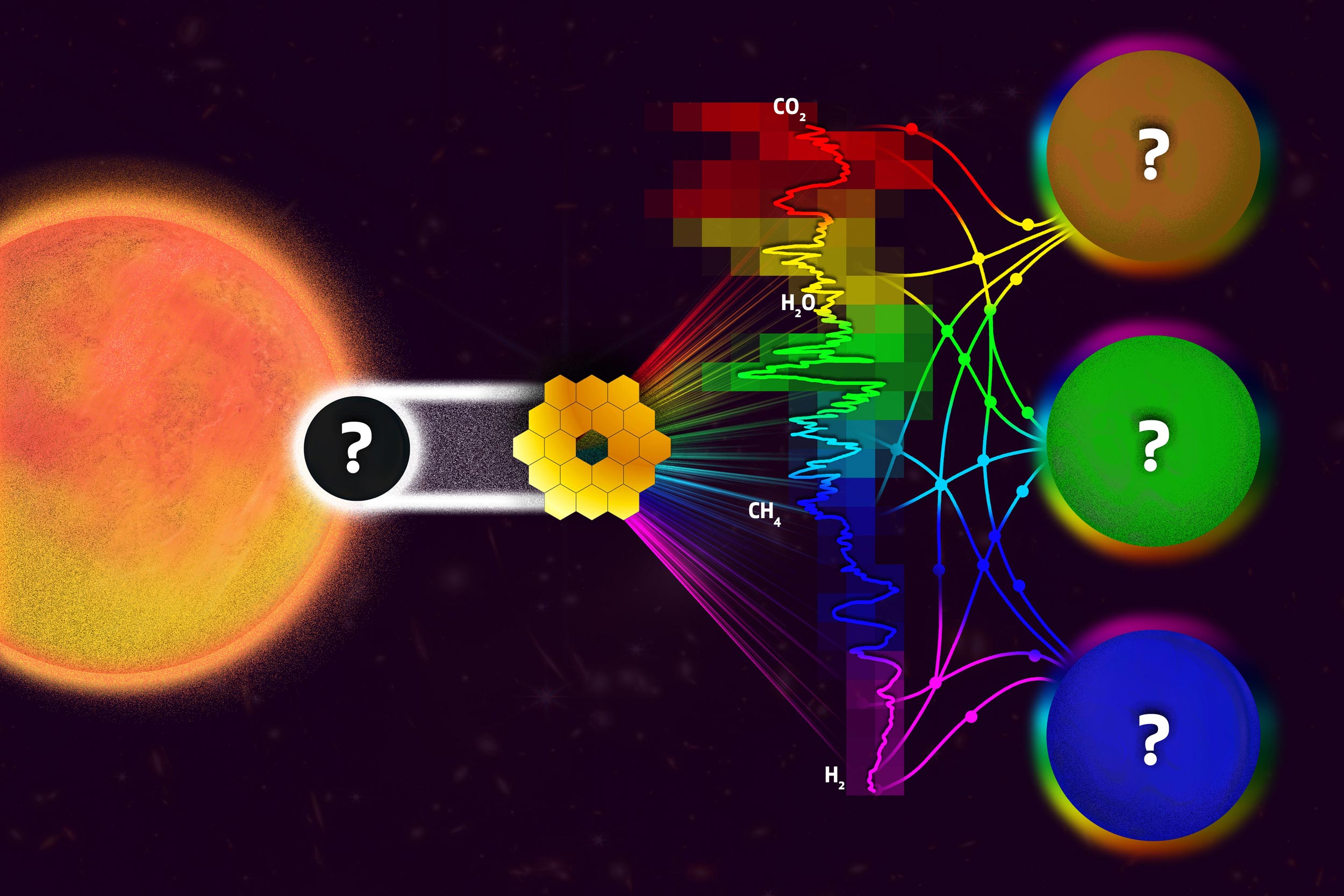
An MIT study finds that astronomers risk misinterpreting planetary signals in James Webb Space Telescope data if models to interpret the data don’t improve. In this conceptual image, the James Webb telescope captures light from around a newly-discovered planet (on left). However, when scientists analyze this data, limitations in opacity models could produce planetary predictions that are off by an order of magnitude (represented by 3 possible planets on the right). Credit: Jose-Luis Olivares, MIT. James Webb icon courtesy of NASA

Refining current opacity models will be key to extracting details of 5,000 exoplanets that have been discovered in the atmospheres surrounding some of these nearby worlds. Clues to how a planet formed and whether it harbors signs of life can be deciphered from the properties of their atmospheres.

“There is a scientifically significant difference between a compound like water being present at 5 percent versus 25 percent, which current models cannot differentiate.” — Julien de Wit

However, a new

Artist Conception James Webb Space Telescope Illustration

James Webb Space Telescope artist’s conception. Credit: NASA-GSFC, Adriana M. Gutierrez (CI Lab)

Leveling up

Opacity is a measure of how easily photons pass through a material. Depending on whether and how they interact with certain molecules within a material, photons of certain wavelengths can pass straight through a material, be absorbed, or be reflected back out. This interaction also depends on a material’s temperature and pressure.

An opacity model works on the basis of various assumptions of how light interacts with matter. Astronomers use opacity models to derive certain properties of a material, given the spectrum of light that the material emits. In the context of exoplanets, an opacity model can decode the type and abundance of chemicals in a planet’s atmosphere, based on the light from the planet that a telescope captures.

De Wit likens the current state-of-the-art opacity model to a classical language-translation tool. He says it has done a decent job of decoding spectral data taken by instruments such as those on the

James Webb Space Telescope Cold Side

This illustration shows the cold side of the Webb telescope, where the mirrors and instruments are positioned. Credit: Northrop Grumman

Light, perturbed

He and his colleagues make this point in their study, in which they put the most commonly used opacity model to the test. The scientists looked to see what atmospheric properties the model would derive if it were tweaked to assume certain limitations in our understanding of how light and matter interact. The researchers created eight such “perturbed” models. They then fed each model, including the real version, “synthetic spectra” — patterns of light that were simulated by the group and similar to the precision that the JWST would see.

They found that, based on the same light spectra, each perturbed model produced wide-ranging predictions for the properties of a planet’s atmosphere. Based on their analysis, the team concludes that, if existing opacity models are applied to light spectra taken by the Webb telescope, they will hit an “DOI: 10.1038/s41550-022-01773-1

Read More

Share:

Leave a Reply

Your email address will not be published. Required fields are marked *