


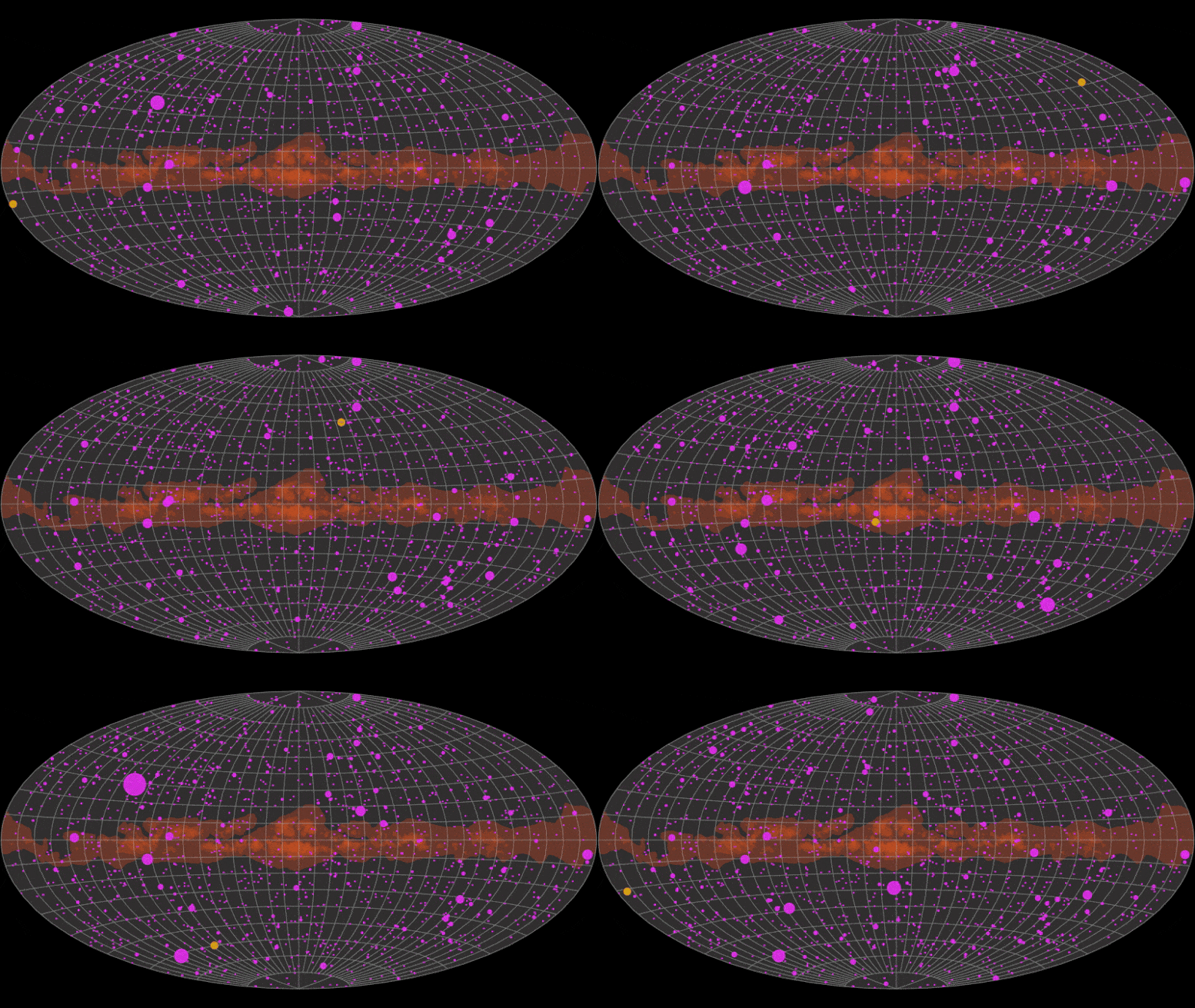
This animation shows a subset of the Large Area Telescope gamma-ray records now available for more than 1,500 objects in a new, continually updated repository. Over 90% of these sources are a type of galaxy called a blazar, powered by the activity of a supermassive black hole. Credit: NASA’s Marshall Space Flight Center/Daniel Kocevski
Cosmic fireworks, invisible to our eyes, fill the night sky. We can get a glimpse of this elusive light show thanks to the Large Area Telescope (LAT) aboard continually updated interactive library. A paper about the repository was published on March 15, 2023, in The NASA’s Marshall Space Flight Center in Huntsville, Alabama. “We were getting requests to process one object at a time. Now the scientific community has access to all the analyzed data for the whole catalog.”
Watch a cosmic gamma-ray fireworks show in this animation using just a year of data from the Large Area Telescope (LAT) aboard NASA’s Fermi Gamma-ray Space Telescope. Each object’s magenta circle grows as it brightens and shrinks as it dims. The yellow circle represents the Sun following its apparent annual path across the sky. The animation shows a subset of the LAT gamma-ray records now available for more than 1,500 objects in a new, continually updated repository. Over 90% of these sources are a type of galaxy called a blazar, powered by the activity of a supermassive blazarscentral regions of galaxies hosting active supermassive black holes that produce powerful particle jets pointed almost directly at Earth. Ground-based observatories, like the National Science Foundation’s IceCube Neutrino Observatory in Antarctica, can sometimes detect high-energy particles produced in these jets. Blazars are important sources for multimessenger astronomywhere scientists use combinations of light, particles, and space-time ripples to study the cosmos.
“In 2018, astronomers announced a candidate joint detection of gamma rays and a high-energy particle called a neutrino from a blazar for the first time, thanks to Fermi LAT and IceCube,” said co-author Michela Negro, an astrophysicist at the University of MarylandBaltimore County, and NASA’s Goddard Space Flight Center in Greenbelt, Maryland. “Having the historical light curve database could lead to new multimessenger insights into past events.”
In the animation, each frame represents three days of observations. Each object’s magenta circle grows as it brightens and shrinks as it dims. Some objects fluctuate throughout the entire year. The reddish-orange band running across the middle of the sky is the central plane of our DOI: 10.3847/1538-4365/acbb6a
The Fermi Gamma-ray Space Telescope is an astrophysics and particle physics partnership managed by Goddard. Fermi was developed in collaboration with the U.S. Department of Energy, with important contributions from academic institutions and partners in France, Germany, Italy, Japan, Sweden, and the United States.


