



While the most famous planetary spot in the solar system would have to be Jupiter’s Great Red Spot, an epic storm 10,000 miles wide that has been raging for hundreds of years, other planets are known to host spots of their own as well. That includes Neptune, which had a large dark spot that was first imaged by Voyager 2 when it passed by in the 1980s.
Neptune’s spot was named the Great Dark Spot, but when the Hubble Space Telescope tried to image the spot in 1994, it had disappeared. Now, a Neptune spot has been imaged from the ground for the first time, using the European Southern Observatory’s Very Large Telescope (VLT).

“Since the first discovery of a dark spot, I’ve always wondered what these short-lived and elusive dark features are,” said lead researcher Patrick Irwin of the University of Oxford in a statement.
Hubble returned to observe Neptune and observed another spot in the northern hemisphere in 2018, providing the chance for astronomers to study a spot while it was present. They used an instrument on the VLT called MUSE, or the Multi Unit Spectroscopic Explorer, to get spectrographic data which shows a 3D view of the spot by looking at different levels in the atmosphere. The research suggests that the spot is caused by darker air particles, which collect beneath the hazy layer in the planet’s atmosphere.
“I’m absolutely thrilled to have been able to not only make the first detection of a dark spot from the ground but also record for the very first time a reflection spectrum of such a feature,” said Irwin.
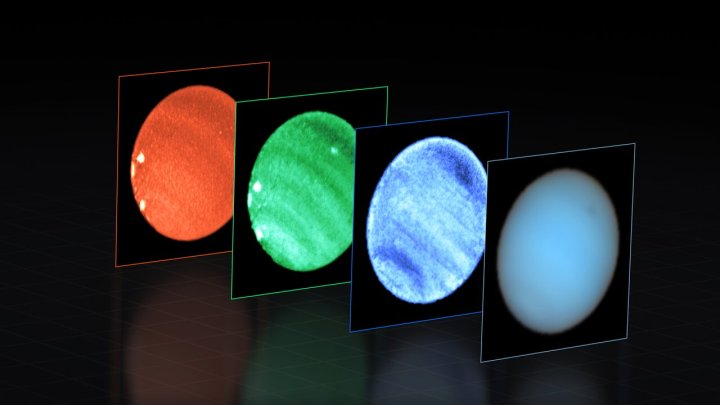
The researchers also found an unexpected bright spot next to the dark spot, thought to be an unusual type of cloud. The research shows how astronomers can learn more about the atmospheres of distant solar system planets from the ground.
“This is an astounding increase in humanity’s ability to observe the cosmos. At first, we could only detect these spots by sending a spacecraft there, like Voyager. Then we gained the ability to make them out remotely with Hubble. Finally, technology has advanced to enable this from the ground,” said co-author Michael Wong.
The research is published in the journal Nature Astronomy.
Editors’ Recommendations
-
James Webb spots ancient dust that could be from the earliest supernovas -
One galaxy, two views: see a comparison of images from Hubble and Webb -
James Webb investigates mystery of where Earth’s water comes from -
JUICE mission to Jupiter sends back first images of Earth from space -
Scientists observe the aftermath of a spacecraft crashing into asteroid

Georgina is the Digital Trends space writer, covering human space exploration, planetary science, and cosmology. She…
James Webb spots exoplanet with gritty clouds of sand floating in its atmosphere

One of the most exciting things about the James Webb Space Telescope is that not only can it detect exoplanets, but it can even peer into their atmospheres to see what they are composed of. Understanding exoplanet atmospheres will help us to find potentially habitable worlds, but it will also turn up some fascinating oddities — like a recent finding of an exoplanet with an atmosphere full of gritty, sand clouds.
Exoplanet VHS 1256 b, around 40 light-years away, has a complex and dynamic atmosphere that shows considerable changes over a 22-hour day. Not only does the atmosphere show evidence of commonly observed chemicals like water, methane, and carbon monoxide, but it also appears to be dotted with clouds made up of silicate grains.
Astronomers share early images from James Webb’s galaxy survey

One of the major aims of the James Webb Space Telescope is to observe some of the earliest galaxies in the universe, and to do that it needs to be able to see extremely distant objects. But looking at a particular very old galaxy in detail is only half of the problem. To truly understand the earliest stages of the universe, astronomers also need to see how these very old galaxies are distributed so they can understand the large-scale structure of the universe.
That’s the aim of the COSMOS-Web program, which is using James Webb to survey a wide area of the sky and look for these rare, ancient galaxies. It aims to study up to 1 million galaxies during over 255 hours of observing time, using both Webb’s near-infrared camera (NIRCam) and its mid-infrared instrument (MIRI) camera. While there is still plenty of observing left to do, the researchers in the COSMOS-Web program recently shared some of their first results.
The ghostly remnants of a dead star captured in stunning image

When a massive star runs out of fuel and comes to the end of its life, it can explode in an enormous and epic event called a supernova, which can be as bright as an entire galaxy. These explosions can obliterate anything around them, but they aren’t simply destructive — they can also create stunning structures called supernova remnants. These remnants are formed as shock waves from the explosion travel through nearby clouds of gas, sculpting them into beautiful shapes.
One such ghostly remnant has been captured by a ground-based instrument called OmegaCAM on the European Southern Observatory’s VLT Survey Telescope. The Vela supernova remnant is located 800 light-years away and was created by the death of a star around 11,000 years ago.