

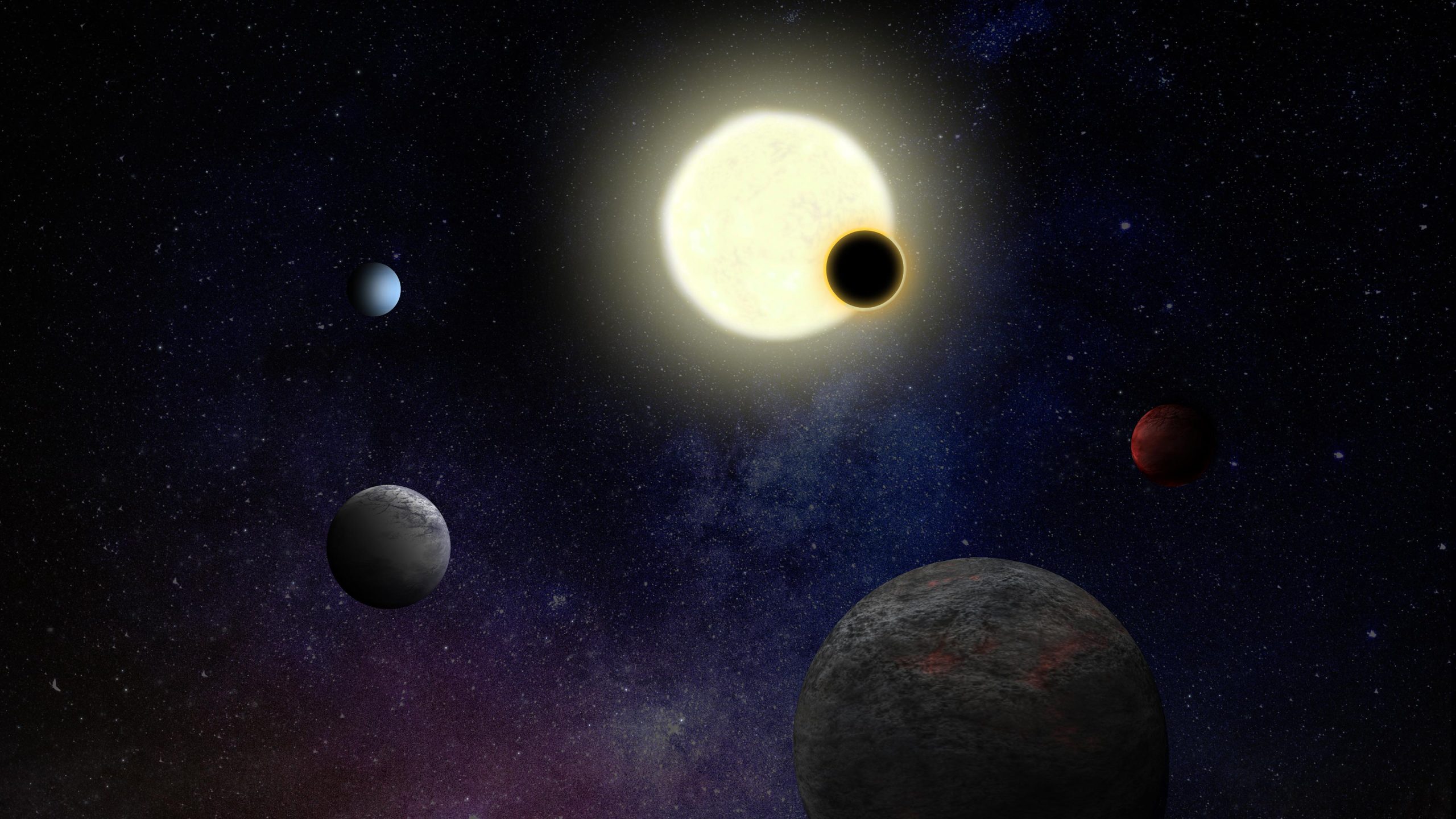
Artist impression of an exoplanet system. Credit: ESA
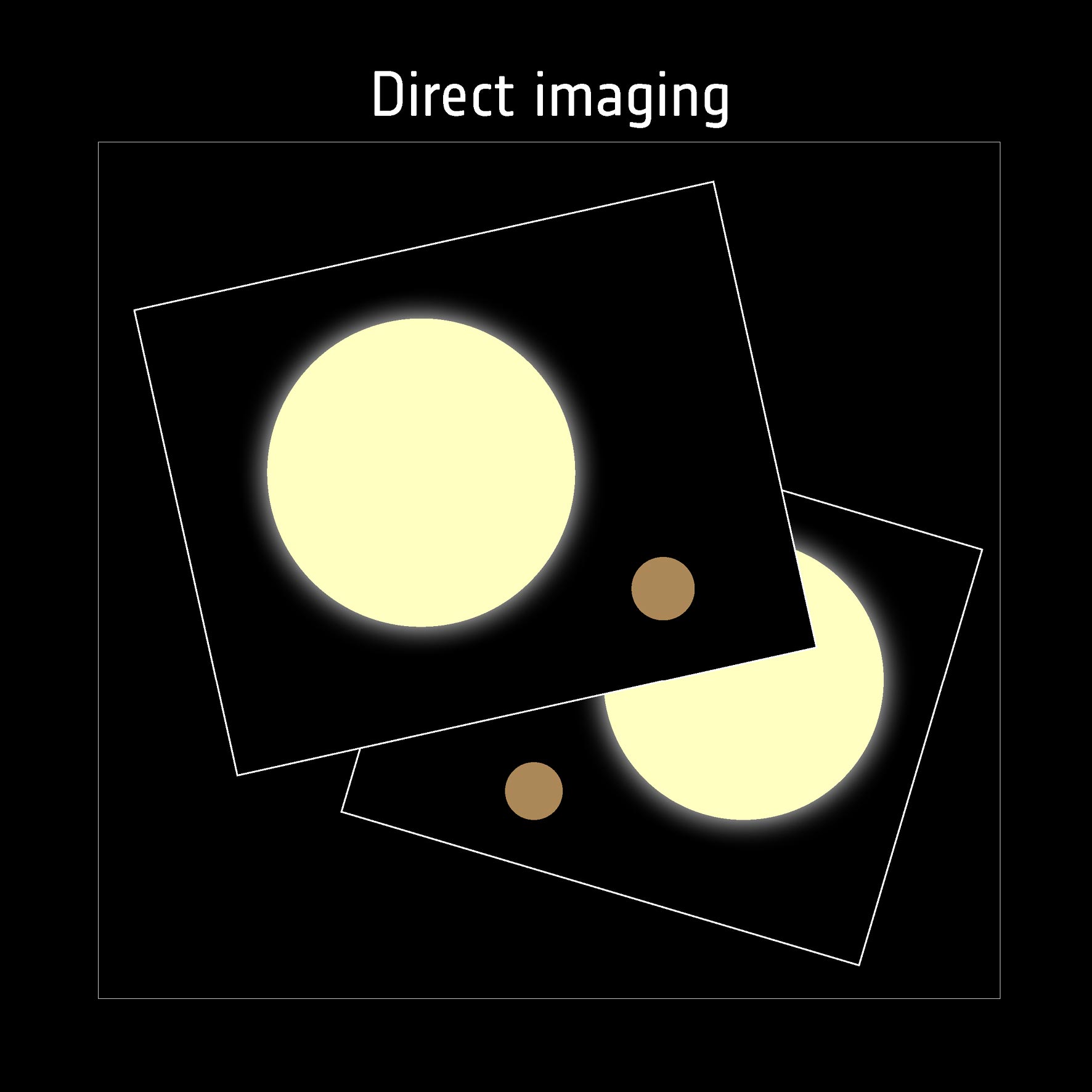
Imagine a gaseous ESA) exoplanet missions. In this endeavor, thousands of exoplanets will be subject to a study of mass, size, density, composition, and age. Below you can find explanations of the various characterization techniques.
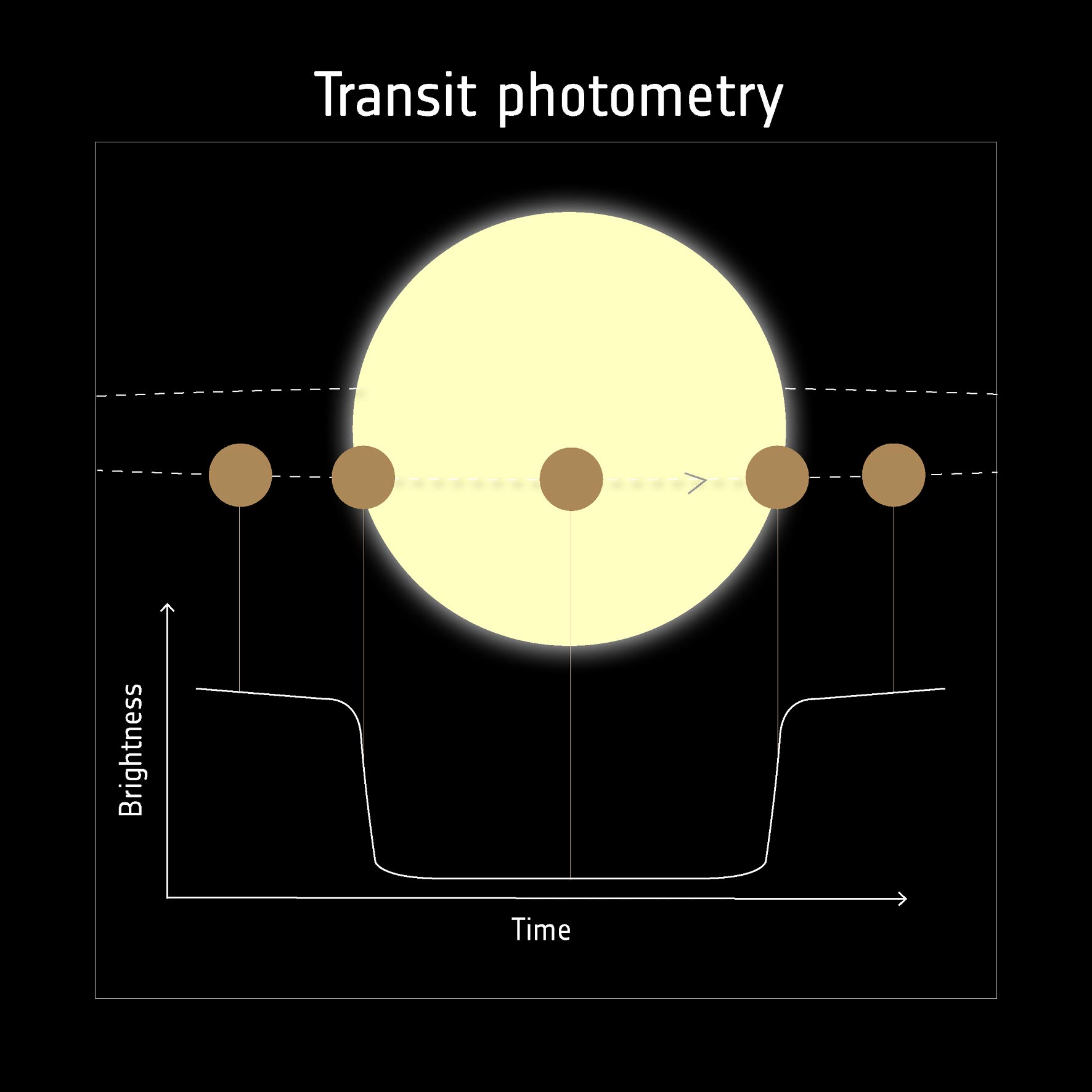
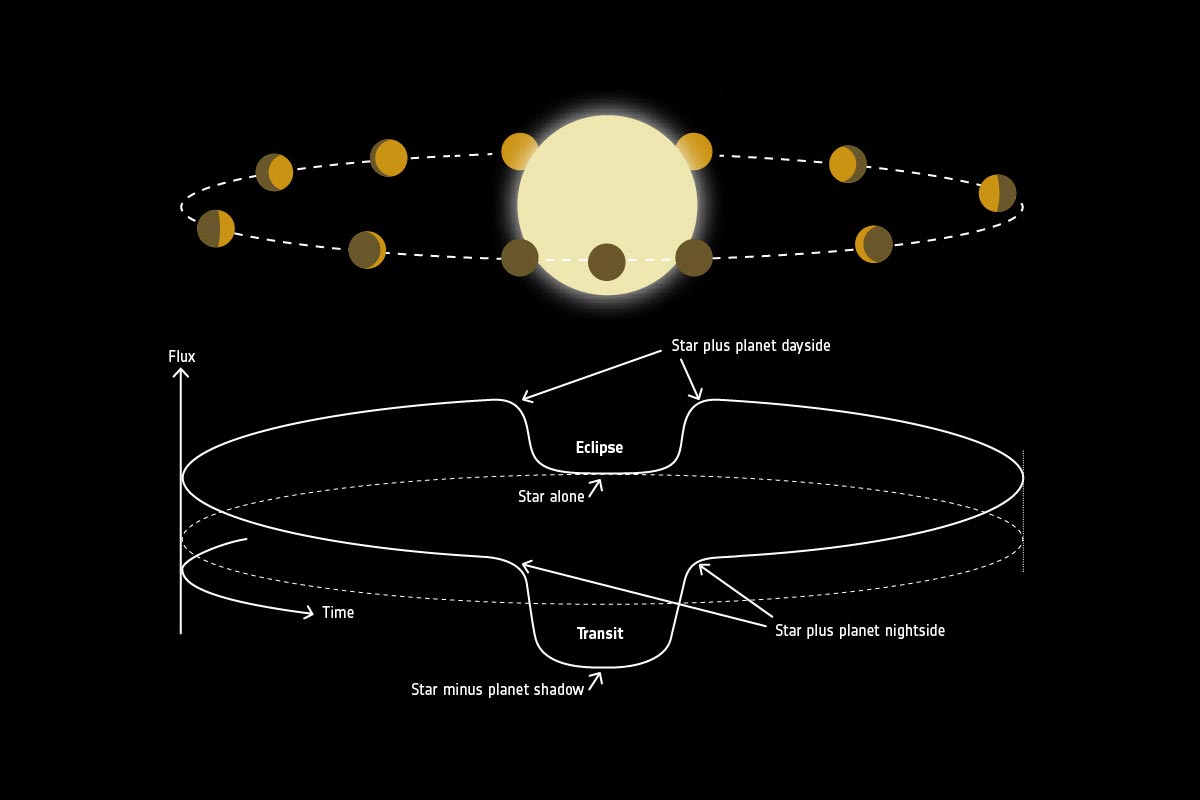
Transiting exoplanets are detected as they pass in front of – transit – their host star, causing a dip in the starlight as seen from the observer’s viewpoint. The transit repeats, with the time interval depending on the time it takes the exoplanet to orbit its star. For example, an observer of our own Solar System would have to wait a year to see a repeat of Earth transiting the Sun. Credit: ESA
Size – transit method
The transit method provides a way to learn about exoplanets. When a planet passes in front of their star (from the point of view of the observer), it causes some of the starlight to be blocked. The observer temporarily receives less light from the star. ESA’s mission Cheops will look at planets known to transit and decipher their size. Plato will look for new, unknown exoplanets using the transit method. The bigger the planet, the deeper the dip in star brightness it causes. Cheops focuses on planets with sizes between that of Earth and
Exoplanets can be detected by measuring the ‘wobble’ in its star’s motion caused by the gravitational pull of a planet as the planet and star orbit around a common centre of mass. When viewed from afar, the star appears to move towards and away from the observer. This motion makes the light from the star appear slightly bluer when it is moving towards the observer, and slightly redder when moving away. This shift in frequency is known as the Doppler effect, the same effect as the change in pitch of an ambulance siren as it rushes past you. Most early exoplanet discoveries were made using this so-called radial velocity method.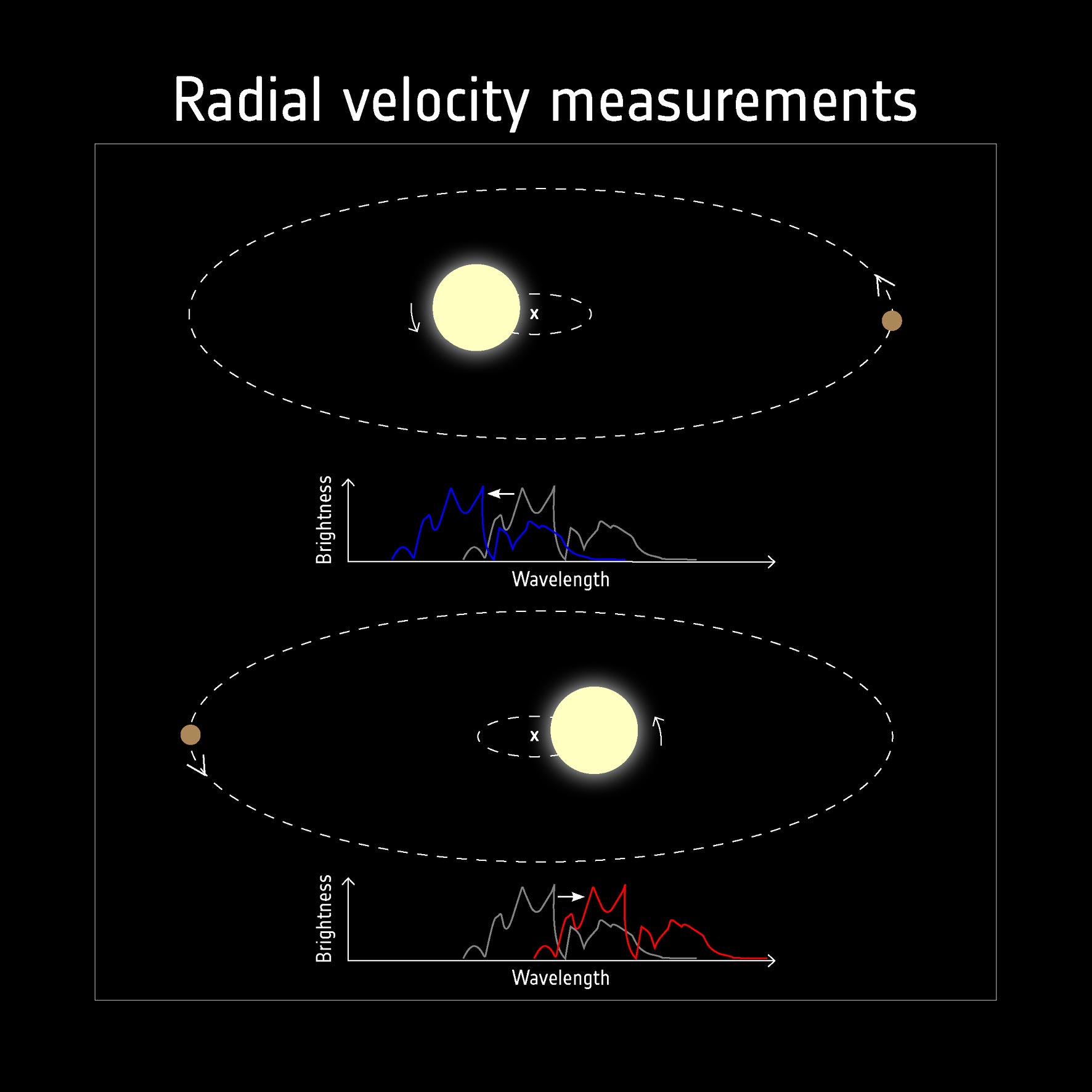
Credit: ESA
Mass – radial velocity and transit time variations
The mass is a fundamental characteristic of an exoplanet. Scientists can learn a lot about how planets form around their stars by comparing how massive different exoplanets are. Two methods can provide us with information on the mass of exoplanets. One is the radial velocity method, used by several ground-based observatories. When a star has a planet, the system moves around a common point, called the mass center. During this orbit, the stars’ light appears bluer when it moves towards the observer and redder when it moves away. This shift in frequency is known as the Doppler effect, the same effect as the change in pitch of an ambulance siren as it rushes past you. By measuring the shift in light coming from the star, it is possible to determine the velocity – the speed and direction – by which the star moves around the center of mass. The velocity is directly correlated with the mass of the planet.
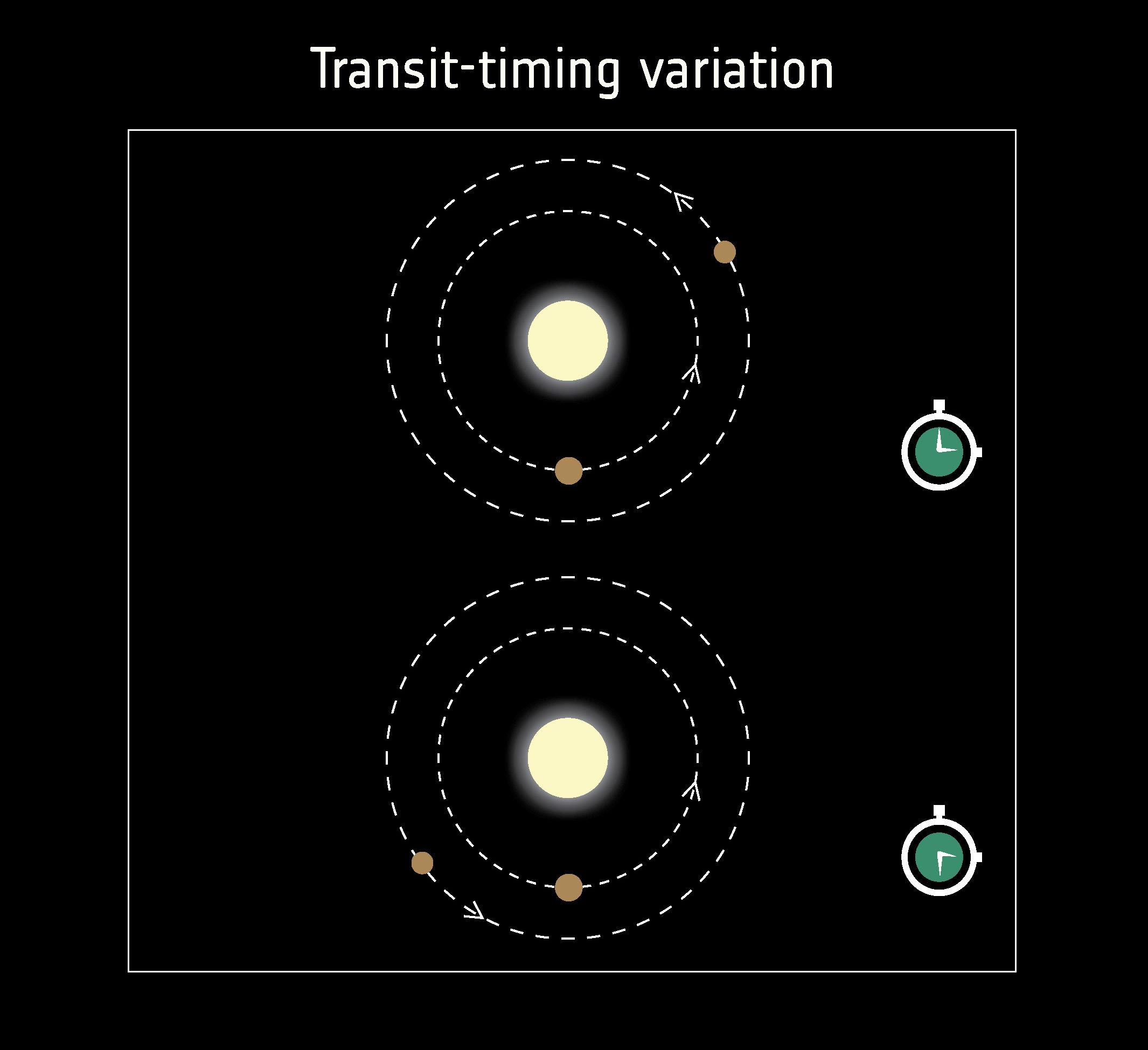
A variation on the transit technique to detect exoplanets – known as transit timing variation (TTV) – can also be used to find additional planets in a system. By measuring tiny variations in the timing of the transit of a known planet, astronomers can reveal the presence of potential other planets orbiting the same parent star. Credit: ESA, CC BY-SA 3.0 IGO
Another method that provides us with information on the mass of exoplanets is that of Transit Time Variations or TTV for short. This method works like the transit method for a planetary system with multiple planets. Normally the time between transits of the same planet is not expected to vary. When a planet is seen crossing the face of its star earlier or later than expected, the system likely has another planet gravitationally tugging or pushing on its neighbor. This method has already led to the discovery of more than 40 exoplanets. What is interesting, is that the time difference between the transits also reveals information on the masses of the planets. This technique is used by ESA’s missions Cheops and Plato.
Density – combine two methods
Once both the mass and size are known, the density of the exoplanet can be determined. This is essential information as it can reveal its nature: is the exoplanet rocky like Earth and
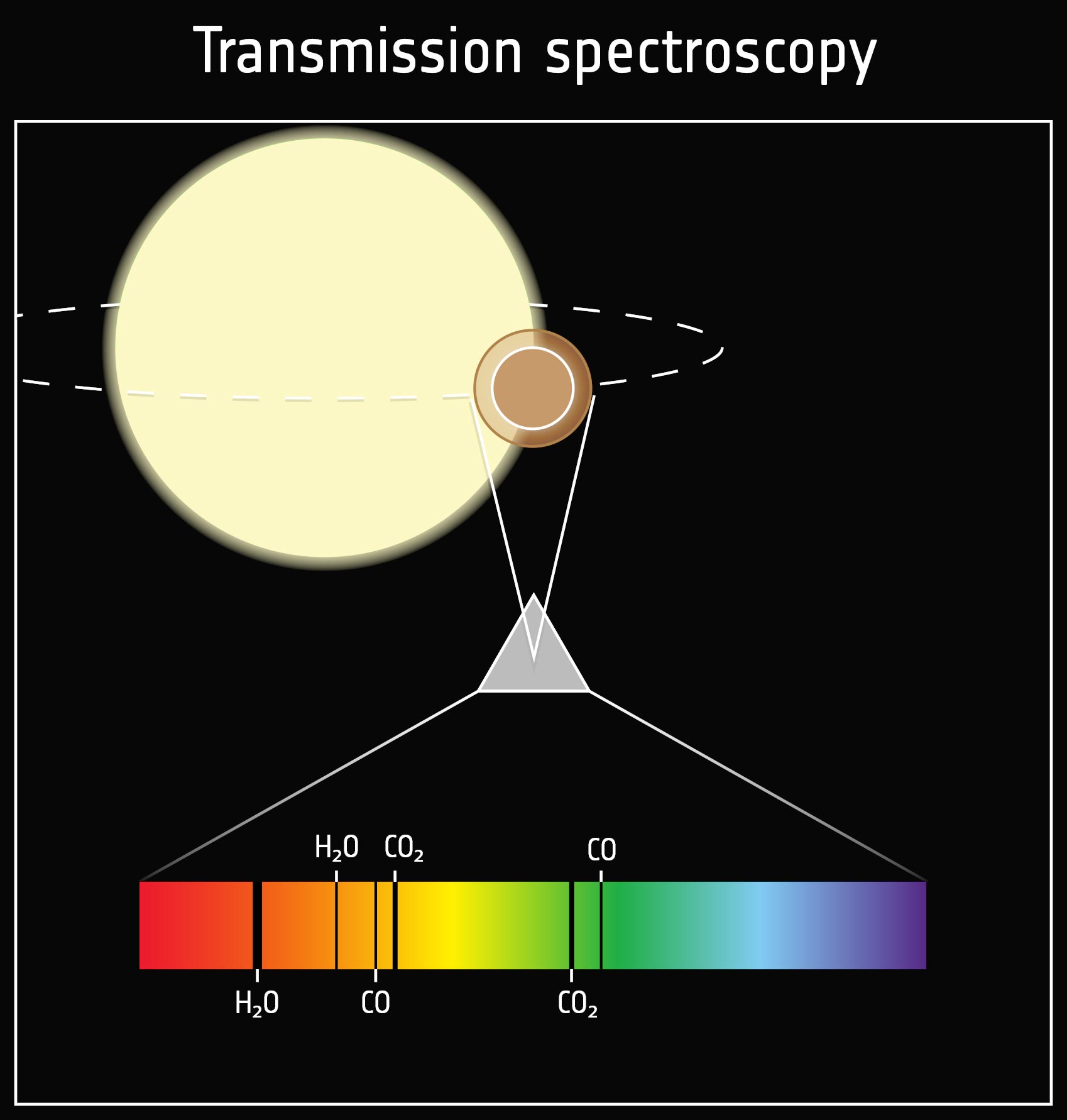
Spectroscopy is the technique of splitting received starlight into its different colors using a prism. Exoplanets orbit their stars, when they transit – pass by from our point of view – some of the starlight passes through the planet’s atmosphere. Particles in the atmosphere like water vapor, carbon dioxide, methane and others absorb some of that light. This absorption happens at specific wavelengths of light. By studying at which wavelengths the starlight is absorbed, we can determine what kind of particles are present in the atmosphere. The NASA/ESA/CSA James Webb Space Telescope uses this technique to characterize exoplanets and ESA’s Ariel mission will study the atmospheres of as many as 1000 exoplanets this way. Both missions focus on infrared light because the signatures of molecules are very prominent in those colors. Credit: ESA, CC BY-SA 3.0 IGO