

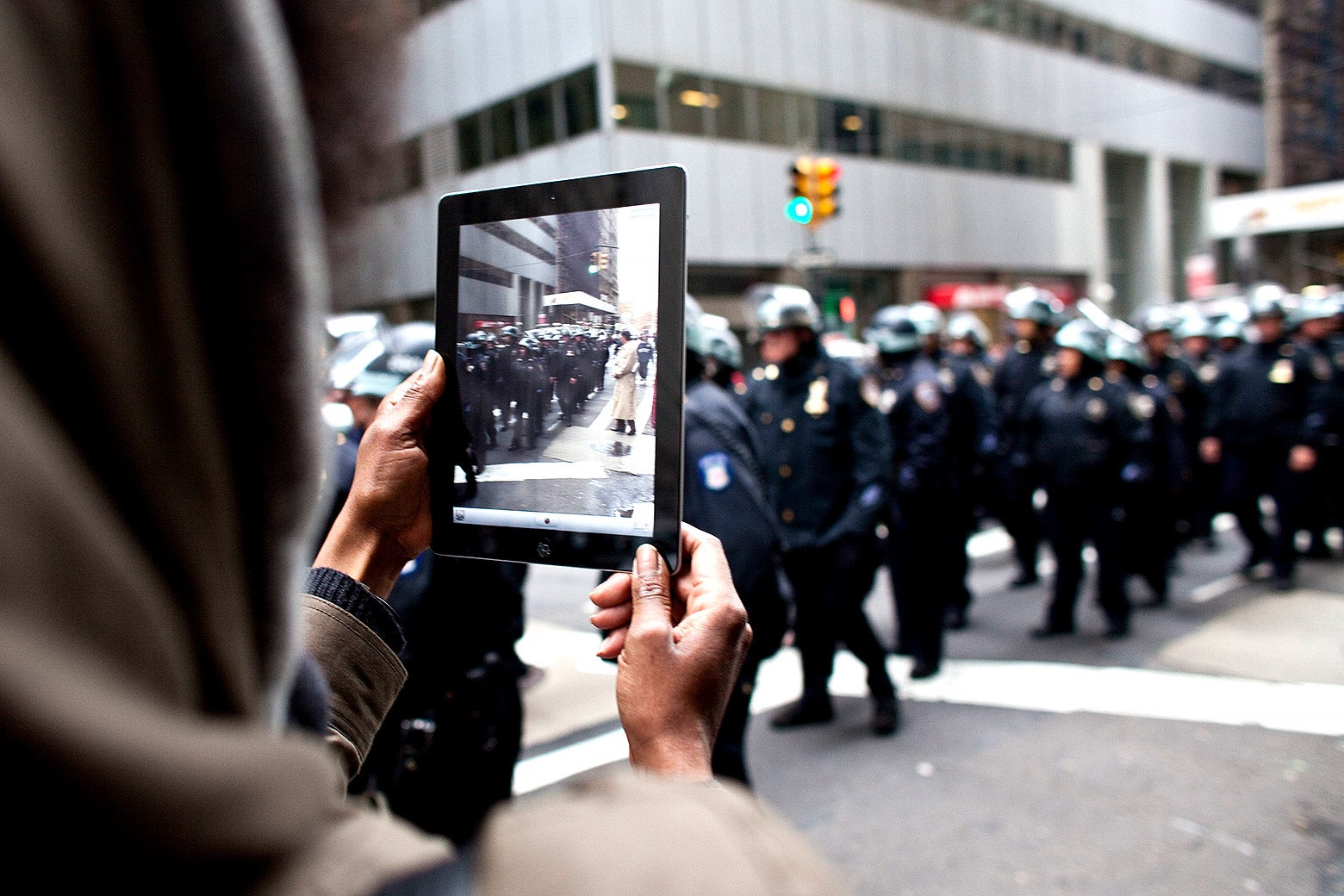

Few seem to have noticed that a dangerous legislative campaign is underway. Its aim: to shield police brutality by shutting down our cameras. On July 1, an Indiana law went into effect making it a crime to come within 25 feet of an on-duty police officer if ordered to stay back. Legislators in Florida, Louisianaand New York have produced similar laws. Other states have promised to follow suit. Under these laws, if you come close enough to film a police officer beating someone up, there’s a good chance you’ll spend two months in jail and end up with a criminal record.
In 2023 alone, the police have killed more than 500 people in the United States. Among them was Jarrell Garriswho died last week in New Rochelle, New York, after police shot him during an arrest for allegedly stealing a banana and some grapes. Garris was unarmed, and tackled by three officers, handcuffed, and shot. The police claim he was reaching for an officer’s gun. They’ve released bodycam footage that mysteriously stops just before the shooting. They want to make sure you don’t see exactly what happened. So do the new laws.
The Indiana, Florida, and Louisiana laws are only the most recent offensives in an ongoing campaign to shield police violence. As the Black Lives Matter protests caught fire in 2020, right-wing organizations jumped into action. They had three goals: quell the protests; silence critics of the police; and keep scenes like George Floyd’s murder out of the public eye, freeing up officers like convicted murderer Derek Chauvin to use traditional techniques to break suspects.
These efforts have been a resounding success. In the wake of the protests, 42 states have enacted laws creating extra penalties for protesters, with new crimes such as “aggravated riot” and “mob intimidation.” Many states have passed hate-speech laws that protect the police from verbal or symbolic abuse, such as stomping on a “Back the Blue” sign while “smirking in an intimidating manner” (the crime for which a woman in Utah was prosecuted). Although some of these laws have been vetoed or deemed unconstitutional, their promoters have only grown more brazen. The Indiana, Louisiana, and Florida laws are the result.
These laws take their cue not only from the anti-protest and police protection laws but from a 2022 Arizona law making it a crime to film the police from 8 feet or closer. That law’s sponsor, then–state Rep. John Kavanagh (a former police officer), was frank about his intentions. “There are groups hostile to the police that follow them around to videotape police incidents,” he declared. The new law would put a stop to this nuisance.
After the bill passed, the ACLU and 10 media organizations sued, arguing that the law was a patent violation of the First Amendment. Federal District Court Judge John Tuchi agreed, issuing a preliminary injunction. We have a clearly established constitutional right to record the police, he explained. Allowing the law to stand for even a moment “constitutes irreparable injury.”
The law may not stand. But Kavanagh has vowed that if it is ruled unconstitutional, he will simply redraft it. “If the judge says, you know, ‘This is bad because of X,’ next year, though, the bill will come in ‘Bill minus X.’ ” In short, he will massage it to make it appear constitutional.
This is precisely what Indiana, Florida, and Louisiana have tried to do. Anticipating constitutional objections, the new laws don’t mention video. “Any suggestion that this … denies somebody the opportunity to film is just not accurate,” protests the Louisiana law’s sponsor, state Rep. Mike Johnsonwho wrote the bill on behalf of the Fraternal Order of Police. (The Louisiana Fraternal Order named Johnson legislator of the year in 2022.) The new law, he insists, merely creates “a bodily separation” that prevents “anyone, friend or foe,” from “walking up to” officers and interfering.
Such claims should fool no one. “Cops have long tried claiming that [filming them] obstructs their ability to do their job,” observes First Amendment lawyer Ari Cohn. “Now that this argument failed, they are … transparently trying to create a safe space from observation.” The new laws are nothing but “a targeted assault on First Amendment activity.”
The new laws don’t in fact criminalize interference (already illegal in all 50 states). They criminalize only the proximity necessary for filming. They give police the right to seize cameras in the no-approach zone. They create a visual and auditory buffer likely to produce reasonable doubt in the courtroom. Is the officer’s knee on the suspect’s shoulder, or on his windpipe? Is the suspect fighting, or flailing? From 25 feet, with officers blocking visibility, phone cameras can’t capture crucial details. From 25 feet, they can’t capture choking sounds or someone crying “I can’t breathe.”
By now, we shouldn’t be surprised that the footage released by New Rochelle police contained critical gaps. Videos give the lie to official reports. The fatal shooting of Nahel Merzouk in France on June 27 offers an object lesson. The police initially claimed they shot Merzouk because he was driving his car directly at them, but the video shows him driving away. Such lies are routine in the United States: We were told that Eric Garner died of a heart attack and George Floyd of “medical distress.” Then we saw the videos.
Such videos may be imperfect witnesses. Prosecutors may ignore them, attorneys may manipulate them, judges and jurors may misread them. But they give justice a fighting chance.
The Florida bill, backed by Gov. Ron DeSantis, is likely to be passed at the next legislative session. Johnson will reintroduce the Louisiana bill after the Democratic governor who vetoed it leaves office in January. These new laws are marching forward, one state at a time. They are brazen attempts to silence protest, designed to dodge the Constitution and cover up criminal violence. They are assaults on the First Amendment’s central function, the sine qua non of democracy: the freedom to protest abuses of power. They must not pass.