


If the responsible sourcing of energy is important when considering a company to transact with, or there is a preference to eat food which is grown responsibly, then it is reasonable to infer that consumers will increasingly take into account responsible automation and AI when they interact with an organisation.
Automation in any form – whether for processes or systems – can be done either to achieve a reduction in humans’ involvement, or to elevate the human component of work to increase productivity.
Most businesses are currently conducting automation work aimed squarely at the former, but unfortunately most ASX 100 companies do not have clearly defined policies for responsible automation.
I include ethical AI as a subset of responsible automation because, left to its own devices, an algorithm will ignore the sensibilities of the humans it was designed to serve.
Most people are now familiar with concepts such as Uber’s surge pricing, which is automation based on data models that decides how much the company can get away with charging us for a journey.
However, this surge pricing tends to be based on a limited data model, where the level of demand and supply is measured, without the addition of the reason or intention of the increased demand.
If this data was designed to incorporate human centric values, it becomes more”responsible automation”. Uber’s algorithms, for example, should be trained not to surge pricing when demand is peaking due to people fleeing a natural disaster or terrorist attack.
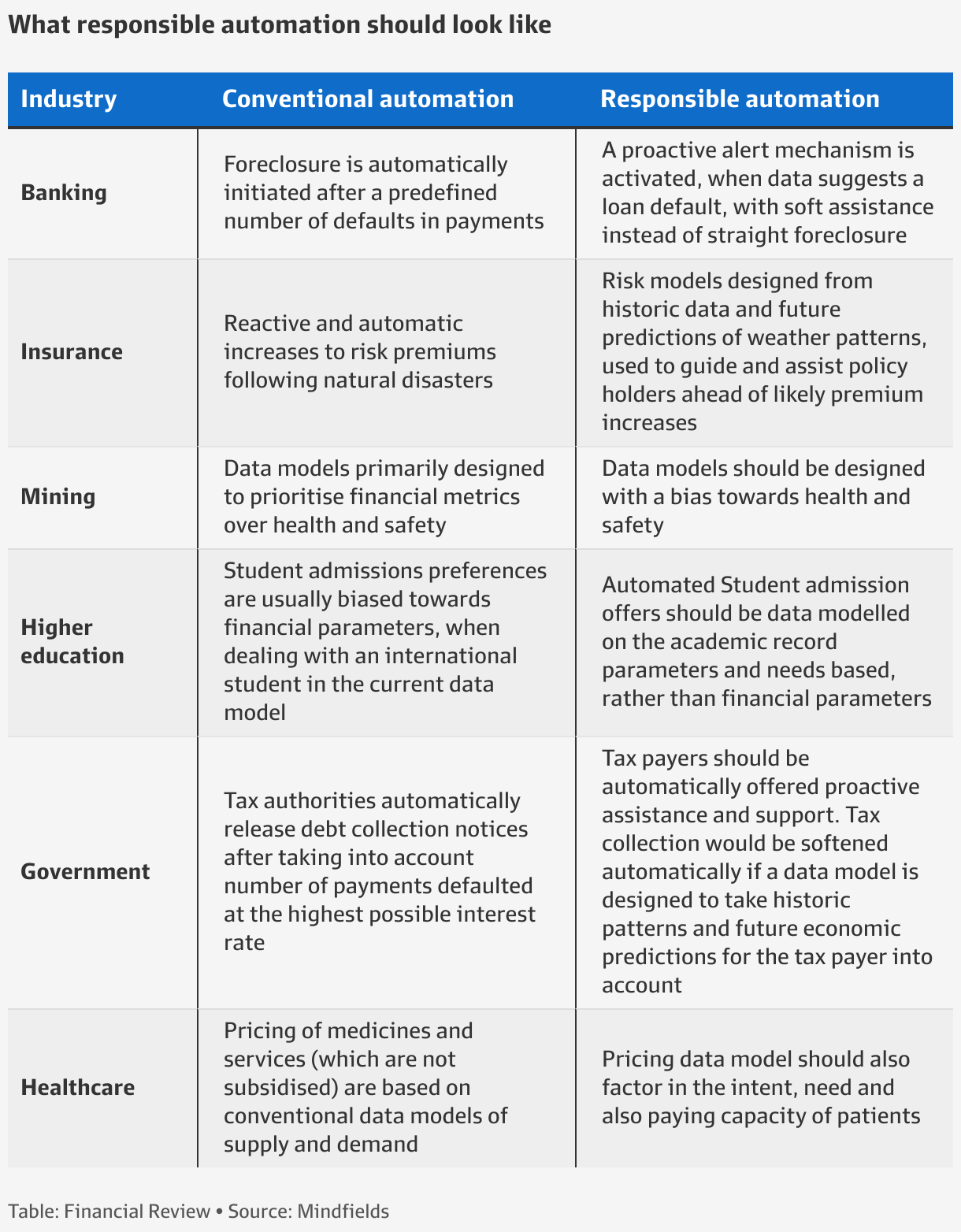
I have been trying to encourage clients to design responsible automation, based on human values, into their digital plans from the beginning.
This begins with organisations developing well-defined policies that specify how they will design and implement automated datasets responsibly, and only use automation when its application is fair by human standards.
I believe we will see consumers to start to prefer transacting with such organisations.
The last 30 months of pandemic life has taught us more than the previous 100 years of societies trying extreme forms of capitalism or communism. Responsible automation should be defined and practiced through empathy and compassion.
In other words, organisations have to be profitable and provide a return on investment to their investors, but this must be done in a responsible manner.
Despite what some companies claim, before COVID-19 most automation was pursued to reduce staff numbers. But now, in an era of skills shortages, it is used to allow employees to do more valuable tasks.
Automation is inevitable
The greater use of automation is inevitable and imminent, and this means regulators also need to be on the front foot and demand transparency around datasets and data models, so that actions that go against our human sensibilities can be properly judged.
The first step for organisations is to have a policy for responsible automation and to educate internal and external stakeholders about what that means.
We want the benefit that automation genuinely offers organisations and the workforce, but we don’t want to have to accept the removal of human values when the algorithms make decisions that we don’t like.
The pre-automation era had more than its fair share of decision-making based on unfair human bias and sentiments, whereas pure automation puts data at the forefront and ignores all human sentiments.
What we want with responsible automation is the development of decision-making models that sit in between these two extreme where data and human values work in tandem.