




Researchers have replicated the tunable transparency of squid skin cells in mammalian cells, which can be cultured, potentially leading to better cell imaging techniques. The team at the University of California, Irvine, focused on cephalopod cells called leucophores and introduced squid-derived genes encoding reflectin proteins into human cells. By adding salt to the cells’ culture media, they observed reflectin proteins forming nanostructures that altered the cells’ opacity. The study not only aids in understanding squid biology but also opens up possibilities for advanced cell imaging strategies based on intrinsic optical properties.
Human Cells Help Researchers Understand Squid Camouflage
Squids and octopuses are masters of camouflage, blending into their environment to evade predators or surprise prey. Some aspects of how these invisibility stickers,” which consisted of bacterially produced squid reflectin proteins that were adhered onto sticky tape. “So then, we had this crazy idea to see whether we could capture some aspect of the ability of squid skin tissues to change transparency within human cell cultures,” says Gorodetsky, who is the principal investigator on the project.
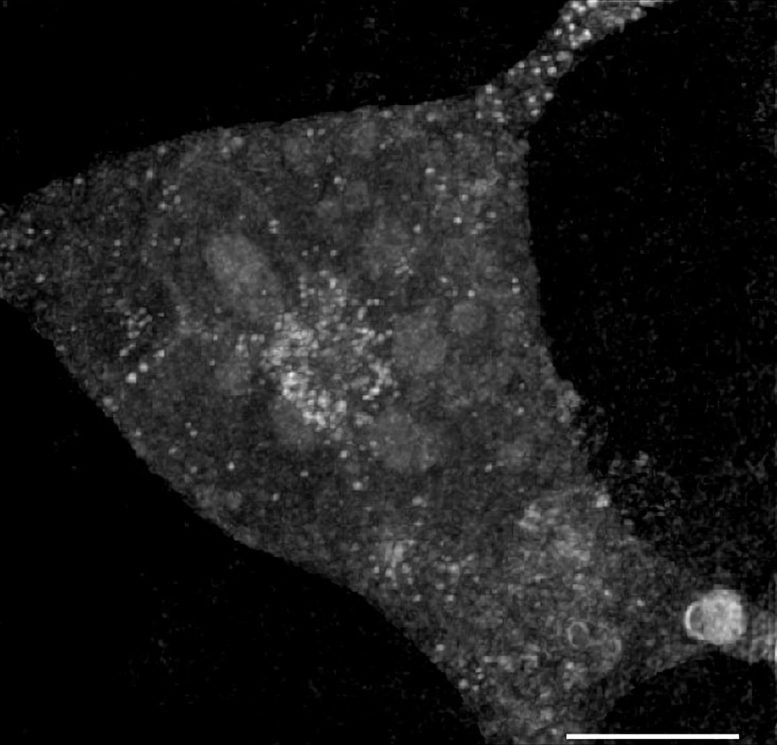
By incorporating squid proteins in mammalian cells, researchers could tune the cells’ transparency from clear to cloudy (scale bar is 10 µm). Credit: Adapted from ACS Biomaterials Science & Engineering, 2023, DOI: 10.1021/acsbiomaterials.2c00088
The team at the University of California, Irvine focused their efforts on cephalopod cells called leucophores, which have particulate-like nanostructures composed of reflectin proteins that scatter light. Typically, reflectins clump together and form the nanoparticles, so light isn’t absorbed or directly transmitted; instead, the light scatters or bounces off of them, making the leucophores appear bright white.
“We wanted to engineer mammalian cells to stably, instead of temporarily, form reflectin nanostructures for which we could better control the scattering of light,” says Gorodetsky. That’s because if cells allow light through with little scattering, they’ll seem more transparent. Alternatively, by scattering a lot more light, cells will become opaque and more apparent. “Then, at a cellular level, or even the culture level, we thought that we could predictably alter the cells’ transparency relative to the surroundings or background,” he says.
To change how light interacts with cultured cells, Georgii Bogdanov, a graduate student in Gorodetsky’s lab who is presenting the results, introduced squid-derived genes that encoded for reflectin into human cells, which then used the