

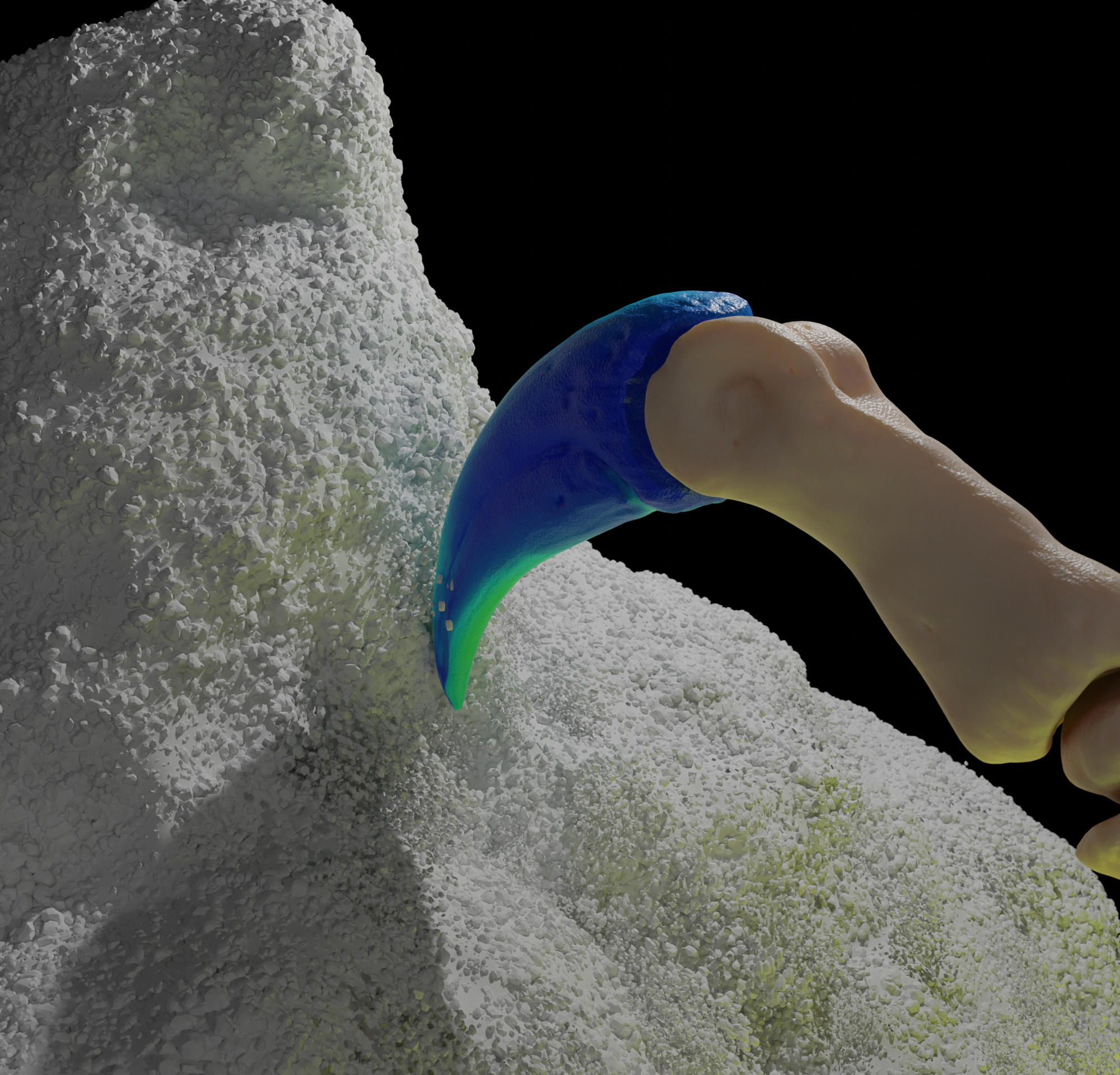
Alvarezsaurs claws when digging dirt. Credit: Shuyang Zhou for the 3D modeling and functional scenario restoration
The claws of dinosaurs had many functions, but a team from the University of Bristol and the Institute of Vertebrate Paleontology and Paleoanthropology (IVPP) in Beijing has now demonstrated that some predatory dinosaurs used their claws for digging or even for display purposes.
The study, which centered on two groups of theropod dinosaurs – the alvarezsaurs and therizinosaurs – aimed to uncover the mystery surrounding their peculiar claws. The findings revealed that the rock-pick-like claws of the alvarezsaurs were utilized for digging, while their close relatives, the giant therizinosaurs, used their overgrown, meter-long, sickle-shaped claws for display purposes.
The new work is led by Zichuan Qin, a Ph.D. student at the
Therizinosaurs claws hooking and pulling trees. Credit: Shuyang Zhou for the 3D modeling and functional scenario restoration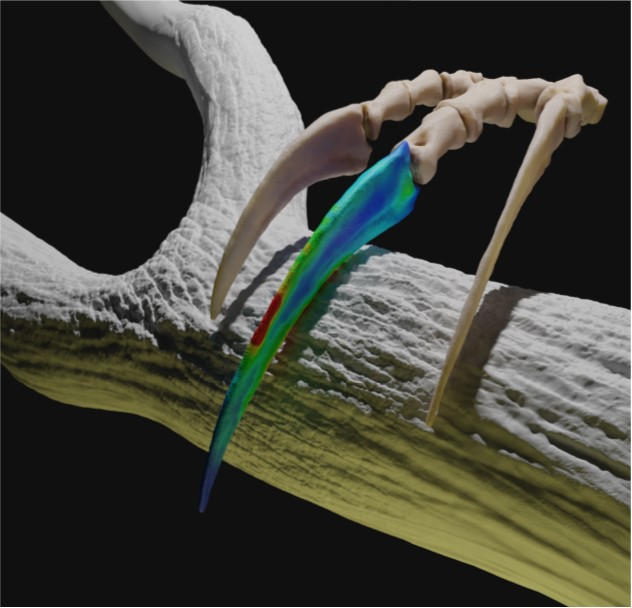
“Alvarezsaurs and therizinosaurs are definitely the strangest cousins among dinosaurs,” said Professor Michael Benton, one of Zichuan’s supervisors. “Alvarezsaurs were the tiniest dinosaurs ever, the size of chickens, with stubby forelimbs and robust single claws, but their closest relative, the therizinosaurs, evolved in the exact opposite path.”
“Therizinosaurusis famous for its sickle-like claws, each as long as a samurai sword: Edward Scissor-hands on speed. We all sawTherizinosaurusin ‘
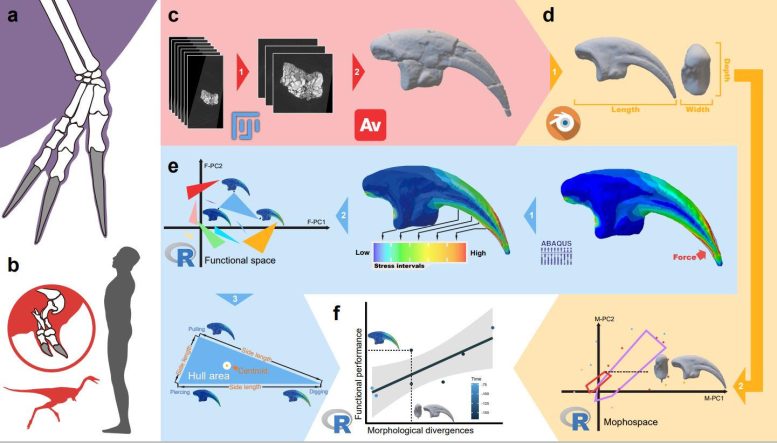
Key taxa and work pipeline use in this paper. Silhouettes show the large and elongated forelimb of the late-branching therizinosaurian Therizinosaurus (a) and the overall body shape and highlighted forelimb of the late-branching alvarezsauroid Mononykus (b), scaled against an adult human (height ~1.8 m). The work pipeline demonstrated by an ungual model from the Jurassic alvarezsauroid Haplocheirusincludes processes of 3D model reconstruction (c); model smoothing, measurement, and morphological analysis (d); finite-element analysis, ‘intervals’ method and functional-space analysis (e); and total evidence functional assessment (f). Credit: Zichuan Qin