



By Nancy W. Stauffer, MIT Energy InitiativeSeptember 17, 2022
Chemical engineers at MIT are using DNA to help convert CO2 into valuable chemicals.
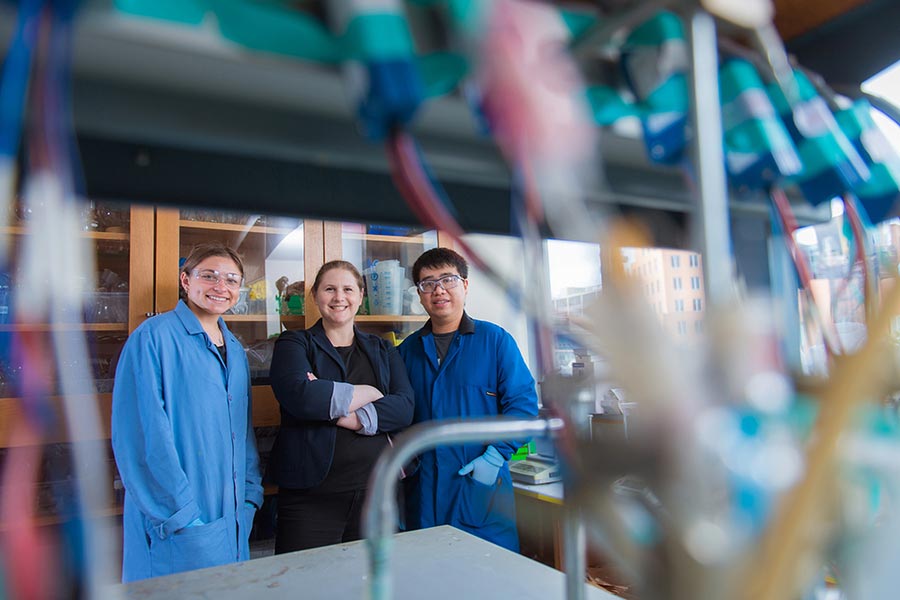
Professor Ariel Furst (center), undergraduate Rachel Ahlmark (left), postdoc Gang Fan (right), and their colleagues are employing biological materials, including DNA, to achieve the conversion of carbon dioxide to valuable products. Credit: Gretchen Ertl
The stumbling block
Challenges begin with the first step in the CO2 conversion process. CO2 must be chemically converted into carbon monoxide (CO) before being transformed into a useful product. Electrochemistry, a process in which input voltage provides the extra energy needed to make the stable CO2 molecules react, can promote that conversion. The problem is that achieving the CO2-to-CO conversion requires large energy inputs — and even then, CO makes up only a small fraction of the products that are produced.To explore opportunities for improving this process, Furst and her research group focused on the electrocatalyst, a material that enhances the rate of a chemical reaction without being consumed in the process. The catalyst is key to successful operation. Inside an electrochemical device, the catalyst is often suspended in an aqueous (water-based) solution. When an electric potential (essentially a voltage) is applied to a submerged electrode, dissolved CO2 will — helped by the catalyst — be converted to CO.But there’s one stumbling block: The catalyst and the CO2 must meet on the surface of the electrode for the reaction to occur. In some studies, the catalyst is dispersed in the solution, but that approach requires more catalyst and isn’t very efficient, according to Furst. “You have to both wait for the diffusion of CO2 to the catalyst and for the catalyst to reach the electrode before the reaction can occur,” she explains. As a result, researchers worldwide have been exploring different methods of “immobilizing” the catalyst on the electrode.
Connecting the catalyst and the electrode
Before Furst could delve into that challenge, she needed to decide which of the two types of CO2 conversion catalysts to work with: the traditional solid-state catalyst or a catalyst made up of small molecules. In examining the literature, she concluded that small-molecule catalysts held the most promise. While their conversion efficiency tends to be lower than that of solid-state versions, molecular catalysts offer one important advantage: They can be tuned to emphasize reactions and products of interest.Two approaches are commonly used to immobilize small-molecule catalysts on an electrode. One involves linking the catalyst to the electrode by strong covalent bonds — a type of bond in which atoms share electrons; the result is a strong, essentially permanent connection. The other sets up a non-covalent attachment between the catalyst and the electrode; unlike a covalent bond, this connection can easily be broken.Neither approach is ideal. In the former case, the catalyst and electrode are firmly attached, ensuring efficient reactions; but when the activity of the catalyst degrades over time (which it will), the electrode can no longer be accessed. In the latter case, a degraded catalyst can be removed; but the exact placement of the small molecules of the catalyst on the electrode can’t be controlled, leading to an inconsistent, often decreasing, catalytic efficiency — and simply increasing the amount of catalyst on the electrode surface without concern for where the molecules are placed doesn’t solve the problem.What was needed was a way to position the small-molecule catalyst firmly and accurately on the electrode and then release it when it degrades. For that task, Furst turned to what she and her team regard as a kind of “programmable molecular Velcro”: deoxyribonucleic DOI: 10.26434/chemrxiv-2022-qll2kThis research was supported by a grant from the MIT Energy Initiative Seed Fund.