


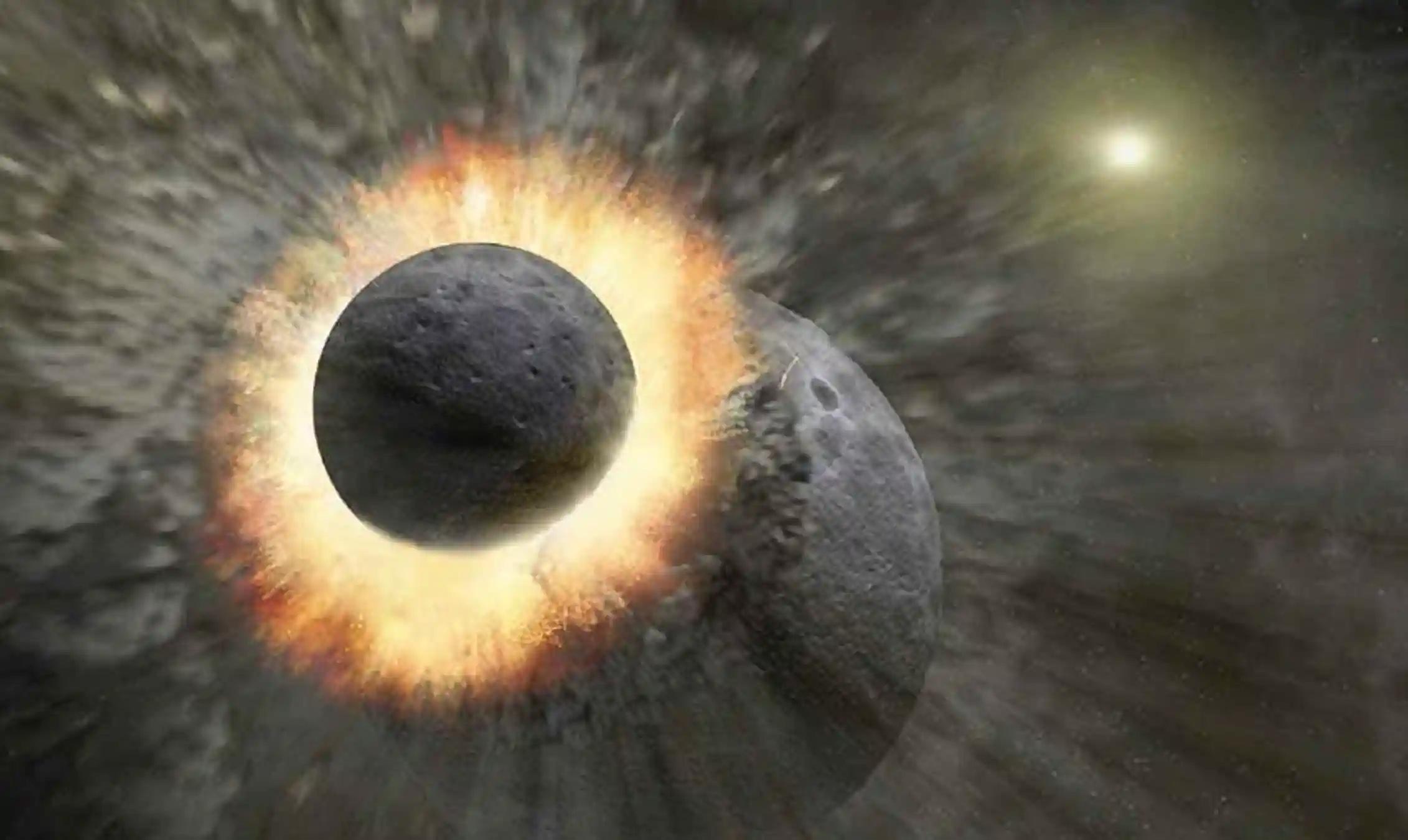

Artist’s impression of the Moon-forming event. Numerous moon formation theories have been suggested by researchers. Nonetheless, the most widely-accepted explanation, backed by the available evidence, posits that the moon resulted from a massive collision between the proto-Earth and another protoplanet approximately the size of Mars, often referred to as “Theia.” Credit: NASA/JPL-CalTech/T. Pyle
Where did our Moon come from?
Well, actually, there have been several theories over many decades. Earlier versions of lunar formation theories included capture, where the Moon would have been a strayed planetoid. Another version was fission, where the Earth was spinning so fast that it would have ejected out of the Earth and then formed its own body.
This led to our current theory, the giant impactor theory. So this collision was during the late stages of planetary formation throughout our entire solar system, when planets were still very new and very much forming. So this happened when Earth was just an embryo — a baby planet, and this was actually in a crash course collision with Theia, which is a
Where did our Moon come from? Over the years, there have been several theories, but most scientists think it’s likely that a Mars-sized object smashed into Earth, creating what we now see in the sky. Is NASA Really Crashing a Spacecraft Into an Asteroid?