


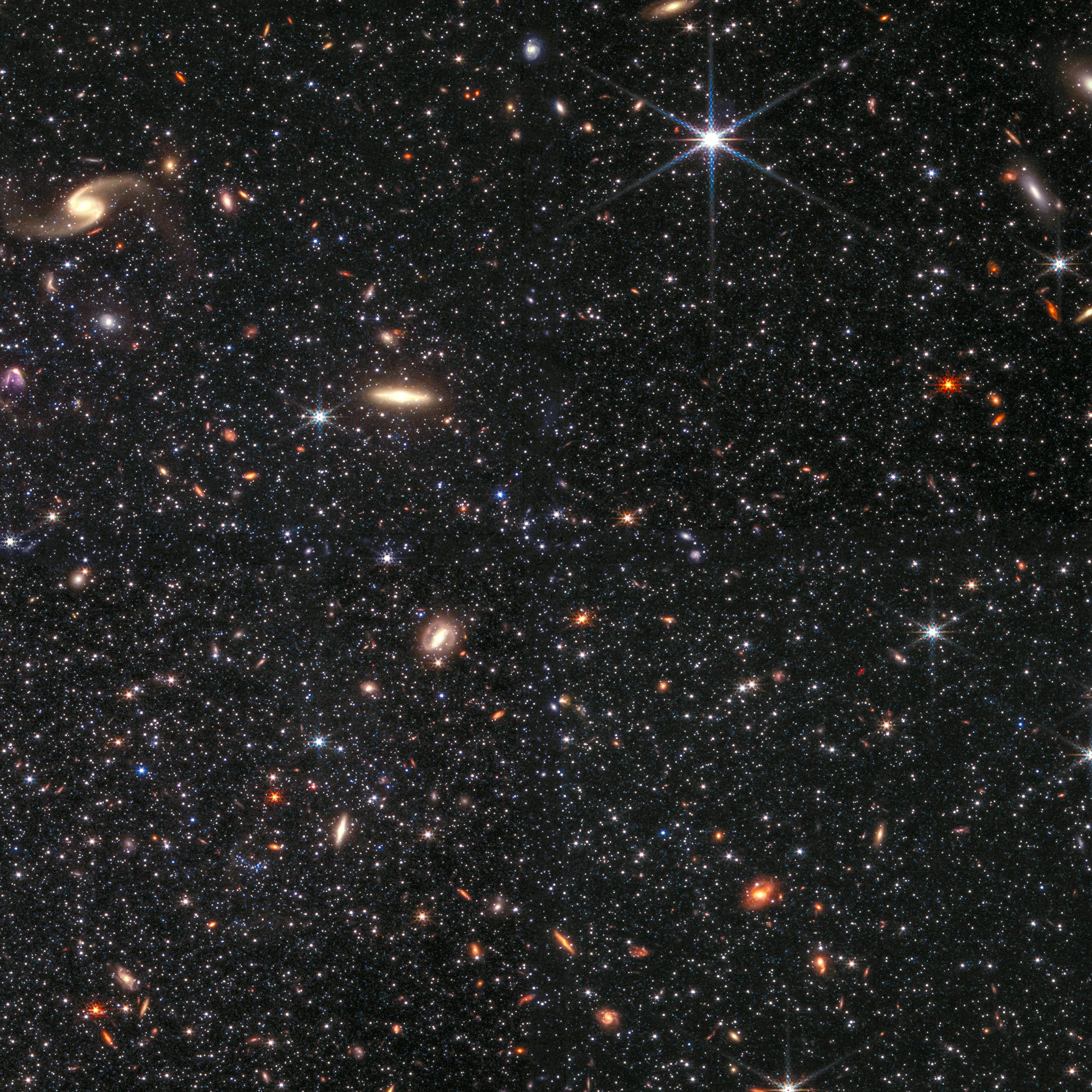
A portion of the dwarf galaxy Wolf–Lundmark–Melotte (WLM) captured by the James Webb Space Telescope’s Near-Infrared Camera. The image demonstrates Webb’s remarkable ability to resolve faint stars outside the Milky Way. Color translation: 0.9-micron light is shown in blue, 1.5-micron in cyan, 2.5-micron in yellow, and 4.3-micron in red (filters F090W, F150W, F250M, and F430M). Credit: Science: NASA, ESA, CSA, Kristen McQuinn (RU), Image Processing: Zolt G. Levay (STScI)
dwarf galaxy in our galactic neighborhood. It’s fairly close to the
A portion of the dwarf galaxy Wolf–Lundmark–Melotte (WLM) captured by the Spitzer Space Telescope’s Infrared Array Camera (left) and the James Webb Space Telescope’s Near-Infrared Camera (right). The images demonstrate Webb’s remarkable ability to resolve faint stars outside the Milky Way. The Spitzer image shows 3.6-micron light in cyan and 4.5-micron in orange. (IRAC1 and IRAC2). The Webb image includes 0.9-micron light shown in blue, 1.5-micron in cyan, 2.5-micron in yellow, and 4.3-micron in red (filters F090W, F150W, F250M, and F430M). Credit: Science: NASA, ESA, CSA, IPAC, Kristen McQuinn (RU), Image Processing: Zolt G. Levay (STScI), Alyssa Pagan (STScI)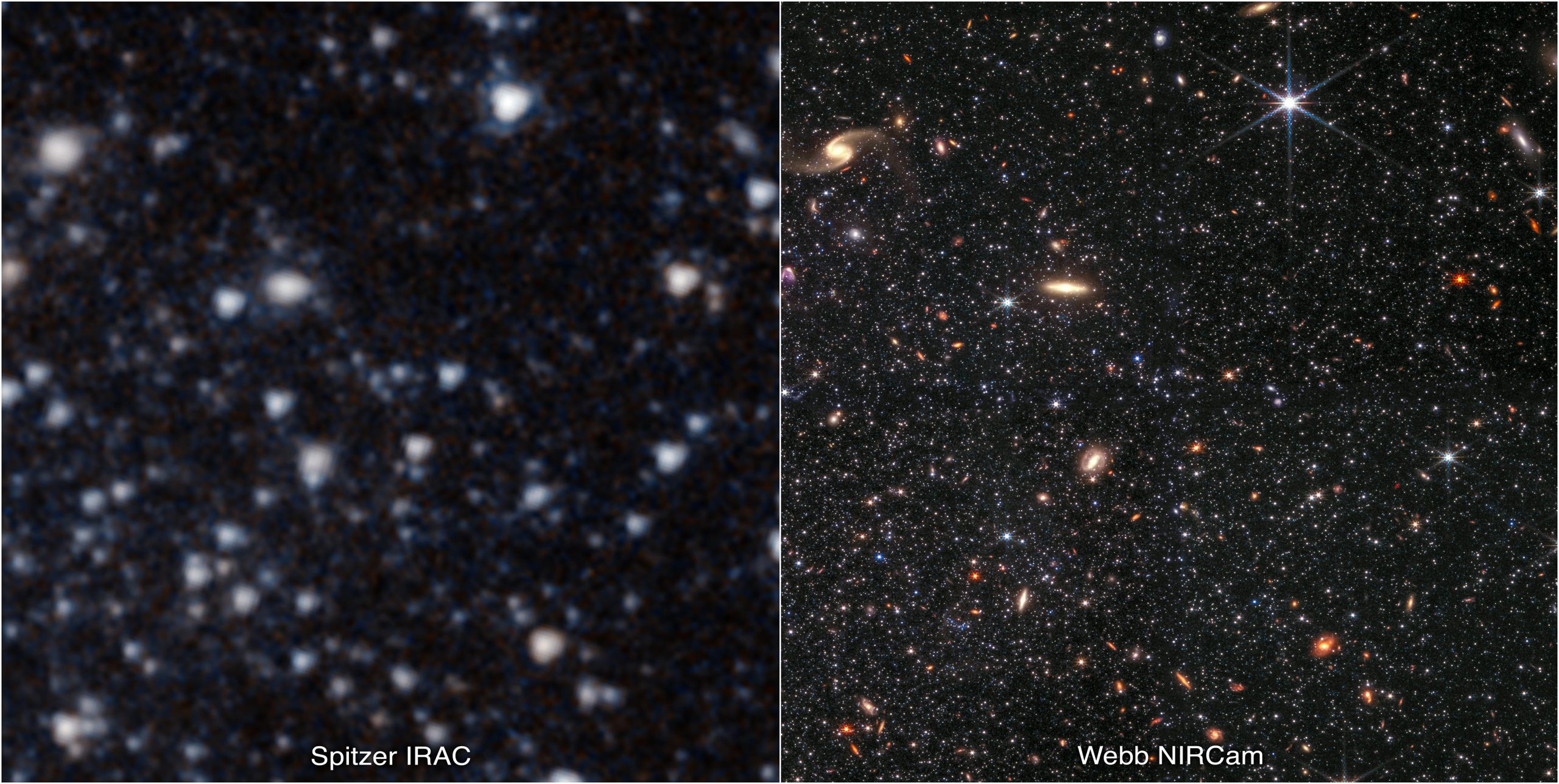
You arranged to show this image at a planetarium. How did you feel when you saw the image projected on the dome?
It was just inspiring. It really was incredible. I will never look at these images the same again. Seeing this on the dome, it was like looking up at our own night sky – at the Milky Way – from a dark site. I could imagine that we were standing on a planet in the WLM galaxy and looking up at its night sky.
We can see a myriad of individual stars of different colors, sizes, temperatures, ages, and stages of evolution; interesting clouds of nebular gas within the galaxy; foreground stars with Webb’s diffraction spikes; and background galaxies with neat features like tidal tails. It’s really a gorgeous image.
And, of course, the view is far deeper and better than our eyes could possibly see. Even if you were looking out from a planet in the middle of this galaxy, and even if you could see infrared light, you would need bionic eyes to be able to see what the Webb Space Telescope sees.
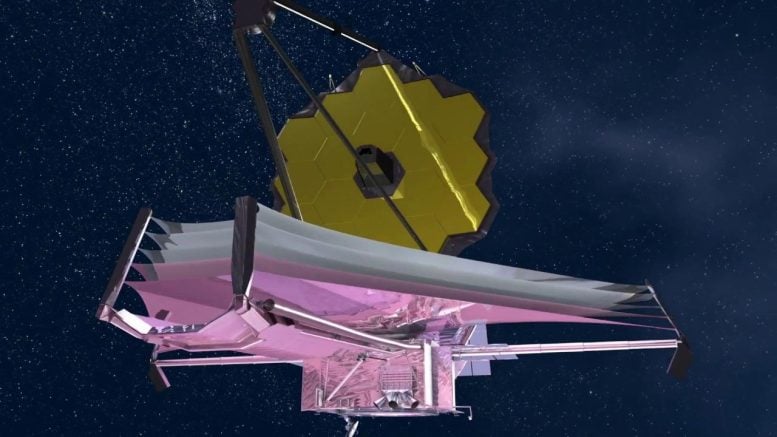
NASA’s James Webb Space Telescope is the successor to the Hubble Space Telescope, the most powerful infrared science observatory ever to be sent into space. From its orbit nearly a million miles from Earth, Webb will study some of the most distant objects in the universe. Credit: NASA
What are you trying to find out by studying WLM?
The main science focus is to reconstruct the star formation history of this galaxy. Low-mass stars can live for billions of years, which means that some of the stars that we see in WLM today formed in the early universe. By determining the properties of these low-mass stars (like their ages), we can gain insight into what was happening in the very distant past. It’s very complementary to what we learn about the early formation of galaxies by looking at high-redshift systemswhere we see the galaxies as they existed when they first formed.
The Early Release Science programs were designed to highlight Webb’s capabilities and help astronomers prepare for future observations. How are you supporting other astronomers with this work?
In a few ways. We’re checking the calibration of the NIRCam instrument itself. We’re checking our stellar evolution models. And we’re developing software to measure star brightnesses.
We already studied this exact same field very carefully with Hubble. Now we’re looking at the near-infrared light with Webb, and we’re using WLM as a sort of standard for comparison (like you would use in a lab) to help us make sure we understand the Webb observations. We want to make sure we’re measuring the stars’ brightnesses really, really accurately and precisely. We also want to make sure that we understand our stellar evolution models in the near-infrared.
Our team is also charged with developing a public software tool to measure the brightness of all the resolved stars in the NIRCam images. This is a non-proprietary tool that everyone will be able to use. We are developing and testing the software, and optimizing the parameters used for measurements. This is a bedrock tool for astronomers around the world. If you want to do anything with resolved stars that are crowded together on the sky, you need a tool like this.
About the Author
Kristen McQuinn is an assistant professor in the Department of Physics and Astronomy at Rutgers Universityand co-investigator on Director’s Discretionary Early Release Science program 1334.
Note: This article highlights data from Webb science in progress, which has not yet been through the peer-review process.


