


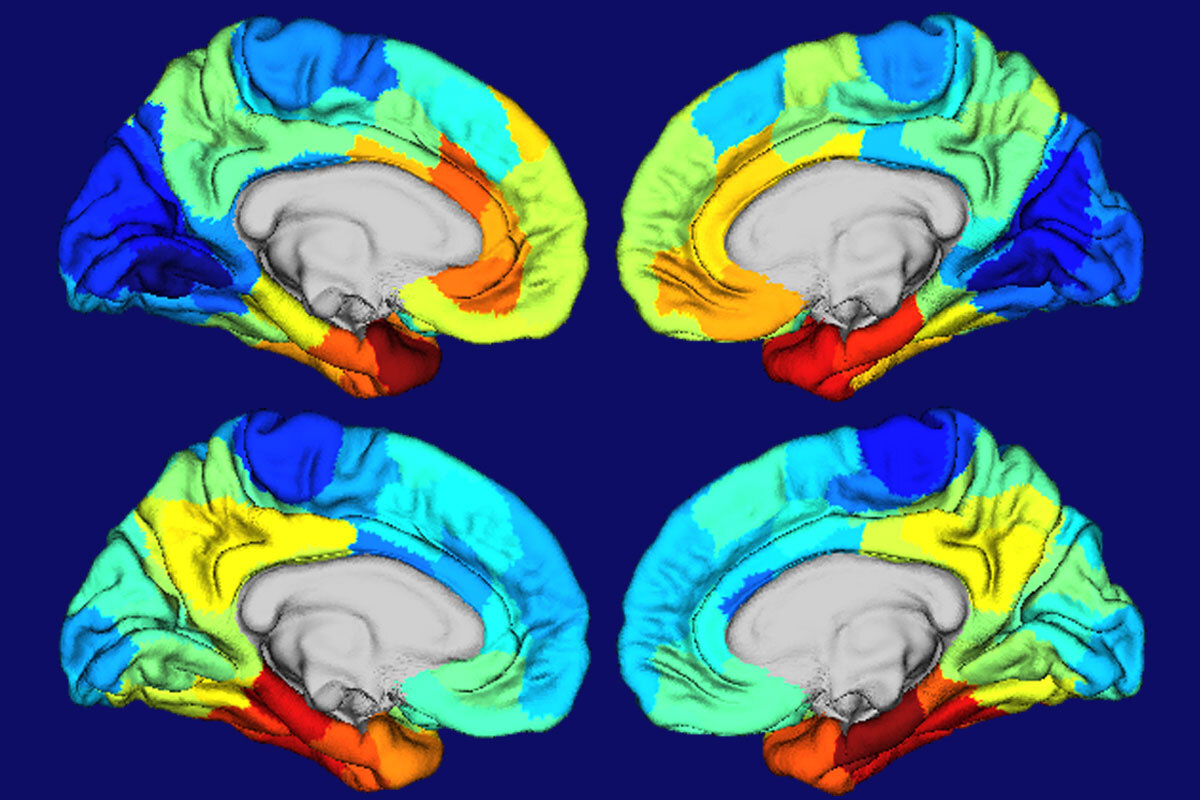
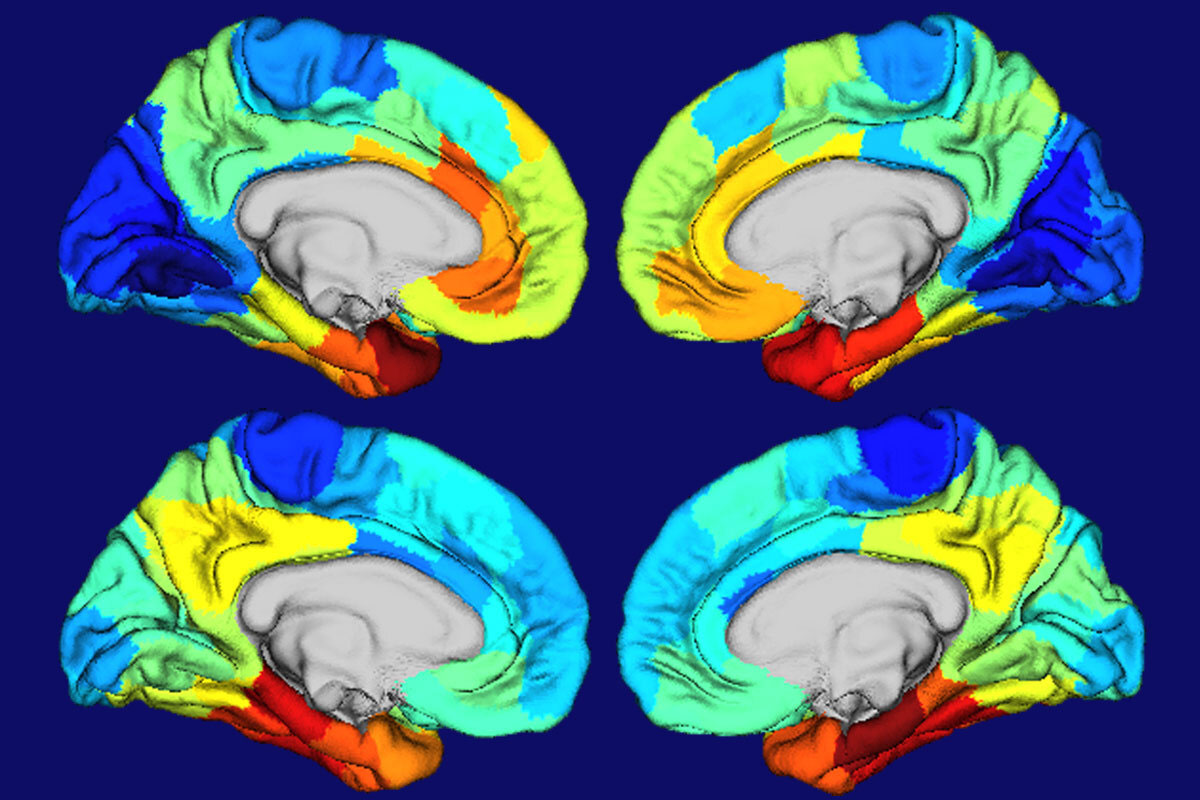
Red and orange areas on these heat maps of human brains show where the gene APOE is most active (top two brain images) and where tangles of the protein tau are most concentrated (bottom two brain images). APOE is the biggest genetic risk factor for Alzheimer’s, and tau tangles drive brain damage in the disease. The similarities in the two sets of maps suggested to researchers at Washington University School of Medicine in St. Louis that APOE plays a role in making certain brain areas particularly vulnerable to Alzheimer’s damage. Credit: Diana Hobbs/Washington University
Research findings could help explain rare symptoms such as problems with language and vision.
The first sign of APOE4 also increases damage due to tau, even without amyloid present.
To assess the effect of the high-risk variant of APOE on tau-related brain damage in people, the researchers classified each participant as carrying the high-risk variant or not, and analyzed the protein clusters and atrophy in their brains.
“APOE4 carriers are more likely to start accumulating amyloid, which puts them on the path to Alzheimer’s,” Gordon said. “Then, for the same amount of amyloid they get more tau tangles, which leads to more atrophy. It’s a double hit on the brain.”
In future work, Gordon and colleagues plan to explore how patterns of gene expression relate to patterns of tau damage in people with atypical Alzheimer’s.
“When we see someone who presents with vision problems, is there a specific genetic signature that corresponds to the areas that are damaged in the brain?” Gordon asked. “We want to know why some people have these altered patterns and what it means about how Alzheimer’s disease develops and how it can be treated.”
Reference: “APOE e4 genotype, amyloid-ß, and sex interact to predict tau in regions of high APOE mRNA expression” by Aylin Dincer, Charles D. Chen, Nicole S. McKay, Lauren N. Koenig, Austin McCullough, Shaney Flores, Sarah J. Keefe, Stephanie A. Schultz, Rebecca L. Feldman, Nelly Joseph-Mathurin, Russ C. Hornbeck, Carlos Cruchaga, Suzanne E. Schindler, David M. Holtzman, John C. Morris, Anne M. Fagan, Tammie L.S. Benzinger and Brian A. Gordon, 16 November 2022, Science Translational Medicine.
DOI: 10.1126/scitranslmed.abl7646
Funding: NIH/National Institutes of Health, Alzheimer’s Association, National Science Foundation


