


 Image source, Getty Images
Water companies have announced hosepipe bans in many areas, after an unusually dry summer.
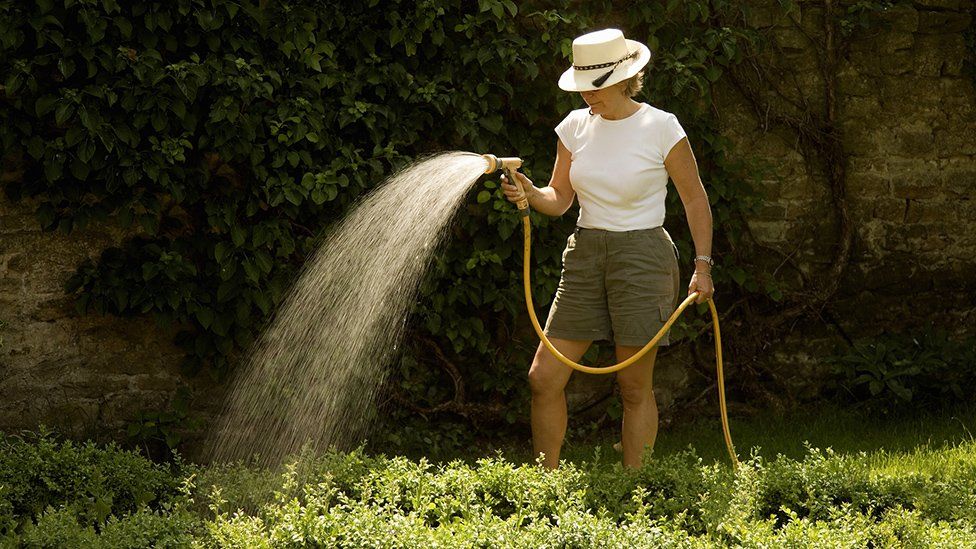
People in affected areas cannot use hosepipes to water gardens, clean their cars or fill paddling pools.
Other water companies are monitoring water levels closely, although no hosepipe bans are currently planned in Scotland or Northern Ireland.
Separately, the Environment Agency has declared an official drought in many parts of England, and a drought has been declared in south-west Wales.
What is a hosepipe ban?
Restrictions vary between providers, but generally people aren’t allowed to use hosepipes – or anything that connects to a hosepipe or an outside tap – in order to:
- water a garden or plants
- fill a paddling or swimming pool
- clean a car
- fill a pond
- clean walls or windows
But there are some exceptions:
- for business use (for example, watering commercial crops or running a car wash business)
- to fill pools needed for medical treatment
- to water a new lawn within 28 days of it being laid
- to fill a fountain used for religious practices
- to top up a fishpond when the welfare of the fish depends on it
Anyone breaking the rules could face a fine of up to £1,000.
How can I water the garden if I can’t use a hosepipe?
Gardener Leigh Johnstone from Southampton, who shares tips on TikTok, says plants are hardier than most people think.
Mr Johnstone suggests using a water butt to collect any rain water, and using “grey water” from baths and cooking pots.
However, he says, soapy water shouldn’t be used on edible crops.
Plants can also be “mulched” to stop moisture escaping, by adding material such as wood chippings to the top of the soil.
Image source, @beardygardener
Leigh Johnstone, known as the Beardy Gardener on TikTok, says there are lots of ways to save water
He also suggests planting drought-resistant plants such as lavender, Euphorbia and wildflowers.
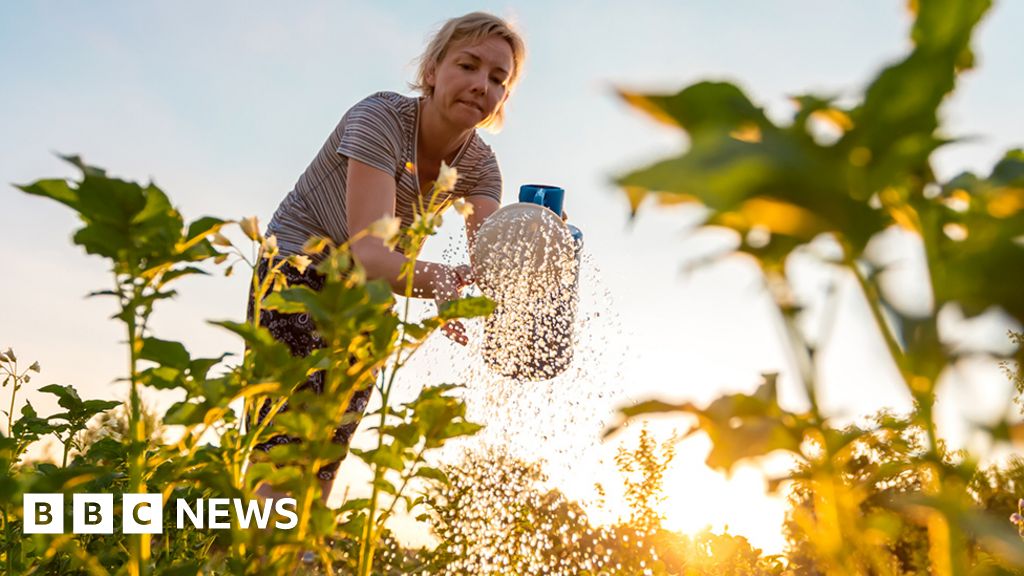
The Royal Horticultural Society (RHS) recommends using watering cans rather than hosepipes because they direct water more accurately to the roots of plants.
Watering in the morning or evening can also help reduce evaporation.
It suggests letting the grass on lawns grow taller, so that it grows deeper roots to draw water from further underground.
The RHS also recommends installing water troughs, putting saucers under plant pots to reduce waste, and using homemade compost.
Do hosepipe ban works?
Water UK, which represents the UK’s water industry, says hosepipe bans normally reduce water usage by about 10%. Daily demand for water in England and Wales was 14 billion litres in 2018.
It suggests further water-saving measures such as reusing paddling pool water, washing dogs outside instead of in the bath, and filling ponds with rain water.
However, each day, three billion litres of water is lost through leakage, according to a National Audit Office (NAO) report.
The Environment Agency has said “government expects water companies to act to reduce leakage and fix leaking pipes as quickly as possible”.
How will you be affected by the issues in this story? Share your experiences haveyoursay@bbc.co.uk.
Please include a contact number if you are willing to speak to a BBC journalist. You can also get in touch in the following ways:
If you are reading this page and can’t see the form you will need to visit the mobile version of the BBC website to submit your question or comment or you can email us at HaveYourSay@bbc.co.uk. Please include your name, age and location with any submission.